Department of Anesthesiology, Medical College of Wisconsin, Milwaukee, Wisconsin.
Research Service, Zablocki Veterans Affairs Medical Center, Milwaukee Wisconsin.
Am J Physiol Regul Integr Comp Physiol. 2022 Nov 1;323(5):R749-R762. doi: 10.1152/ajpregu.00073.2022. Epub 2022 Sep 26.
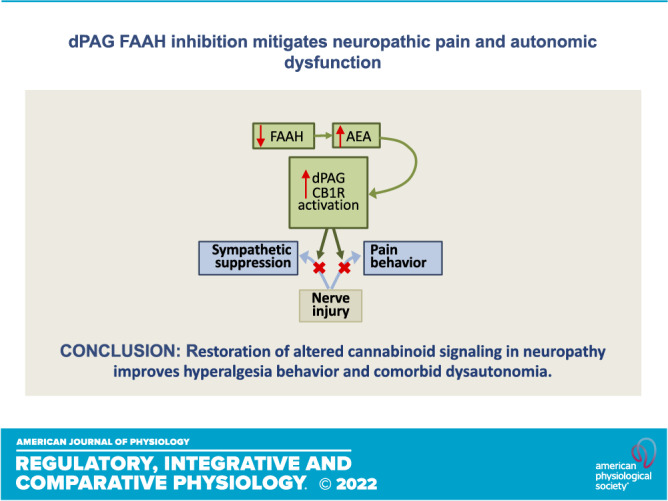
The complexity of neuropathic pain and its associated comorbidities, including dysautonomia, make it difficult to treat. Overlap of anatomical regions and pharmacology of sympathosensory systems in the central nervous system (CNS) provide targets for novel treatment strategies. The dorsal periaqueductal gray (dPAG) is an integral component of both the descending pain modulation system and the acute stress response and is critically involved in both analgesia and the regulation of sympathetic activity. Local manipulation of the endocannabinoid signaling system holds great promise to provide analgesia without excessive adverse effects and also influence autonomic output. Inhibition of fatty acid amide hydrolase (FAAH) increases brain concentrations of the endocannabinoid -arachidonoylethanolamine (AEA) and reduces pain-related behaviors in neuropathic pain models. Neuropathic hyperalgesia and reduced sympathetic tone are associated with increased FAAH activity in the dPAG, which suggests the hypothesis that inhibition of FAAH in the dPAG will normalize pain sensation and autonomic function in neuropathic pain. To test this hypothesis, the effects of systemic or intra-dPAG FAAH inhibition on hyperalgesia and dysautonomia developed after spared nerve injury (SNI) were assessed in male and female rats. Administration of the FAAH inhibitor PF-3845 into the dPAG reduces hyperalgesia behavior and the decrease in sympathetic tone induced by SNI. Prior administration of the CB1 receptor antagonist AM281, attenuated the antihyperalgesic and sympathetic effects of FAAH inhibition. No sex differences were identified. These data support an integrative role for AEA/CB1 receptor signaling in the dPAG contributing to the regulation of both hyperalgesia behavior and altered sympathetic tone in neuropathic pain.
神经病理性疼痛及其相关合并症(包括自主神经功能障碍)的复杂性使得其难以治疗。中枢神经系统(CNS)中交感感觉系统的解剖区域和药理学的重叠为新的治疗策略提供了靶点。背侧periaqueductal 灰色(dPAG)是下行疼痛调节系统和急性应激反应的一个组成部分,对于镇痛和交感神经活动的调节都至关重要。内源性大麻素信号系统的局部操作具有提供镇痛而无过度不良反应的巨大潜力,并且还可以影响自主神经输出。脂肪酸酰胺水解酶(FAAH)的抑制增加了大脑中内源性大麻素 - 花生四烯酸乙醇胺(AEA)的浓度,并减少了神经病理性疼痛模型中的疼痛相关行为。神经病理性痛觉过敏和交感神经张力降低与 dPAG 中 FAAH 活性增加有关,这表明 FAAH 在 dPAG 中的抑制将使神经病理性疼痛中的疼痛感觉和自主功能正常化的假说。为了验证这一假说,在雄性和雌性大鼠中评估了全身性或 dPAG 内 FAAH 抑制对 spared 神经损伤(SNI)后出现的痛觉过敏和自主神经功能障碍的影响。将 FAAH 抑制剂 PF-3845 给药至 dPAG 可减轻 SNI 引起的痛觉过敏行为和交感神经张力降低。CB1 受体拮抗剂 AM281 的预先给药减弱了 FAAH 抑制的抗痛觉过敏和交感作用。没有发现性别差异。这些数据支持 AEA/CB1 受体信号在 dPAG 中的整合作用,有助于调节神经病理性疼痛中的痛觉过敏行为和改变的交感神经张力。