Gigante Elia, Hobeika Christian, Le Bail Brigitte, Paradis Valérie, Tougeron David, Lequoy Marie, Bouattour Mohamed, Blanc Jean-Frederic, Ganne-Carrié Nathalie, Tran Henri, Hollande Clémence, Allaire Manon, Amaddeo Giuliana, Regnault Hélène, Vigneron Paul, Ronot Maxime, Elkrief Laure, Verset Gontran, Trepo Eric, Zaanan Aziz, Ziol Marianne, Ningarhari Massih, Calderaro Julien, Edeline Julien, Nault Jean-Charles
Service d'Hépatologie, Hôpital Avicenne, Hôpitaux Universitaires Paris-Seine-Saint-Denis, Assistance-Publique Hôpitaux de Paris, Bobigny, France et Centre de recherche sur l'inflammation, Inserm, Université de Paris, INSERM UMR 1149, De l'inflammation au cancer, Paris, France.
Service de Chirurgie Digestive, Hépato-Bilio-Pancréatique et Transplantation Hépatique, Hôpital de la Pitié Salpêtrière, AP-HP, Paris, France.
Liver Cancer. 2022 Jun 14;11(5):460-473. doi: 10.1159/000525488. eCollection 2022 Sep.
Even if no systemic treatment is currently validated for unresectable hepatocellular-cholangiocarcinoma (cHCC-CCA), tyrosine kinase inhibitors (TKIs) and platinum-based chemotherapy are frequently used in clinical practice. Our study aims to describe the effectiveness of first-line systemic treatments in patients with cHCC-CCA.
Patients with histological diagnosis of unresectable or metastatic cHCC-CCA confirmed by a centralized review (WHO classification 2019) and who received systemic treatment from 2009 to 2020 were included retrospectively in 11 centers. The outcomes of patients with cHCC-CCA were compared with patients with hepatocellular carcinoma (HCC) treated by sorafenib ( = 117) and with intrahepatic cholangiocarcinoma (iCCA, = 94) treated mainly by platinum-based chemotherapy using a frailty Cox model. The efficacy of TKIs and platinum-based chemotherapies in patients with cHCC-CCA was assessed using a doubly robust estimator.
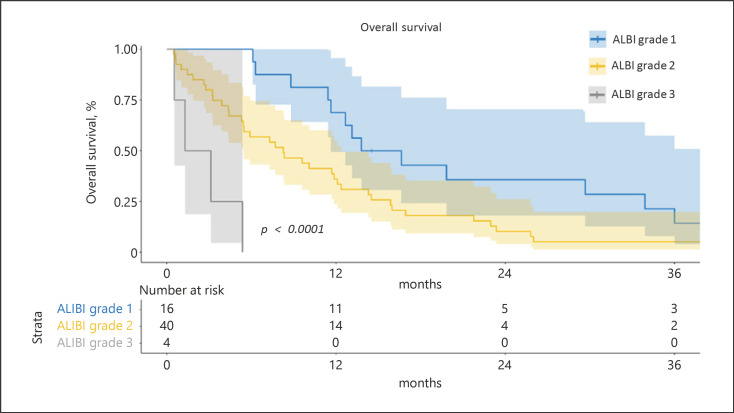
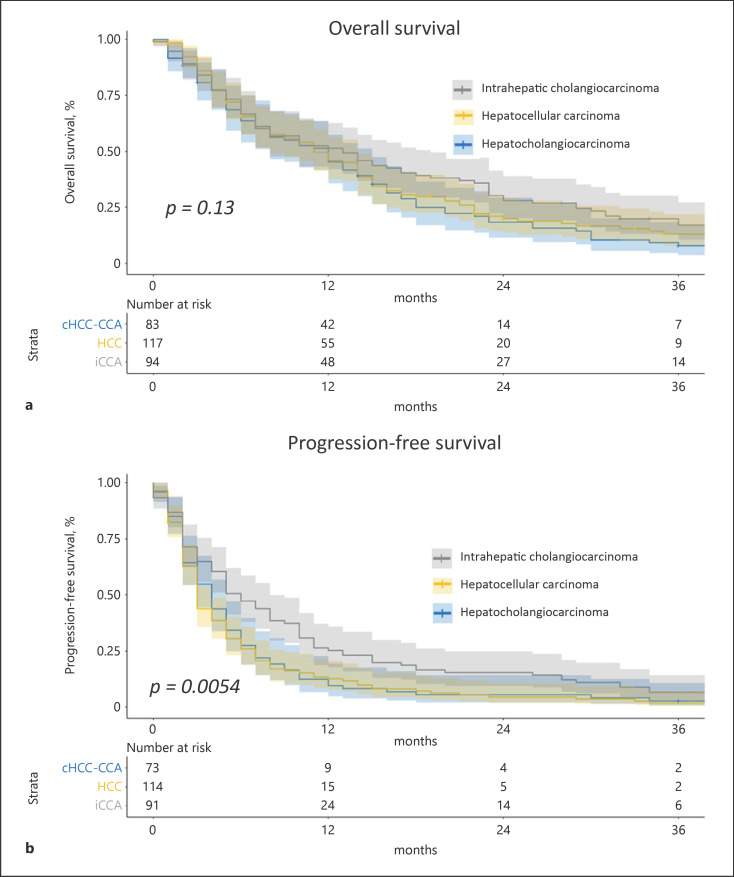
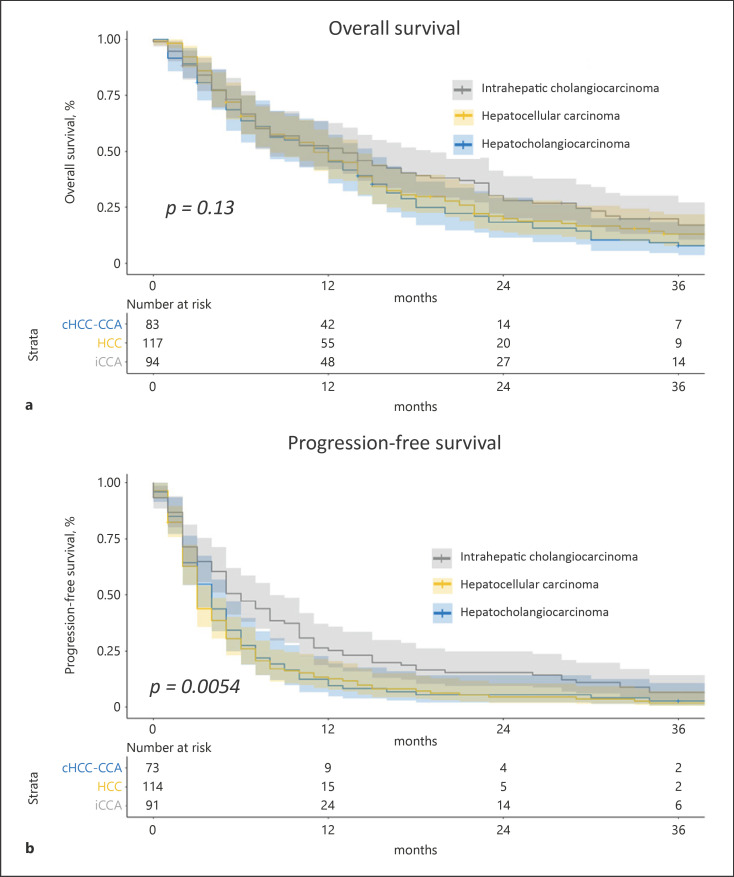
A total of 83 patients with cHCC-CCA were included and were predominantly male (72%) with underlying cirrhosis (55%). 67% of patients had extrahepatic metastases and 31% macrovascular tumor invasion. cHCC-CCAs were more often developed on cirrhosis (55.4%) than iCCA (26.6%) but less frequently than HCC (80.2%) ( < 0.001). Both HCC (36.8% and cHCC-CCA (66.2%) had less frequent extrahepatic metastases than iCCA (81%) ( < 0.001). Unadjusted overall survival (OS) was better in iCCA (13 months) compared to cHCC-CCA (12 months) and HCC (11 months) ( = 0.130). In multivariable analysis, after adjustment by a Cox frailty model, patients with cHCC-CCA had the same survival as HCC and iCCA (HR = 0.67, 95% CI: 0.37-1.22, = 0.189 and HR = 0.66, 95% CI: 0.43-1.02, = 0.064, respectively). ALBI score (HR = 2.15; 95% CI: 1.23-3.76; = 0.009), ascites (HR = 3.45, 95% CI: 1.31-9.03, = 0.013), and tobacco use (HR = 2.29, 95% CI: 1.08-4.87, = 0.032) were independently associated with OS in patients with cHCC-CCA. Among patients with cHCC-CCA, 25 patients treated with TKI were compared with 54 patients who received platinum-based chemotherapies. Patients treated with TKI had a median OS of 8.3 months compared to 11.9 months for patients treated with platinum-based chemotherapy ( = 0.86). After a robust doubly adjustment on tumor number and size, vascular invasion, ALBI, MELD, and cirrhosis, the type of treatment did not impact OS (HR = 0.92, 95% CI: 0.27-3.15, = 0.88) or progression-free survival (HR = 1.24, 95% CI: 0.44-3.49, = 0.67).
First-line systemic treatments with TKIs or platinum-based chemotherapies have similar efficacy in patients with unresectable/metastatic cHCC-CCA. The ALBI score predicts OS.
尽管目前尚无针对不可切除型肝细胞胆管癌(cHCC-CCA)的系统治疗方案得到验证,但酪氨酸激酶抑制剂(TKIs)和铂类化疗在临床实践中仍被广泛应用。本研究旨在描述cHCC-CCA患者一线系统治疗的有效性。
回顾性纳入了11个中心在2009年至2020年间接受系统治疗、经集中审查确诊为不可切除或转移性cHCC-CCA(WHO 2019分类)的患者。采用脆弱Cox模型,将cHCC-CCA患者的预后与接受索拉非尼治疗的肝细胞癌(HCC,n = 117)患者以及主要接受铂类化疗的肝内胆管癌(iCCA,n = 94)患者进行比较。使用双重稳健估计量评估TKIs和铂类化疗在cHCC-CCA患者中的疗效。
共纳入83例cHCC-CCA患者,以男性为主(72%),伴有潜在肝硬化(55%)。67%的患者有肝外转移,31%有大血管肿瘤侵犯。cHCC-CCA在肝硬化基础上发生的频率(55.4%)高于iCCA(26.6%),但低于HCC(80.2%)(P < 0.001)。HCC(36.8%)和cHCC-CCA(66.2%)的肝外转移频率均低于iCCA(81%)(P < 0.001)。未经调整的总生存期(OS)在iCCA(13个月)中优于cHCC-CCA(12个月)和HCC(11个月)(P = 0.130)。在多变量分析中,经Cox脆弱模型调整后,cHCC-CCA患者的生存率与HCC和iCCA相同(HR = 0.67,95%CI:0.37 - 1.22,P = 0.189;HR = 0.66,95%CI:0.43 - 1.02,P = 0.064)。ALBI评分(HR = 2.15;95%CI:1.23 - 3.76;P = 0.009)、腹水(HR = 3.45,95%CI:1.31 - 9.03,P = 0.013)和吸烟(HR = 2.29,95%CI:1.08 - 4.87,P = 0.032)与cHCC-CCA患者的OS独立相关。在cHCC-CCA患者中,25例接受TKI治疗的患者与54例接受铂类化疗的患者进行了比较。接受TKI治疗的患者中位OS为8.3个月,而接受铂类化疗的患者为11.9个月(P = 0.86)。在对肿瘤数量和大小进行稳健的双重调整以及血管侵犯、ALBI、MELD和肝硬化后,治疗类型对OS(HR = 0.92,95%CI:0.27 - 3.15,P = 0.88)或无进展生存期(HR = 1.24,95%CI:0.44 - 3.49,P = 0.67)无影响。
对于不可切除/转移性cHCC-CCA患者,TKIs或铂类化疗的一线系统治疗疗效相似。ALBI评分可预测OS。