Christoforidou Maria, Borghuis Gerlo, Seijger Chris, van Halsema Gerardo E, Hellegers Petra
Water Resources Management Group, Wageningen University and Research, Wageningen, The Netherlands.
Food Secur. 2023;15(1):171-185. doi: 10.1007/s12571-022-01310-y. Epub 2022 Sep 16.
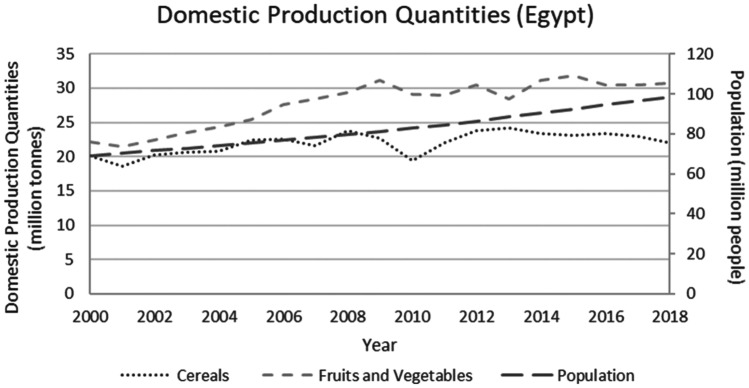
Although there seems enough water available for our global food needs, there are large areas with growing water scarcity. Food security in these water scarce areas cannot be met through self-sufficiency. The only option is to become more dependent on food imports which is increasingly risky due to volatility in production and food prices. Before 2008, declining food prices and increasing global cereal production favoured the food import strategy. The 2008 world food crisis represented a shock to this strategy and renewed attention was paid to the self-sufficiency strategy. The aim of this paper is to compare the food security strategies of Egypt and Jordan, two water-stressed, increasingly populated, oil-poor countries, pre and post 2008, by means of a food-water analytical framework using FAOSTAT data. Findings show that Egypt and Jordan have many similarities in their food security situation as both are highly dependent on food imports (Egypt 50%, Jordan 95%), and both have a reduced capacity to absorb future price increases. As food imports are inevitable under the water scarce context of Egypt and Jordan, it is important to focus on how to cope with volatilities. Our analysis shows that Jordan has better absorbed the costs of rising food imports than Egypt and that Egypt is trapped by its high domestic cereal production. Having revealed the limited options available to water-scarce countries for food security, we discuss the potential of grain reserves to cope with future price hikes and production shocks.
The online version contains supplementary material available at 10.1007/s12571-022-01310-y.
尽管全球粮食需求似乎有足够的水资源可用,但仍有大片地区水资源短缺问题日益严重。这些缺水地区无法通过自给自足来保障粮食安全。唯一的选择是更加依赖粮食进口,而由于产量和粮食价格波动,这种依赖的风险越来越大。2008年之前,粮食价格下降和全球谷物产量增加有利于粮食进口战略。2008年世界粮食危机给这一战略带来了冲击,人们重新关注自给自足战略。本文旨在通过使用联合国粮食及农业组织统计数据库(FAOSTAT)的数据,借助粮食-水分析框架,比较埃及和约旦这两个水资源紧张、人口不断增加且石油资源匮乏的国家在2008年前后的粮食安全战略。研究结果表明,埃及和约旦在粮食安全状况方面有许多相似之处,因为它们都高度依赖粮食进口(埃及为50%,约旦为95%),而且二者应对未来价格上涨的能力都有所下降。鉴于在埃及和约旦水资源稀缺的情况下,粮食进口不可避免,因此重点关注如何应对波动至关重要。我们的分析表明,约旦比埃及更好地消化了粮食进口增加的成本,而埃及则因国内谷物产量高而陷入困境。在揭示了缺水国家在粮食安全方面可用的选择有限之后,我们讨论了粮食储备应对未来价格上涨和生产冲击的潜力。
在线版本包含可在10.1007/s12571-022-01310-y获取的补充材料。