
糖尿病和非糖尿病冠心病患者的二级预防:来自 EUROASPIRE IV 和 V 调查医院部分的德国亚组的观察。
Secondary prevention in diabetic and nondiabetic coronary heart disease patients: Insights from the German subset of the hospital arm of the EUROASPIRE IV and V surveys.
机构信息
Institute of Clinical Epidemiology and Biometry, University of Würzburg, Josef-Schneider-Str. 2, 97080, Würzburg, Bavaria, Germany.
Charité - Universitätsmedizin Berlin, Corporate Member of Freie Universität Berlin and Humboldt-Universität Zu Berlin, Berlin, Berlin, Germany.
出版信息
Clin Res Cardiol. 2023 Feb;112(2):285-298. doi: 10.1007/s00392-022-02093-0. Epub 2022 Sep 27.
BACKGROUND
Patients with coronary heart disease (CHD) with and without diabetes mellitus have an increased risk of recurrent events requiring multifactorial secondary prevention of cardiovascular risk factors. We compared prevalences of cardiovascular risk factors and its determinants including lifestyle, pharmacotherapy and diabetes mellitus among patients with chronic CHD examined within the fourth and fifth EUROASPIRE surveys (EA-IV, 2012-13; and EA-V, 2016-17) in Germany.
METHODS
The EA initiative iteratively conducts European-wide multicenter surveys investigating the quality of secondary prevention in chronic CHD patients aged 18 to 79 years. The data collection in Germany was performed during a comprehensive baseline visit at study centers in Würzburg (EA-IV, EA-V), Halle (EA-V), and Tübingen (EA-V).
RESULTS
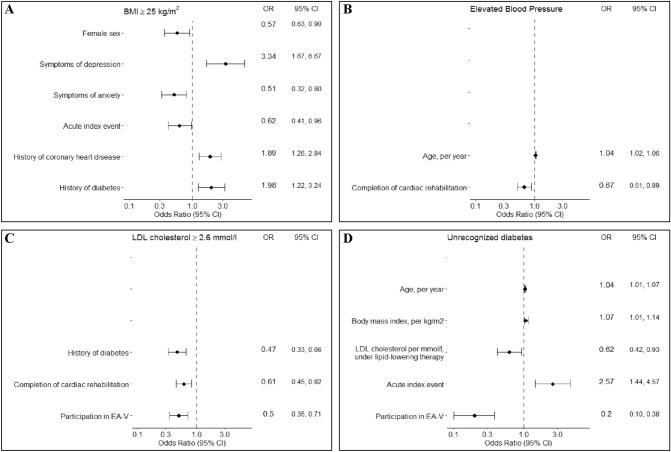
384 EA-V participants (median age 69.0 years, 81.3% male) and 536 EA-IV participants (median age 68.7 years, 82.3% male) were examined. Comparing EA-IV and EA-V, no relevant differences in risk factor prevalence and lifestyle changes were observed with the exception of lower LDL cholesterol levels in EA-V. Prevalence of unrecognized diabetes was significantly lower in EA-V as compared to EA-IV (11.8% vs. 19.6%) while the proportion of prediabetes was similarly high in the remaining population (62.1% vs. 61.0%).
CONCLUSION
Between 2012 and 2017, a modest decrease in LDL cholesterol levels was observed, while no differences in blood pressure control and body weight were apparent in chronic CHD patients in Germany. Although the prevalence of unrecognized diabetes decreased in the later study period, the proportion of normoglycemic patients was low. As pharmacotherapy appeared fairly well implemented, stronger efforts towards lifestyle interventions, mental health programs and cardiac rehabilitation might help to improve risk factor profiles in chronic CHD patients.
背景
患有冠心病(CHD)和糖尿病的患者发生需要多因素心血管危险因素二级预防的复发性事件的风险增加。我们比较了在德国进行的第四次和第五次 EUROASPIRE 调查(EA-IV,2012-13 年;EA-V,2016-17 年)中检查的慢性 CHD 患者的心血管危险因素及其决定因素(包括生活方式、药物治疗和糖尿病)的患病率。
方法
EA 倡议在欧洲范围内反复进行多中心调查,以研究年龄在 18 至 79 岁的慢性 CHD 患者二级预防的质量。在德国,数据收集是在 Würzburg(EA-IV,EA-V)、Halle(EA-V)和 Tübingen(EA-V)的研究中心进行全面基线检查期间进行的。
结果
共检查了 384 名 EA-V 参与者(中位数年龄 69.0 岁,81.3%为男性)和 536 名 EA-IV 参与者(中位数年龄 68.7 岁,82.3%为男性)。与 EA-IV 相比,EA-V 中除 LDL 胆固醇水平较低外,危险因素患病率和生活方式改变没有明显差异。与 EA-IV 相比,EA-V 中未确诊的糖尿病患病率显著降低(11.8%比 19.6%),而其余人群的糖尿病前期比例相似(62.1%比 61.0%)。
结论
在 2012 年至 2017 年期间,LDL 胆固醇水平略有下降,而德国慢性 CHD 患者的血压控制和体重无差异。尽管在较晚的研究期间未确诊的糖尿病患病率有所下降,但血糖正常的患者比例较低。由于药物治疗似乎实施得相当好,因此加强生活方式干预、心理健康计划和心脏康复可能有助于改善慢性 CHD 患者的危险因素状况。


 Zotero 插件