Norwegian Meat and Poultry Research Centre, Lorenveien 38, 0515 Oslo, Norway.
Center for Proper Housing: Poultry and Rabbits, Division of Animal Welfare, University of Bern, Switzerland.
Poult Sci. 2022 Nov;101(11):102160. doi: 10.1016/j.psj.2022.102160. Epub 2022 Aug 30.
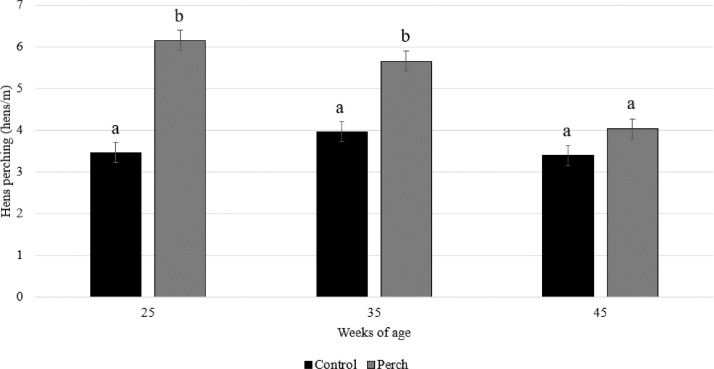
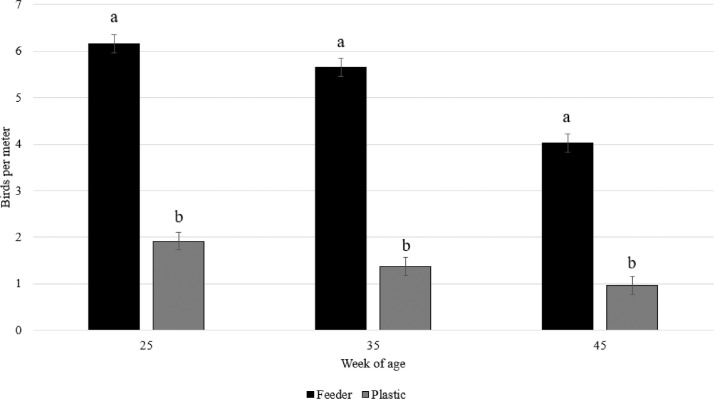
There is a need for more knowledge about perch use in broiler breeders and the potential effects of perches on health and production outcomes. The aim of this study was to investigate the use of perches by commercial broiler breeders, effect of perch access on keel bone fractures (KBF), footpad dermatitis (FPD) and number of floor eggs. Two commercial breeder flocks (Ross 308) reared at the same facility were observed during the production period. Half of each flock was provided with 15 cm perch/bird and the other half had no perches. The perch group had two types of perches; a steel plate mounted on the hen feeder lines "feeder perch" (15 cm high) and elevated plastic perches (5 cm high). Perching by hens and roosters was recorded during the dark period by counting birds on each of the two perch types in 10 sections and in the corresponding patches on the control side at 25, 35, and 45 wk of age (WOA). FPD was scored in 100 random hens in each group at 30 WOA and end of lay, KBF was scored by postmortem in 100 random hens in each group at end of lay, and number of floor eggs (n) in each treatment was scored daily. More hens perched on the feeder perch with the steel plate mounted, compared to the feeder line without the steel plate, but this difference decreased with age (P < 0.0001). Within the perch treatment, more hens perched on the feeder lines compared to the plastic perches at all ages (P < 0.0001). When combining number of hens on the plastic and feeder perches, on average 6.7 birds perched per meter perch, which is full capacity given an average shoulder width of 15 cm/bird. Perch use among the roosters was low overall, but more roosters perched in the perch group compared to the control group at 35 WOA (P = 0.007). Between 47 and 53% of the hens had KBF at the end of the lay. At 30 WOA, birds housed with perches were more likely to have lower FPD. Perch treatment did not affect number of floor eggs. In conclusion, broiler breeder hens perch when the perches are sufficiently high and allow all birds to perch simultaneously, and access to perches may have positive effects on FPD.
需要更多关于肉鸡种鸡使用栖木的知识,以及栖木对健康和生产结果的潜在影响。本研究的目的是调查商业肉鸡种鸡使用栖木的情况,以及接触栖木对龙骨骨折(KBF)、脚垫皮炎(FPD)和地面蛋数量的影响。在生产期间,观察了两个在同一设施中饲养的商业种鸡群(罗斯 308)。每个鸡群的一半提供 15 厘米高的栖木/只,另一半没有栖木。栖木组有两种类型的栖木;一种是安装在母鸡喂料线上的钢板“喂料栖木”(高 15 厘米)和高架塑料栖木(高 5 厘米)。在黑暗期,通过在每个鸡群的两种栖木类型的 10 个部分和对照侧的相应斑块上计数鸟类,记录母鸡和公鸡的栖息情况,在 25、35 和 45 周龄(WOA)时进行。在每个鸡群中,在 30 WOA 和产蛋结束时,对 100 只随机母鸡进行 FPD 评分,在每个鸡群中,在产蛋结束时对 100 只随机母鸡进行剖检评分,对每个处理的地面蛋(n)进行每日评分。与没有钢板的喂料线相比,母鸡更喜欢在装有钢板的喂料栖木上栖息,但随着年龄的增长,这种差异(P < 0.0001)减小。在栖木处理中,在所有年龄段,母鸡更喜欢在喂料线上栖息,而不是在塑料栖木上栖息(P < 0.0001)。当将塑料和喂料栖木上的母鸡数量结合起来时,平均每米栖木有 6.7 只母鸡栖息,这是考虑到每只鸡的平均肩部宽度为 15 厘米/只时的最大容量。总体而言,公鸡的栖息行为较少,但与对照组相比,在 35 WOA 时,栖木组的公鸡栖息更多(P = 0.007)。在产蛋结束时,47%至 53%的母鸡有 KBF。在 30 WOA 时,使用栖木的鸡更有可能患有较低的 FPD。栖木处理对地面蛋数量没有影响。总之,肉鸡种鸡在栖木足够高且允许所有鸡同时栖息时会栖息,并且接触栖木可能对 FPD 有积极影响。