
微生态制剂对改善慢性肾脏病患者肾功能及代谢指标的有效性
Effectiveness of Microecological Preparations for Improving Renal Function and Metabolic Profiles in Patients With Chronic Kidney Disease.
作者信息
Tan Jiaxing, Zhou Huan, Deng Jiaxin, Sun Jiantong, Zhou Xiaoyuan, Tang Yi, Qin Wei
机构信息
Division of Nephrology, Department of Medicine, West China Hospital, Sichuan University, Chengdu, China.
West China School of Medicine, Sichuan University, Chengdu, China.
出版信息
Front Nutr. 2022 Sep 12;9:850014. doi: 10.3389/fnut.2022.850014. eCollection 2022.
BACKGROUND
Determining whether microecological preparations, including probiotics, prebiotics, and synbiotics, are beneficial for patients with chronic kidney disease (CKD) has been debated. Moreover, determining which preparation has the best effect remains unclear. In this study, we performed a network meta-analysis of randomized clinical trials (RCTs) to address these questions.
METHODS
MEDLINE, EMBASE, PubMed, Web of Science, and the Cochrane Central Register of Controlled Trials were searched. Eligible RCTs with patients with CKD who received intervention measures involving probiotics, prebiotics, and/or synbiotics were included. The outcome indicators included changes in renal function, lipid profiles, inflammatory factors, and oxidative stress factors.
RESULTS
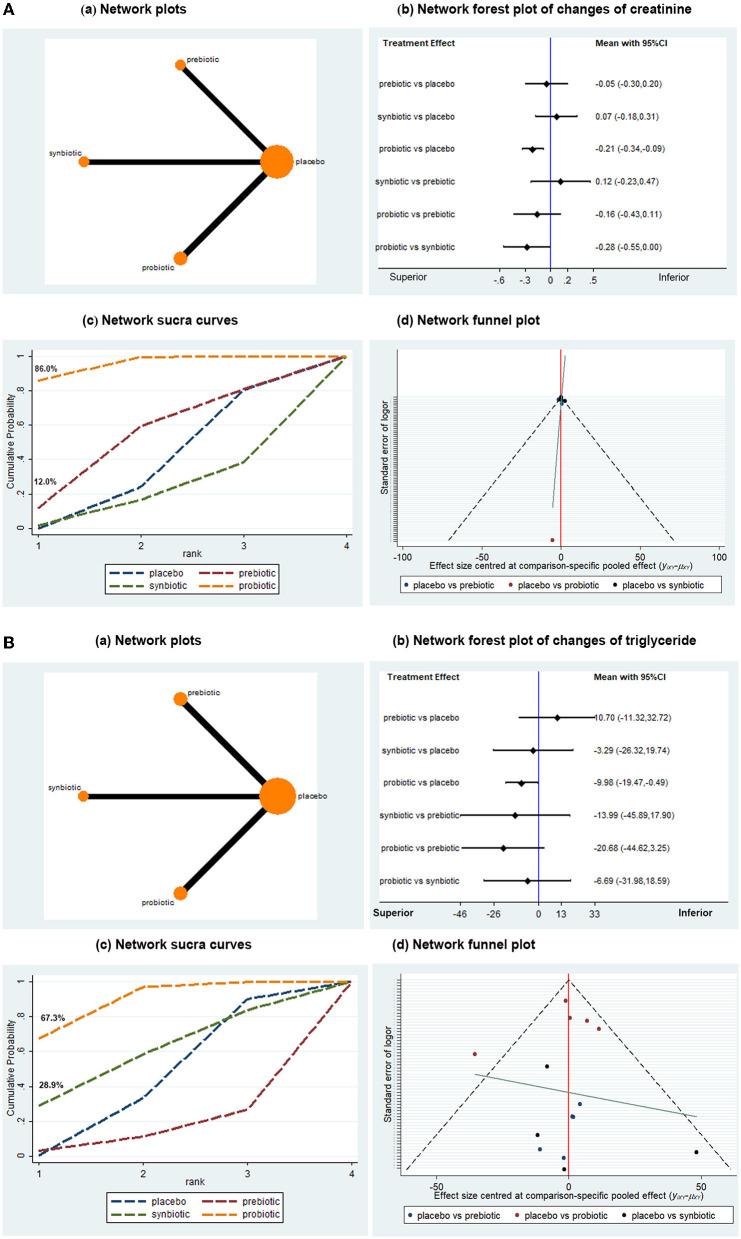
Twenty-eight RCTs with 1,373 patients were ultimately included. Probiotics showed greater effect in lowering serum creatinine [mean difference (MD) -0.21, 95% confidence interval (CI) -0.34, -0.09] and triglycerides (MD -9.98, 95% CI -19.47, -0.49) than the placebo, with the largest surface area under the cumulative ranking curve, while prebiotics and synbiotics showed no advantages. Probiotics were also able to reduce malondialdehyde (MDA) (MD -0.54, 95% CI -0.96, -0.13) and increase glutathione (MD 72.86, 95% CI 25.44, 120.29). Prebiotics showed greater efficacy in decreasing high-sensitivity C-reactive protein (MD -2.06, 95% CI -3.79, -0.32) and tumor necrosis factor-α (MD -2.65, 95% CI -3.91, -1.39). Synbiotics showed a partially synergistic function in reducing MDA (MD -0.66, 95% CI -1.23, -0.09) and high-sensitivity C-reactive protein (MD -2.01, 95% CI -3.87, -0.16) and increasing total antioxidant capacity (MD 145.20, 95% CI 9.32, 281.08).
CONCLUSION
The results indicated that microbial supplements improved renal function and lipid profiles and favorably affected measures of oxidative stress and inflammation in patients with CKD. After thorough consideration, probiotics provide the most comprehensive and beneficial effects for patients with CKD and might be used as the best choice for microecological preparations.
SYSTEMATIC REVIEW REGISTRATION
https://www.crd.york.ac.uk/prospero/display_record.php?ID=CRD42022295497, PROSPERO 2022, identifier: CRD42022295497.
背景
包括益生菌、益生元及合生元在内的微生态制剂对慢性肾脏病(CKD)患者是否有益一直存在争议。此外,哪种制剂效果最佳仍不明确。在本研究中,我们进行了一项随机临床试验(RCT)的网状Meta分析以解决这些问题。
方法
检索了MEDLINE、EMBASE、PubMed、Web of Science及Cochrane对照试验中央注册库。纳入了符合条件的CKD患者接受涉及益生菌、益生元及/或合生元干预措施的RCT。结局指标包括肾功能、血脂谱、炎症因子及氧化应激因子的变化。
结果
最终纳入了28项RCT,共1373例患者。与安慰剂相比,益生菌在降低血清肌酐[平均差(MD)-0.21,95%置信区间(CI)-0.34,-0.09]和甘油三酯(MD -9.98,95%CI -19.47,-0.49)方面效果更佳,累积排名曲线下面积最大,而益生元和合生元未显示出优势。益生菌还能够降低丙二醛(MDA)(MD -0.54,95%CI -0.96,-0.13)并增加谷胱甘肽(MD 72.



 Zotero 插件