Henan University of Chinese Medicine, Zhengzhou, China.
The First Affiliated Hospital of Henan University of TCM, Zhengzhou, China.
Front Public Health. 2022 Jul 25;10:862266. doi: 10.3389/fpubh.2022.862266. eCollection 2022.
Nonalcoholic fatty liver disease (NAFLD) is a chronic liver disease with a high prevalence worldwide, seriously harming human health, and its pathogenesis remains unclear. In recent years, increasing evidence has indicated that intestinal microbiota plays an important role in the occurrence and development of NAFLD. The regulation method of probiotics/prebiotics/synbiotics can alter the intestinal microbiota and has been suggested as an option in the treatment of NAFLD.
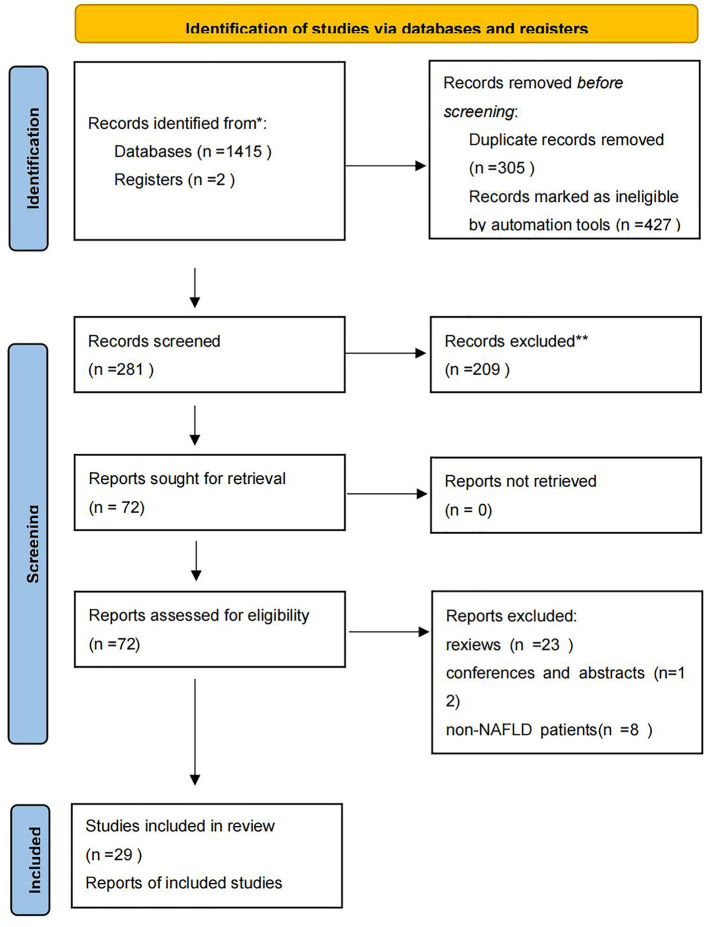
Five databases of PubMed, Embase, the Cochrane Library, clinicaltrails.gov, and China National Knowledge Infrastructure were searched initially, and then the eligible studies were screened. Finally, the data of included studieswere extracted, combined and analyzed.
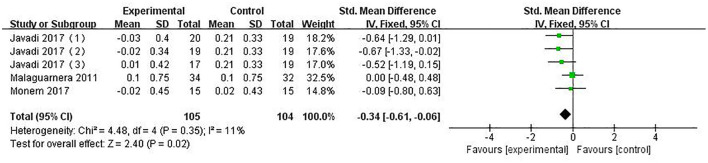
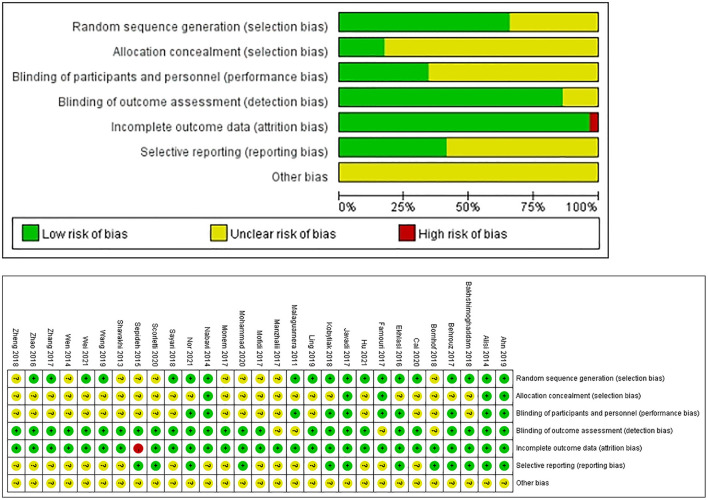
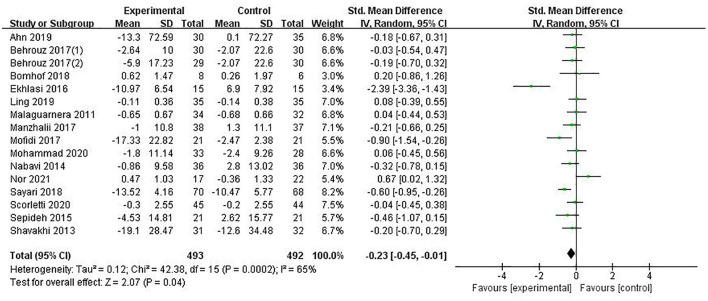
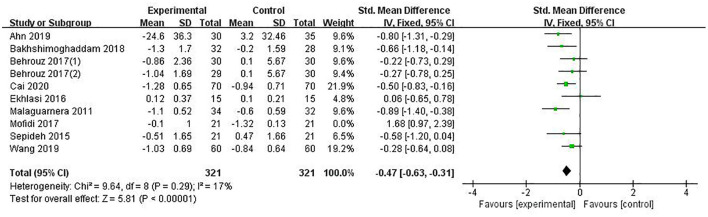
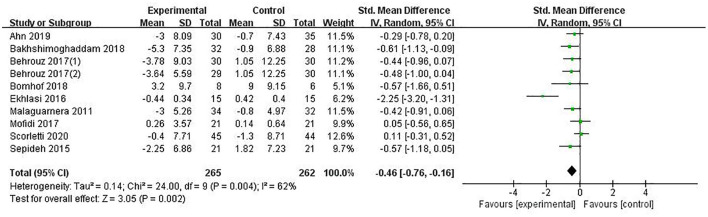
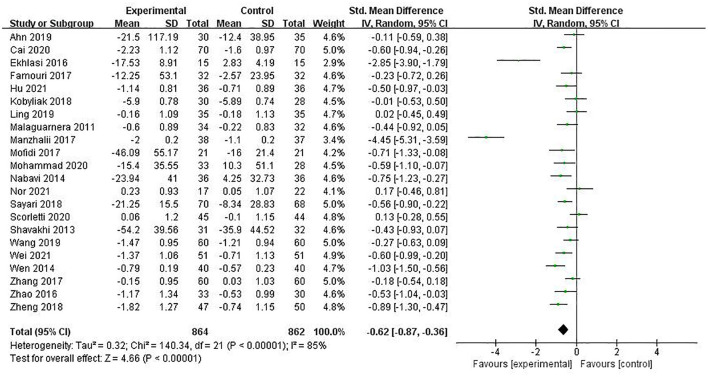
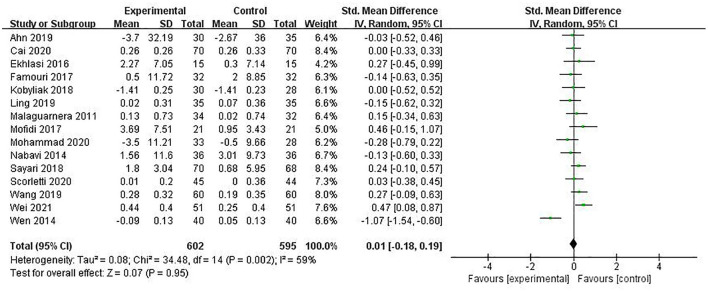
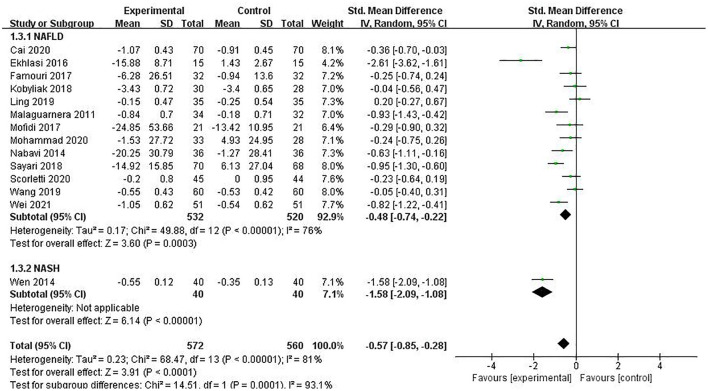
A total of 29 randomized controlled trials involving 2,110 patients were included in this study. The results showed that using probiotics/prebiotics/synbiotics in the intervention group could reduce the levels of glucose (SMD = -0.23, 95% CI [-0.45, -0.01], = 0.04), HOMA-IR (SMD = -0.47, 95% CI [-0.63, -0.31], < 0.00001) and insulin (SMD = -0.46, 95% CI [-0.76, -0.16], = 0.002) in sugar metabolism; in terms of lipid metabolism, the levels of TC (SMD = -0.62, 95%CI [-0.87, -0.36], < 0.00001), and LDL-C (SMD = -0.57, 95%CI [-0.85, -0.28], < 0.00001) were decreased; and the level of ALB was decreased in protein metabolism (SMD = -0.34, 95%CI [-0.61, -0.06], = 0.02).
Based on the current evidence, probiotics/prebiotics/synbiotics may improve energy metabolism biomarkers in the NAFLD population, but these effects still need to be confirmed by further research.
非酒精性脂肪性肝病(NAFLD)是一种全球高发的慢性肝病,严重危害人类健康,其发病机制尚不清楚。近年来,越来越多的证据表明肠道微生物群在 NAFLD 的发生和发展中起着重要作用。益生菌/益生元/合生菌的调节方法可以改变肠道微生物群,并被提议作为治疗 NAFLD 的一种选择。
最初在 PubMed、Embase、Cochrane 图书馆、clinicaltrails.gov 和中国知网五个数据库中进行了搜索,然后筛选出合格的研究。最后,提取、合并和分析纳入研究的数据。
本研究共纳入 29 项随机对照试验,涉及 2110 名患者。结果表明,在干预组中使用益生菌/益生元/合生菌可以降低血糖(SMD=-0.23,95%CI[-0.45,-0.01], = 0.04)、HOMA-IR(SMD=-0.47,95%CI[-0.63,-0.31], < 0.00001)和胰岛素(SMD=-0.46,95%CI[-0.76,-0.16], = 0.002)水平;在脂代谢方面,TC(SMD=-0.62,95%CI[-0.87,-0.36], < 0.00001)和 LDL-C(SMD=-0.57,95%CI[-0.85,-0.28], < 0.00001)水平降低;蛋白质代谢中 ALB 水平降低(SMD=-0.34,95%CI[-0.61,-0.06], = 0.02)。
根据目前的证据,益生菌/益生元/合生菌可能改善 NAFLD 人群的能量代谢生物标志物,但这些效果仍需要进一步研究证实。