Kids Neuroscience Centre, The Children's Hospital at Westmead, Faculty of Medicine and Health, University of Sydney, NSW, Australia; Department of Biochemistry, The Children's Hospital at Westmead, NSW, Australia; Clinical School, The Children's Hospital at Westmead, Faculty of Medicine and Health, University of Sydney, NSW, Australia.
Kids Neuroscience Centre, The Children's Hospital at Westmead, Faculty of Medicine and Health, University of Sydney, NSW, Australia; TY Nelson Department of Neurology and Neurosurgery, The Children's Hospital at Westmead, The University of Sydney, Westmead, New South Wales, Australia.
EBioMedicine. 2022 Oct;84:104280. doi: 10.1016/j.ebiom.2022.104280. Epub 2022 Sep 26.
Epileptic (previously infantile) spasms is the most common epileptic encephalopathy occurring during infancy and is frequently associated with abnormal neurodevelopmental outcomes. Epileptic spasms have a diverse range of known (genetic, structural) and unknown aetiologies. High dose corticosteroid treatment for 4 weeks often induces remission of spasms, although the mechanism of action of corticosteroid is unclear. Animal models of epileptic spasms have shown decreased brain kynurenic acid, which is increased after treatment with the ketogenic diet. We quantified kynurenine pathway metabolites in the cerebrospinal fluid (CSF) of infants with epileptic spasms and explored clinical correlations.
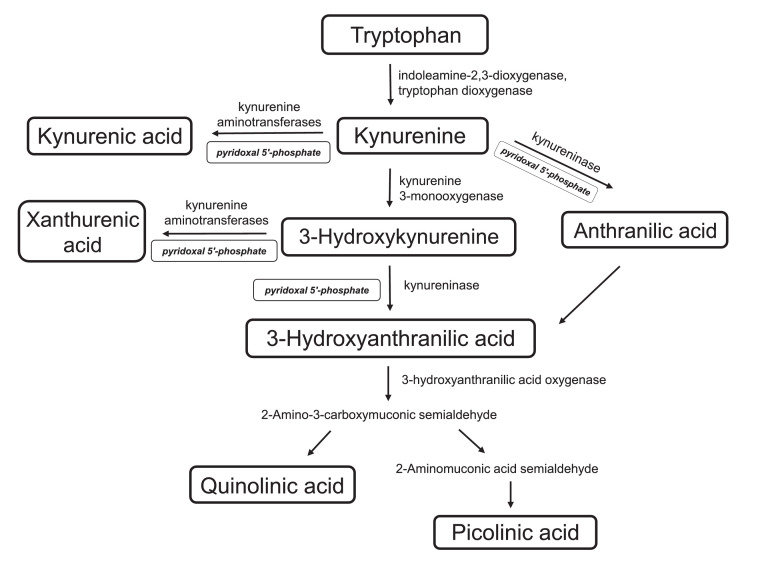
A panel of nine metabolites in the kynurenine pathway (tryptophan, kynurenine, kynurenic acid, 3-hydroxykynurenine, xanthurenic acid, anthranilic acid, 3-hydroxyanthranilic acid, quinolinic acid, and picolinic acid) were measured using liquid chromatography coupled to tandem mass spectrometry (LC-MS/MS). CSF collected from paediatric patients less than 3 years of age with epileptic spasms (n=34, 19 males, mean age 0.85, median 0.6, range 0.3-3 yrs) were compared with other epilepsy syndromes (n=26, 9 males, mean age 1.44, median 1.45, range 0.3-3 yrs), other non-inflammatory neurological diseases (OND) (n=29, 18 males, mean age 1.47, median 1.6, range 0.1-2.9 yrs) and inflammatory neurological controls (n=12, 4 males, mean age 1.80, median 1.80, range 0.8-2.5 yrs).
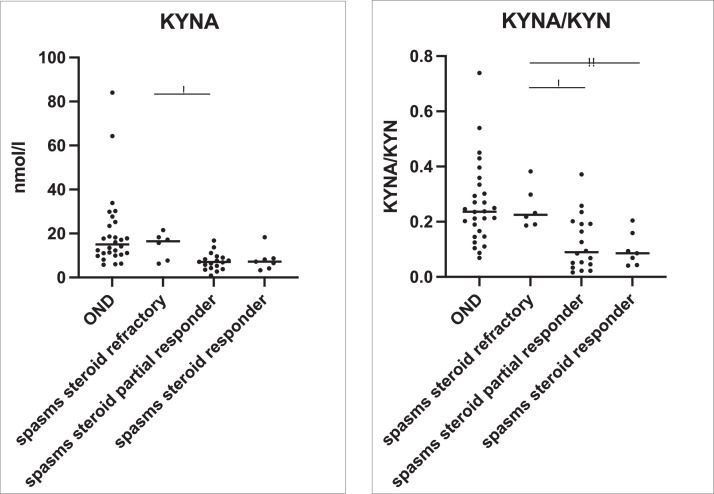
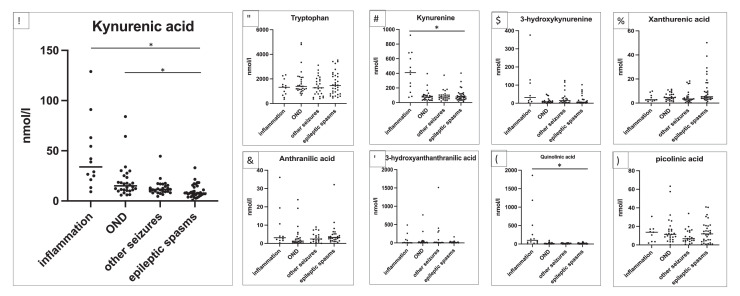
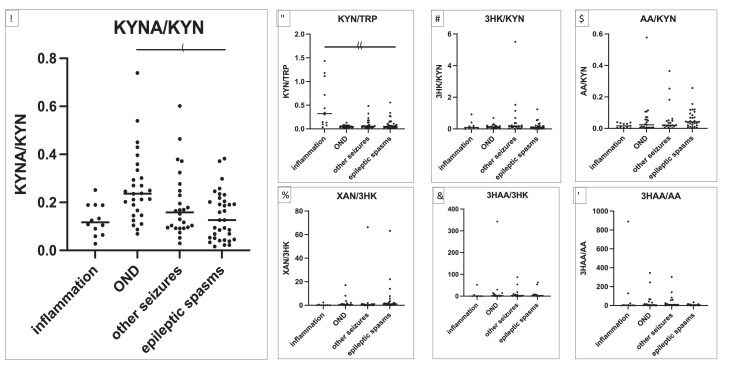
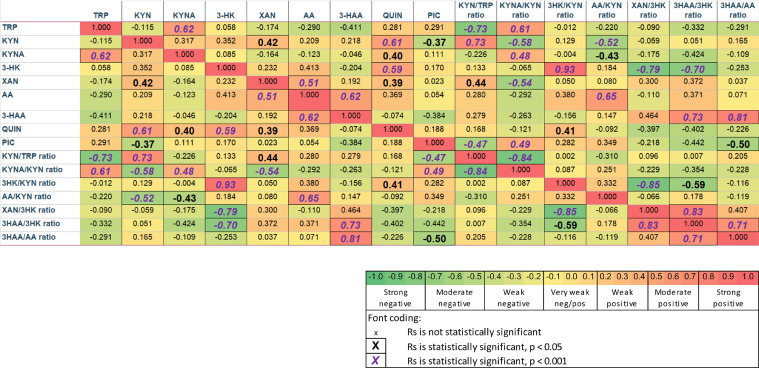
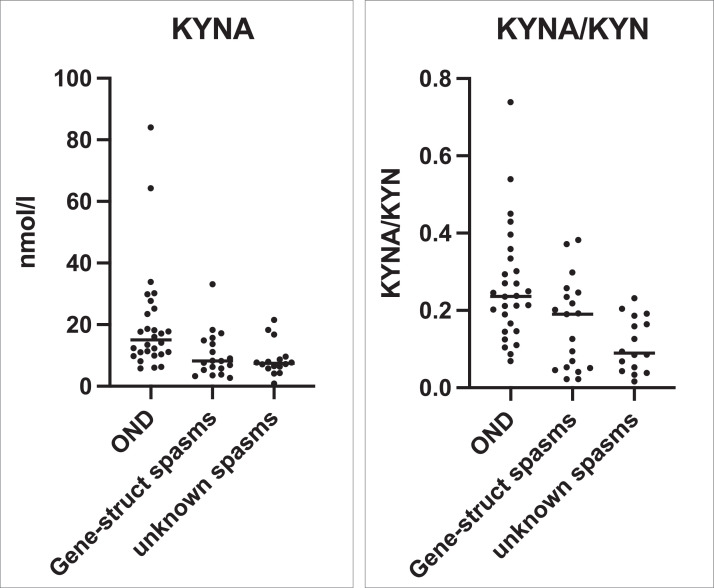
There was a statistically significant decrease of CSF kynurenic acid in patients with epileptic spasms compared to OND (p<0.0001). In addition, the kynurenic acid/kynurenine (KYNA/KYN) ratio was lower in the epileptic spasms subgroup compared to OND (p<0.0001). Epileptic spasms patients who were steroid responders or partial steroid responders had lower KYNA/KYN ratio compared to patients who were refractory to steroids (p<0.005, p<0.05 respectively).
This study demonstrates decreased CSF kynurenic acid and KYNA/KYN in epileptic spasms, which may also represent a biomarker for steroid responsiveness. Given the anti-inflammatory and neuroprotective properties of kynurenic acid, further therapeutics able to increase kynurenic acid should be explored.
Financial support for the study was granted by Dale NHMRC Investigator grant APP1193648, Petre Foundation, Cerebral Palsy Alliance and Department of Biochemistry at the Children's Hospital at Westmead. Prof Guillemin is funded by NHMRC Investigator grant APP1176660 and Macquarie University.
癫痫(以前称为婴儿痉挛)是婴儿期最常见的癫痫性脑病,常伴有神经发育异常的不良结局。癫痫发作有多种已知(遗传、结构)和未知病因。4 周的大剂量皮质类固醇治疗常能诱导痉挛缓解,尽管皮质类固醇的作用机制尚不清楚。癫痫发作的动物模型显示脑犬尿氨酸途径的犬尿氨酸酸减少,而用生酮饮食治疗后则增加。我们定量测定了癫痫发作婴儿脑脊液(CSF)中的犬尿氨酸途径代谢物,并探讨了临床相关性。
使用液相色谱-串联质谱(LC-MS/MS)法测定了犬尿氨酸途径中的 9 种代谢物(色氨酸、犬尿氨酸、犬尿氨酸酸、3-羟基犬尿氨酸、黄尿酸、邻氨基苯甲酸、3-羟基邻氨基苯甲酸、喹啉酸和吡啶甲酸)。比较了小于 3 岁的癫痫发作患儿(n=34,男 19 例,平均年龄 0.85,中位数 0.6,范围 0.3-3 岁)与其他癫痫综合征(n=26,男 9 例,平均年龄 1.44,中位数 1.45,范围 0.3-3 岁)、其他非炎症性神经疾病(OND)(n=29,男 18 例,平均年龄 1.47,中位数 1.6,范围 0.1-2.9 岁)和炎症性神经对照组(n=12,男 4 例,平均年龄 1.80,中位数 1.80,范围 0.8-2.5 岁)。
与 OND 相比,癫痫发作患者的 CSF 犬尿氨酸酸含量明显降低(p<0.0001)。此外,癫痫发作亚组的犬尿氨酸酸/犬尿氨酸(KYNA/KYN)比值也低于 OND(p<0.0001)。对类固醇有反应或部分反应的癫痫发作患者的 KYNA/KYN 比值低于对类固醇无反应的患者(p<0.005,p<0.05)。
本研究表明,癫痫发作患者的 CSF 犬尿氨酸酸和 KYNA/KYN 降低,这也可能代表类固醇反应性的生物标志物。鉴于犬尿氨酸酸具有抗炎和神经保护作用,应进一步探索能够增加犬尿氨酸酸的治疗方法。
这项研究得到了 Dale NHMRC 研究员赠款 APP1193648、Petre 基金会、脑瘫联盟和西悉尼儿童医院生物化学系的支持。Guillemin 教授的研究得到了 NHMRC 研究员赠款 APP1176660 和麦考瑞大学的资助。