Jang Siyoung, Kim Geon Woo, Han Koeun, Kim Young Min, Jo Jinkwan, Lee Seo-Young, Kwon Jin-Kyung, Kang Byoung-Cheorl
Department of Agriculture, Forestry and Bioresources, Research Institute of Agriculture and Life Sciences, Plant Genomics and Breeding Institute, College of Agriculture and Life Sciences, Seoul National University, Seoul, South Korea.
Front Plant Sci. 2022 Sep 15;13:922963. doi: 10.3389/fpls.2022.922963. eCollection 2022.
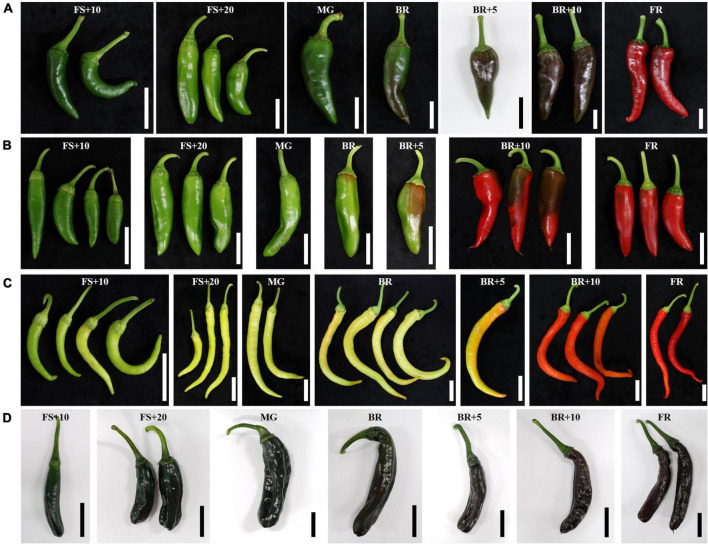
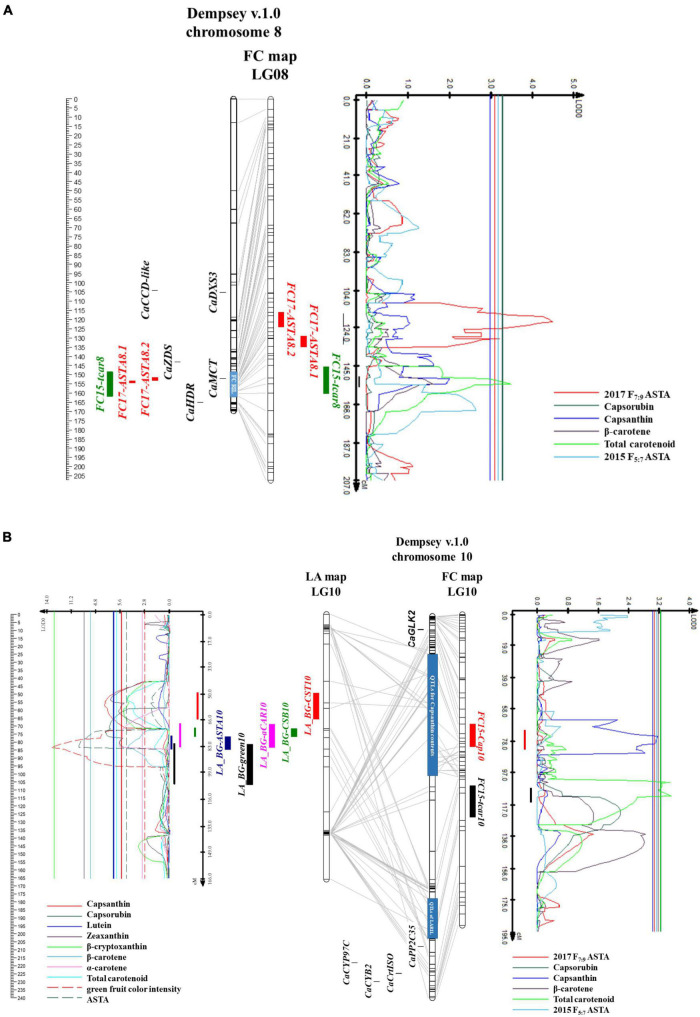
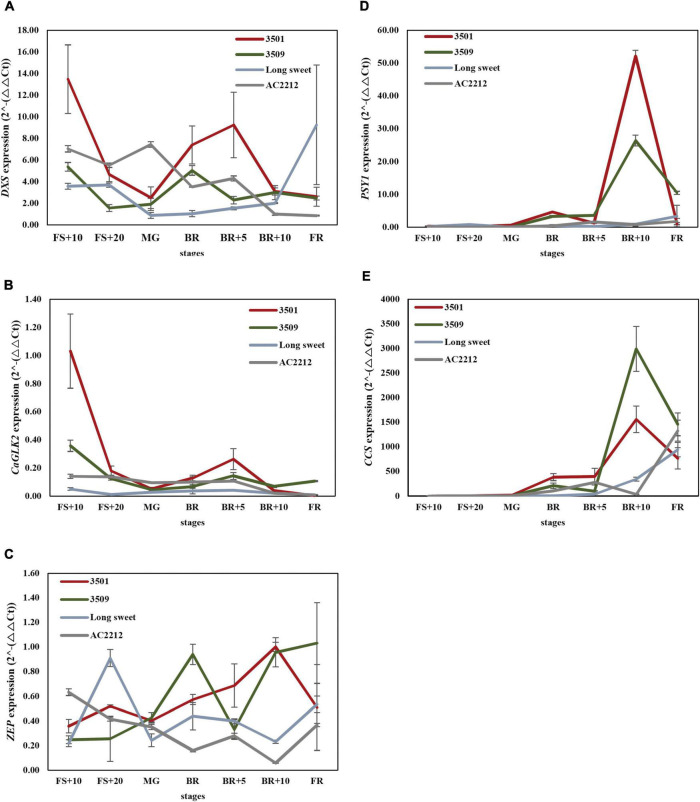
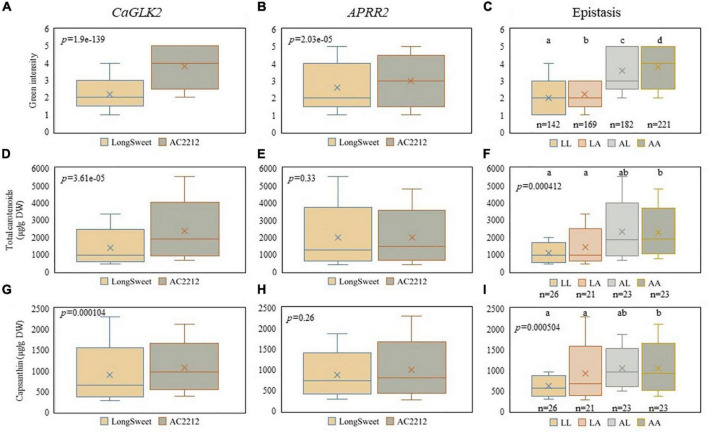
Chlorophylls and carotenoids are synthesized in the chloroplast and chromoplast, respectively. Even though the two pigments are generated from the same precursor, the genetic correlation between chlorophyll and carotenoid biosynthesis has not yet been fully understood. We investigated the genetic correlation of chlorophyll and carotenoid biosynthesis during fruit ripening. Two recombinant inbred lines populations, "Long Sweet" × "AC2212" ("LA") RILs derived from a cross between "Long Sweet" with light-green and light-red fruit and "AC2212" with dark-green and brown-fruit and "3501 (F)" × "3509 (C)" ("FC") RILs from "3501" with dark-green and dark-red fruit and "3509" with intermediate green and light-red fruit, were used. As the fruit ripened, three accessions produced high levels of xanthophyll. The dark-green immature fruit accumulated more total carotenoids than the light-green fruit. This trend corresponded to the expression pattern of () and genes during fruit development. The expression levels of and in the dark-green accession "3501" were significantly higher than those of "3509" and "Long Sweet" during the early stages of fruit development. Furthermore, the genotype analysis of the transcription factor controlling chloroplast development () in LA RILs revealed that expression affected both carotenoid and chlorophyll contents. The single nucleotide polymorphism (SNP) linkage maps were constructed using genotyping-by-sequencing (GBS) for the two populations, and QTL analysis was performed for green fruit color intensity and carotenoid content. The QTL () for capsanthin content in LA RILs located at 24.4 to 100.4 Mbp on chromosome 10 was overlapped with the QTL () for capsanthin content in FC RILs. Three QTLs for capsanthin content, American spice trade association (ASTA) value, and immature green fruit color intensity were also overlapped from 178.2 to 204 Mbp on chromosome 10. At the location, 151.6 to 165 Mbp on chromosome 8, QTLs () for total carotenoid content and ASTA value were discovered, and this region contained (), which is involved in the MEP pathway. This result is the first report to show the correlation between carotenoid and chlorophyll biosynthesis in pepper. This research will expand our understanding of the mechanism of the chloroplast-to-chromoplast transition and the development of high pigment pepper varieties.
叶绿素和类胡萝卜素分别在叶绿体和有色体中合成。尽管这两种色素由相同的前体生成,但叶绿素和类胡萝卜素生物合成之间的遗传相关性尚未完全明确。我们研究了果实成熟过程中叶绿素和类胡萝卜素生物合成的遗传相关性。使用了两个重组自交系群体,即源自浅绿色和浅红色果实的“Long Sweet”与深绿色和棕色果实的“AC2212”杂交产生的“Long Sweet”דAC2212”(“LA”)重组自交系,以及源自深绿色和深红色果实的“3501”与中间绿色和浅红色果实的“3509”杂交产生的“3501(F)”ד3509(C)”(“FC”)重组自交系。随着果实成熟,三个材料积累了高水平的叶黄素。深绿色未成熟果实比浅绿色果实积累了更多的总类胡萝卜素。这种趋势与果实发育过程中()和基因的表达模式相对应。在果实发育早期,深绿色材料“3501”中()和的表达水平显著高于“3509”和“Long Sweet”。此外,对LA重组自交系中控制叶绿体发育的转录因子()的基因型分析表明,的表达影响类胡萝卜素和叶绿素含量。使用简化基因组测序(GBS)为两个群体构建了单核苷酸多态性(SNP)连锁图谱,并对绿色果实颜色强度和类胡萝卜素含量进行了QTL分析。LA重组自交系中辣椒红素含量的QTL()位于第10号染色体上24.4至100.4 Mbp处,与FC重组自交系中辣椒红素含量的QTL()重叠。第10号染色体上178.2至204 Mbp处还重叠了三个辣椒红素含量、美国香料贸易协会(ASTA)值和未成熟绿色果实颜色强度的QTL。在第8号染色体上151.6至165 Mbp的位置,发现了总类胡萝卜素含量和ASTA值的QTL(),该区域包含参与MEP途径的()。这一结果是首次报道辣椒中类胡萝卜素和叶绿素生物合成之间的相关性。这项研究将扩展我们对叶绿体向有色体转变机制以及高色素辣椒品种发育的理解。