Meng Xin, Xia Guofang, Zhang Lili, Xu Congfeng, Chen Zhong
Department of Cardiology, The Affiliated Sixth People's Hospital, Shanghai Jiao Tong University School of Medicine, Shanghai, China.
Front Cardiovasc Med. 2022 Sep 15;9:933532. doi: 10.3389/fcvm.2022.933532. eCollection 2022.
T cell immunoglobulin and mucin domain-containing protein 3 (Tim-3) is mainly expressed by immune cells and plays an immunomodulatory role in cardiovascular disease. However, the prognostic value of Tim-3 in acute decompensated heart failure (ADHF) is unclear. This study aimed to investigate the expression profile of Tim-3 on CD4 and CD8 T cells in patients with ADHF and its impact on their prognosis.
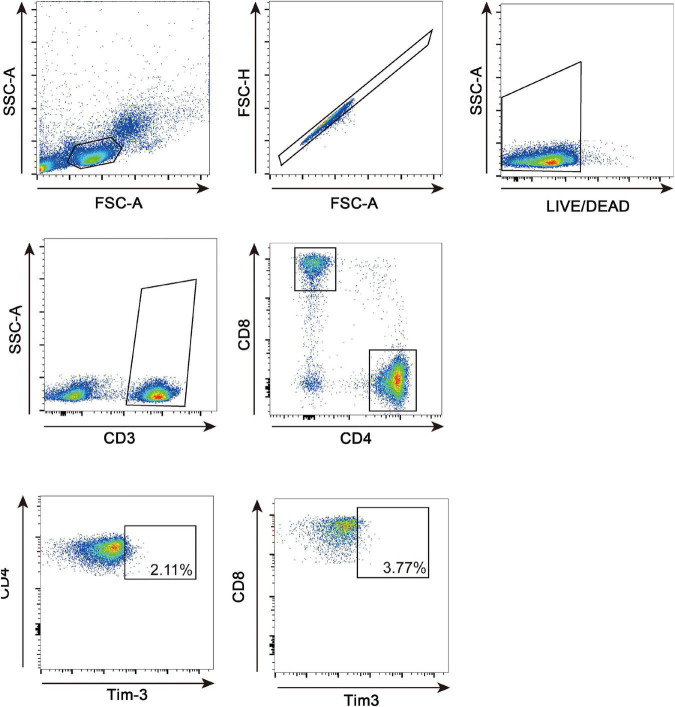
In this prospective study, 84 patients who were hospitalized with ADHF and 83 patients without heart failure were enrolled. Main clinical data were collected during patient visits. The Tim-3 expression on CD4 and CD8 T cells in peripheral blood samples was assayed by flow cytometry. Long-term prognosis of the patients with ADHF was evaluated by major adverse cardiac and cerebrovascular events (MACCE) over a 12-month follow-up period.
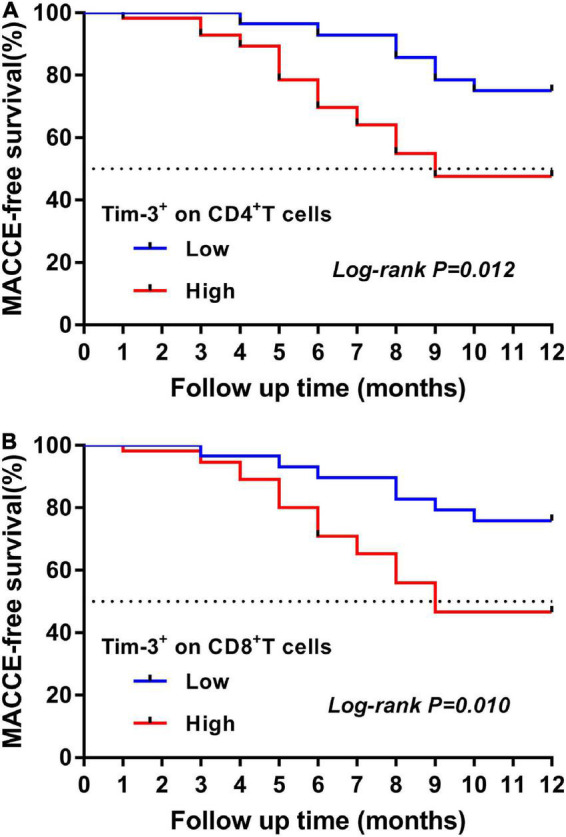
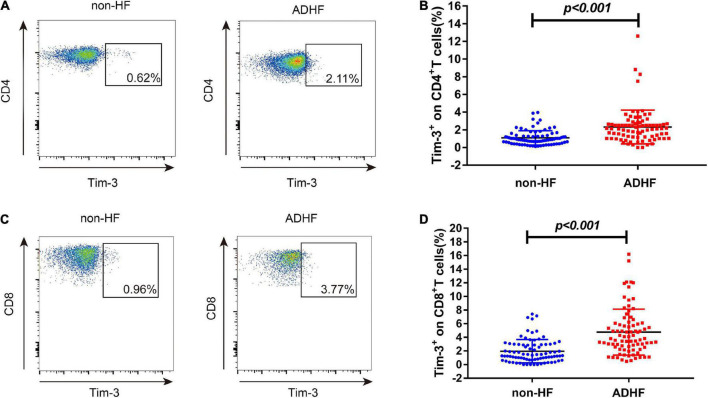
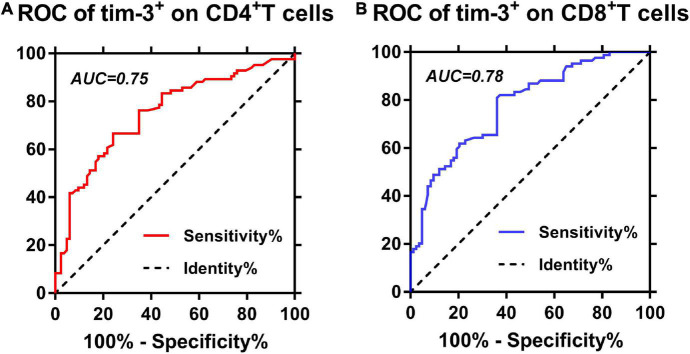
We found that the Tim-3 expression on CD4 T cells [2.08% (1.15-2.67%) vs. 0.88% (0.56-1.39%), < 0.001] and CD8 T cells [3.81% (2.24-6.03%) vs. 1.36% (0.76-3.00%), < 0.001] in ADHF group were significantly increased vs. the non-ADHF group. Logistic analysis revealed that high levels of Tim-3 expressed on CD4 and CD8 T cells were independent risk factors of ADHF (OR: 2.76; 95% CI: 1.34-5.65, = 0.006; OR: 2.58; 95% CI: 1.26-5.31, = 0.010, respectively). ROC curve analysis showed that the high level of Tim-3 on CD4 or CD8 T cells as a biomarker has predictive performance for ADHF (AUC: 0.75; 95% CI: 0.68-0.83; AUC: 0.78, 95% CI: 0.71-0.85, respectively). During a median follow-up of 12 months, the Cox regression analysis revealed that higher Tim-3 on CD4 and CD8 T cells were strongly associated with increased risks of MACCE within 12 months after ADHF (HR: 2.613; 95% CI: 1.11-6.13, = 0.027; HR: 2.762, 95% CI: 1.15-6.63, = 0.023; respectively).
Our research indicated that the expression level of Tim-3 on CD4 and CD8 T cells, elevated in patients with ADHF, was an independent predictor of MACCE within 12 months after ADHF. It suggests a potential immunoregulatory role of Tim-3 signaling system in the mechanism of ADHF.
含T细胞免疫球蛋白和粘蛋白结构域蛋白3(Tim-3)主要由免疫细胞表达,在心血管疾病中发挥免疫调节作用。然而,Tim-3在急性失代偿性心力衰竭(ADHF)中的预后价值尚不清楚。本研究旨在探讨ADHF患者CD4和CD8 T细胞上Tim-3的表达谱及其对患者预后的影响。
在这项前瞻性研究中,纳入了84例因ADHF住院的患者和83例无心力衰竭的患者。在患者就诊期间收集主要临床数据。采用流式细胞术检测外周血样本中CD4和CD8 T细胞上Tim-3的表达。通过12个月随访期内的主要不良心脑血管事件(MACCE)评估ADHF患者的长期预后。
我们发现,ADHF组CD4 T细胞上的Tim-3表达[2.08%(1.15-2.67%)对0.88%(0.56-1.39%),<0.001]和CD8 T细胞上的Tim-3表达[3.81%(2.24-6.03%)对1.36%(0.76-3.00%),<0.001]与非ADHF组相比显著增加。逻辑分析显示,CD4和CD8 T细胞上高水平的Tim-3表达是ADHF的独立危险因素(OR:2.76;95%CI:1.34-5.65,=0.006;OR:2.58;95%CI:1.26-5.31,=0.010)。ROC曲线分析表明,CD4或CD8 T细胞上高水平的Tim-3作为生物标志物对ADHF具有预测性能(AUC:0.75;95%CI:0.68-0.83;AUC:0.78,95%CI:0.71-0.85)。在中位随访12个月期间,Cox回归分析显示,CD4和CD8 T细胞上较高的Tim-3与ADHF后12个月内MACCE风险增加密切相关(HR:2.613;95%CI:1.11-6.13,=0.027;HR:2.762,95%CI:1.15-6.63,=0.023)。
我们的研究表明,ADHF患者CD4和CD8 T细胞上Tim-3的表达水平升高,是ADHF后12个月内MACCE的独立预测因子。这提示Tim-3信号系统在ADHF机制中具有潜在的免疫调节作用。