Department of Pathology and Laboratory Medicine, Pennsylvania State University College of Medicine, 500 University Drive, Hershey, PA, 17033, USA.
Department of Urology, Pennsylvania State University College of Medicine, Hershey, PA, 17033, USA.
Sci Rep. 2022 Oct 3;12(1):16538. doi: 10.1038/s41598-022-20927-9.
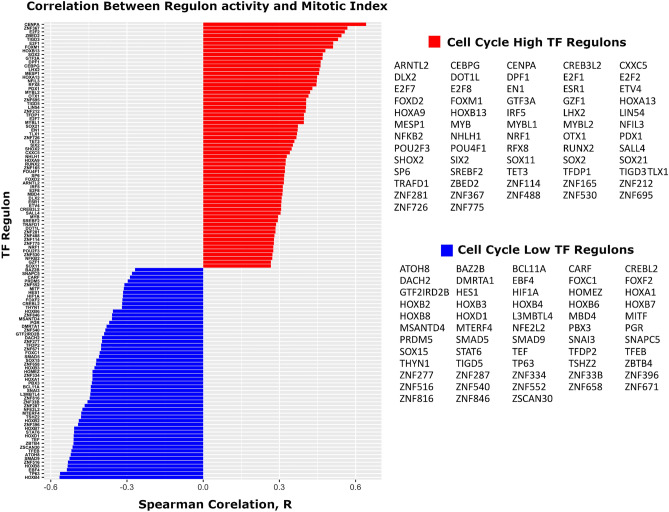
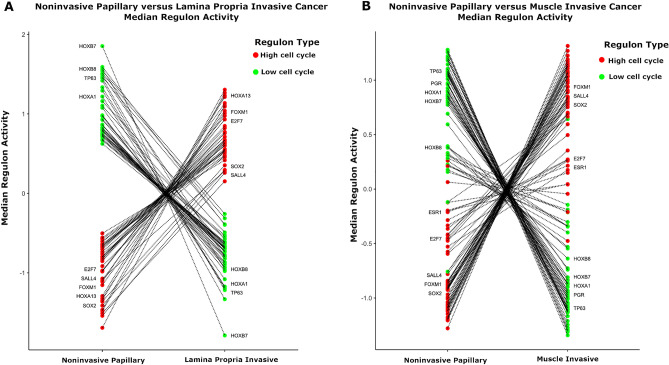
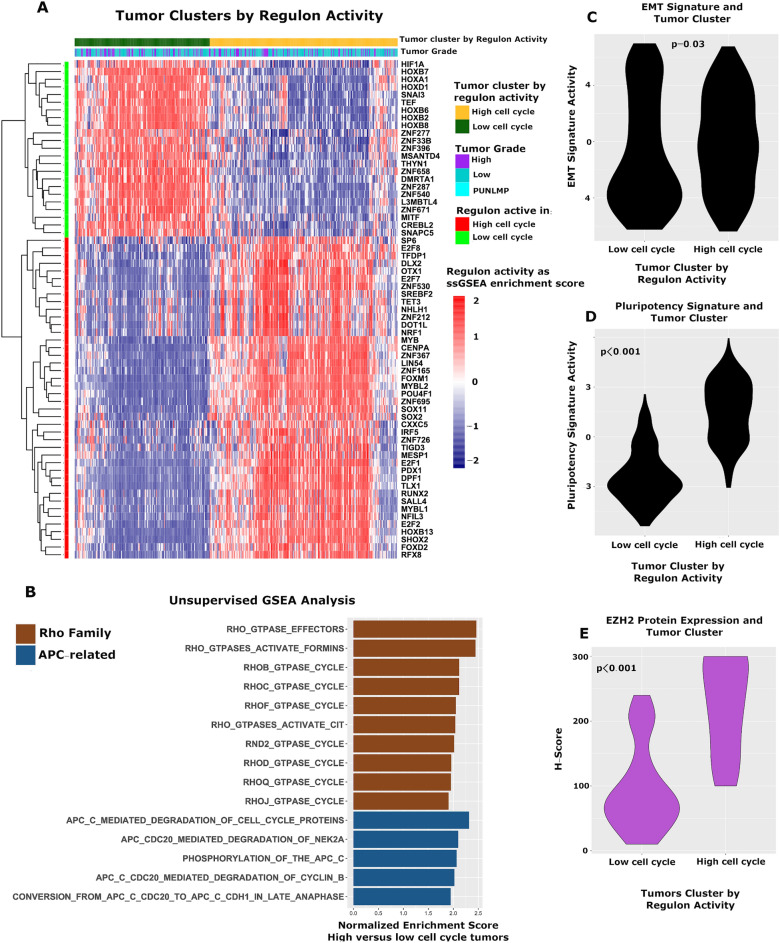
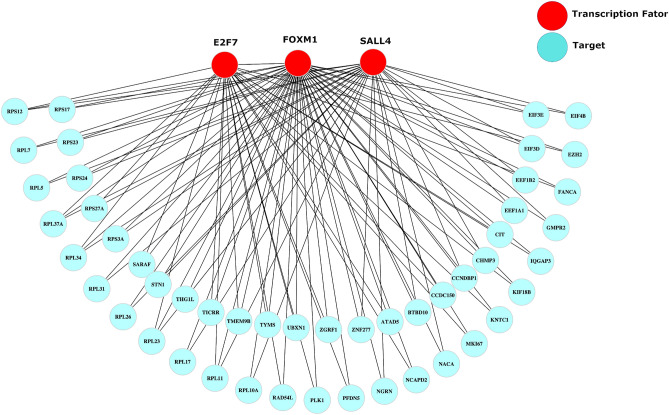
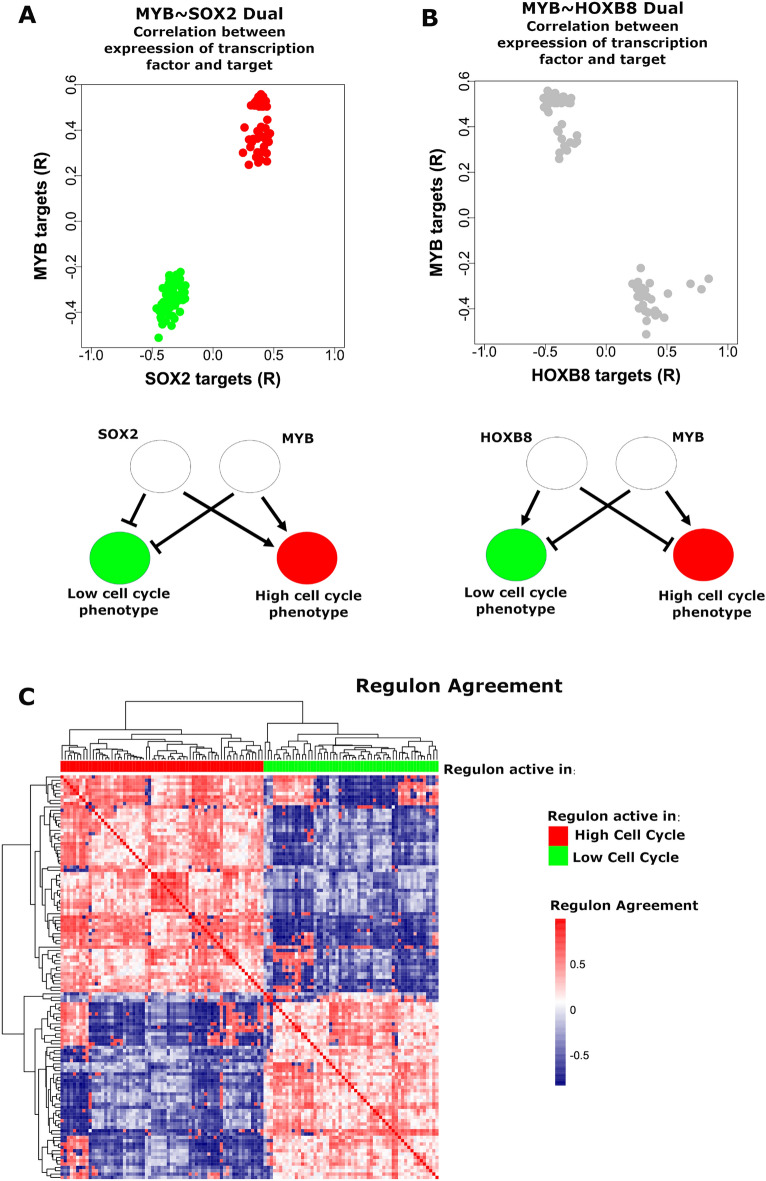
Human cancers display a restricted set of expression profiles, despite diverse mutational drivers. This has led to the hypothesis that select sets of transcription factors act on similar target genes as an integrated network, buffering a tumor's transcriptional state. Noninvasive papillary urothelial carcinoma (NIPUC) with higher cell cycle activity has higher risk of recurrence and progression. In this paper, we describe a transcriptional network of cell cycle dysregulation in NIPUC, which was delineated using the ARACNe algorithm applied to expression data from a new cohort (n = 81, RNA sequencing), and two previously published cohorts. The transcriptional network comprised 121 transcription factors, including the pluripotency factors SOX2 and SALL4, the sex hormone binding receptors ESR1 and PGR, and multiple homeobox factors. Of these 121 transcription factors, 65 and 56 were more active in tumors with greater and less cell cycle activity, respectively. When clustered by activity of these transcription factors, tumors divided into High Cell Cycle versus Low Cell Cycle groups. Tumors in the High Cell Cycle group demonstrated greater mutational burden and copy number instability. A putative mutational driver of cell cycle dysregulation, such as homozygous loss of CDKN2A, was found in only 50% of High Cell Cycle NIPUC, suggesting a prominent role of transcription factor activity in driving cell cycle dysregulation. Activity of the 121 transcription factors strongly associated with expression of EZH2 and other members of the PRC2 complex, suggesting regulation by this complex influences expression of the transcription factors in this network. Activity of transcription factors in this network also associated with signatures of pluripotency and epithelial-to-mesenchymal transition (EMT), suggesting they play a role in driving evolution to invasive carcinoma. Consistent with this, these transcription factors differed in activity between NIPUC and invasive urothelial carcinoma.
人类癌症表现出有限的表达谱,尽管存在多种突变驱动因素。这导致了这样一种假设,即某些转录因子集作为一个集成网络作用于相似的靶基因,缓冲肿瘤的转录状态。具有较高细胞周期活性的非浸润性乳头状尿路上皮癌(NIPUC)具有更高的复发和进展风险。在本文中,我们描述了 NIPUC 中细胞周期失调的转录网络,该网络使用 ARACNe 算法应用于来自新队列(n=81,RNA 测序)和两个先前发表的队列的表达数据进行了描绘。转录网络包括 121 个转录因子,包括多能性因子 SOX2 和 SALL4、性激素结合受体 ESR1 和 PGR,以及多个同源盒因子。在这 121 个转录因子中,有 65 个和 56 个在细胞周期活性较高和较低的肿瘤中更为活跃。当根据这些转录因子的活性进行聚类时,肿瘤分为高细胞周期组和低细胞周期组。高细胞周期组的肿瘤显示出更大的突变负担和拷贝数不稳定性。在高细胞周期 NIPUC 中,仅发现 50%存在细胞周期失调的潜在突变驱动因素,如 CDKN2A 纯合缺失,这表明转录因子活性在驱动细胞周期失调方面发挥着重要作用。这 121 个转录因子的活性与 EZH2 和 PRC2 复合物的其他成员的表达强烈相关,表明该复合物调节了这个网络中转录因子的表达。这个网络中转录因子的活性也与多能性和上皮-间充质转化(EMT)的特征相关,表明它们在驱动向浸润性膀胱癌的进化中发挥作用。与这一观点一致的是,这些转录因子在 NIPUC 和浸润性尿路上皮癌之间的活性存在差异。