Faculty of Economic Sciences, University of Warsaw, Długa 44/50, 00-241, Warsaw, Poland.
BMC Geriatr. 2022 Oct 5;22(1):781. doi: 10.1186/s12877-022-03464-y.
Commonly observed low activity of older adults harms their well-being. We perceive the retirement as a new opening that could be utilized to fulfill previously neglected needs and involve in new activities. They can be a remedy for losing the sense of life while changing the social role and getting older. This study explores trends in activity over retirement. In particular, it verifies if different post-retirement activities: 1) formal social engagement; 2) informal help given outside the household; 3) solitary leisure or self-development activities, and 4) sociable leisure or self-development activities are mutually exclusive or supportive of each other.
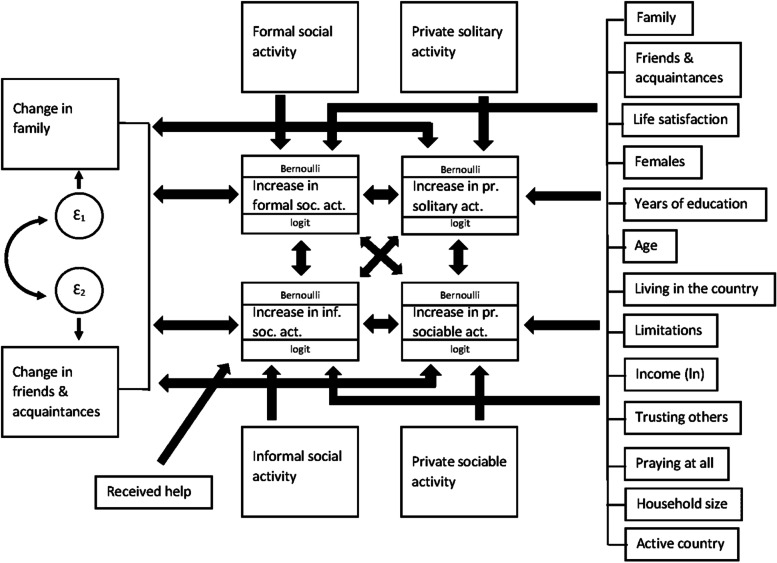
We use the data from 4 and 6th wave of Survey of Health, Ageing and Retirement in Europe, taking into consideration 2757 respondents who participated in both waves. We analyze trends in activity over retirement and verify the hypotheses regarding the relationships between engaging into different types of activities and between the activity and development of personal social networks. We conduct the descriptive analysis and utilize the Generalized Structural Equation Model.
Most people do not change their involvement in different activities after retirement. Among those who change, the average trend is upward. We find support that different types of activities undertaken after retirement do not crowd out each other. On the contrary, being active in one sphere goes hand in hand with activity in another. We give evidence for presence of social network mechanisms that enhance such understood complementarity. Maintaining social relationships correlates with engagement in socially-oriented activities and privately-oriented sociable pastimes. Being active, with exception of solitary forms of recreation, creates an opportunity to foster relations with other people and, thanks to their encouragement, to engage in new activities.
The small change in activity after retirement signifies the need to encourage non-work activity during earlier stages of life. As different types of post-retirement activities are complementary, the most active group of older adults would be the most open for social engagement and volunteering, however the least active group needs the biggest support to involve in any activities.
老年人活动量普遍较低会损害他们的幸福感。我们认为退休是一个新的开始,可以利用这个机会满足以前被忽视的需求,参与新的活动。这些活动可以帮助他们在改变社会角色和变老的过程中重新找到生活的意义。本研究探讨了退休后活动量的变化趋势。具体来说,它验证了不同的退休后活动:1)正式的社会参与;2)家庭外的非正式帮助;3)独自的休闲或自我发展活动;4)社交休闲或自我发展活动是否相互排斥或相互支持。
我们使用了欧洲健康、老龄化和退休调查的第 4 波和第 6 波数据,考虑了参与了这两波调查的 2757 名受访者。我们分析了退休后活动量的变化趋势,并验证了关于不同类型活动之间以及活动与个人社交网络发展之间关系的假设。我们进行了描述性分析,并利用了广义结构方程模型。
大多数人在退休后不会改变他们参与不同活动的方式。在那些改变的人中,平均趋势是向上的。我们发现支持退休后从事的不同类型的活动不会相互排斥。相反,在一个领域活跃与在另一个领域活跃是相辅相成的。我们提供了证据,证明存在增强这种互补性的社会网络机制。维持社会关系与参与面向社会的活动和以个人为导向的社交娱乐活动有关。积极参与活动(除了独自的娱乐形式)为与他人建立关系创造了机会,并在他们的鼓励下,参与新的活动。
退休后活动量的微小变化表明需要在生命早期鼓励非工作活动。由于退休后不同类型的活动是互补的,最活跃的老年人群体将最开放地参与社会参与和志愿服务,而最不活跃的老年人群体则需要最大的支持来参与任何活动。