Department of Neurology, Zigong First People's Hospital, No. 42, shangyihao 1st branch road, Ziliujing, Zigong, 643000, Sichuan, China.
Outpatient department, Zigong First People's Hospital, No. 42, Shangyihao 1st Branch Road, Ziliujing District, Zigong, 643000, Sichuan, China.
BMC Neurol. 2022 Oct 5;22(1):378. doi: 10.1186/s12883-022-02904-x.
Acute vestibular syndrome (AVS) is a common clinical syndrome in neurology clinics and emergency department. Canonical standard for AVS diagnosis requires the presence of persistent vertigo for more than 24 h. HINTS (head impulse-nystagmus-test of skew) is an emerging scheme in the diagnosis of AVS. In this prospective study, we evaluated the specificity and sensitivity of HINTS in distinguishing between central and peripheral AVS.
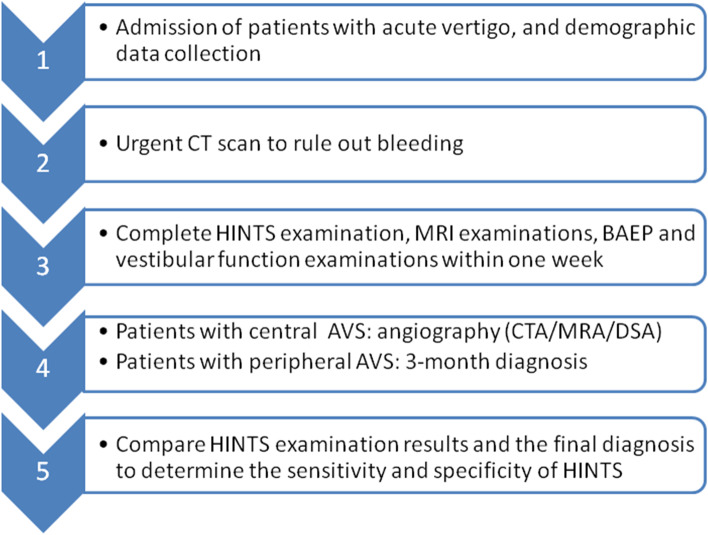
A cohort of 239 cases with complete clinical record was recruited in the study. All patients completed emergency brain CT examination to exclude hemorrhagic stroke. HINTS examination was conducted to distinguish between central AVS and peripheral AVS, and all patients completed head MRI, BAEP and vestibular function examinations within one week. Patients diagnosed as central AVS were subject to angiography (CTA/MRA/DSA), and patients with peripheral AVS were considered for a 3-month follow-up to correct the initial diagnosis.
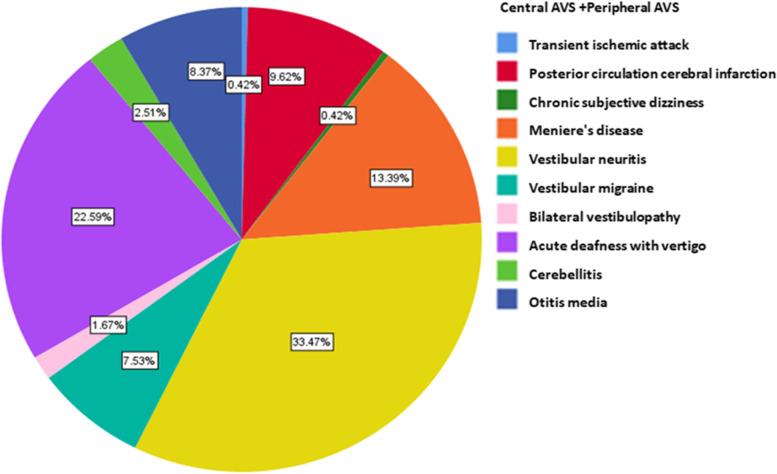
Patients with central AVS were associated with an elder age, higher incidences of hypertension, atrial fibrillation, family history of stroke and previous history of stroke. Posterior circulation cerebral infarction, vestibular migraine and cerebellitis were the dominant diseases associated with central AVS. The sensitivities of HIT, GE, and TS in the diagnosis of central AVS were 73.5%, 61.2%, and 26.5%, and the specificities were 97.9%, 92.6%, and 93.2% respectively.
The sensitivity of HINTS for central AVS diagnosis is 89.8% and the specificity is 84.2%. HINTS is an easy-to-operate, low-cost, high-sensitivity and specific examination technique, which is practical in neurology outpatient clinics and emergency departments.
急性前庭综合征(AVS)是神经内科和急诊科常见的临床综合征。AVS 的典型标准诊断需要持续 24 小时以上的眩晕。HINTS(头脉冲-眼震试验-偏斜)是 AVS 诊断中的新兴方案。在这项前瞻性研究中,我们评估了 HINTS 区分中枢性和周围性 AVS 的特异性和敏感性。
本研究纳入了 239 例具有完整临床记录的患者。所有患者均完成急诊脑 CT 检查以排除出血性中风。进行 HINTS 检查以区分中枢性 AVS 和周围性 AVS,所有患者在一周内完成头部 MRI、BAEP 和前庭功能检查。诊断为中枢性 AVS 的患者进行血管造影(CTA/MRA/DSA),而周围性 AVS 的患者则考虑进行 3 个月的随访以纠正初始诊断。
中枢性 AVS 患者的年龄较大,高血压、心房颤动、中风家族史和既往中风史的发生率较高。后循环脑梗死、前庭性偏头痛和小脑炎是与中枢性 AVS 相关的主要疾病。HIT、GE 和 TS 在诊断中枢性 AVS 中的敏感性分别为 73.5%、61.2%和 26.5%,特异性分别为 97.9%、92.6%和 93.2%。
HINTS 对中枢性 AVS 的诊断敏感性为 89.8%,特异性为 84.2%。HINTS 是一种易于操作、成本低、敏感性和特异性高的检查技术,在神经内科门诊和急诊科具有实用性。