Tsinghua Clinical Research Institute, School of Medicine, Tsinghua University, Beijing, China.
National Center for Drug Evaluation, National Medical Products Administration, Beijing, China.
J Hematol Oncol. 2022 Oct 5;15(1):139. doi: 10.1186/s13045-022-01354-9.
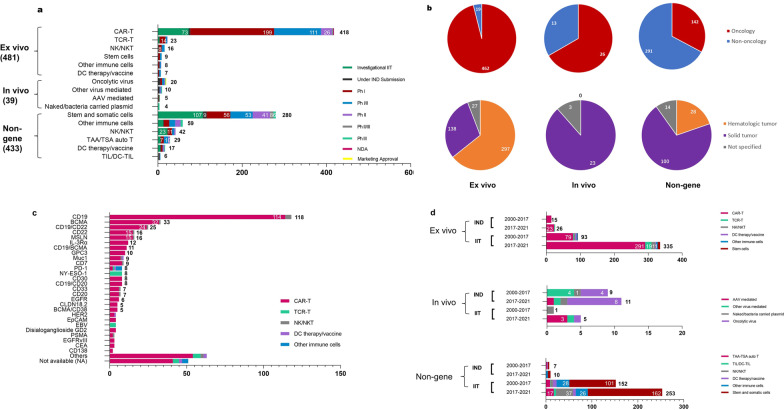
The booming of gene and cell therapy (GCT) worldwide in recent years has been observed, especially in the field of cancers. In order to provide the comprehensive GCT landscape in China with a focus on differential development pathways under the current dual-track regulation mode, we analyzed 953 clinical trials initiated by March 2021 including Investigational New Drugs (IND) registered trials and investigator-initiated trials (IITs). We classified GCT products into three categories and analyzed the clinical development by phases and regulation tracks, disease areas, indications, and targets. We found that CAR-T therapies from ex vivo category and stem and somatic cells from non-gene category are two most studied therapy types and GCT mostly focused on cancers. The number of IITs far exceeded IND-registered trials except for in vivo category. After 2017, when the cell therapy guideline issued, products of all categories boomed, especially the ex vivo categories. These data showed that current dual regulation tracks in China complemented each other and together facilitated the GCT development, especially after 2017. More consistent technical standards and risk-based regulation will help bring more GCT products to patients.
近年来,全球基因和细胞治疗(GCT)蓬勃发展,尤其是在癌症领域。为了全面展示中国 GCT 的发展现状,重点介绍当前双轨制监管模式下的差异化发展路径,我们分析了截至 2021 年 3 月启动的 953 项临床试验,包括新药临床试验(IND)注册试验和研究者发起的试验(IIT)。我们将 GCT 产品分为三类,按阶段和监管轨道、疾病领域、适应症和靶点进行临床开发分析。结果发现,体外 CAR-T 疗法和非基因来源的干细胞和体细胞是研究最多的两种治疗类型,GCT 主要集中在癌症领域。除了体内类别外,IIT 数量远远超过 IND 注册试验。2017 年细胞治疗指导原则发布后,所有类别的产品都出现了繁荣,尤其是体外类别。这些数据表明,中国当前的双轨制监管模式相互补充,共同促进了 GCT 的发展,尤其是 2017 年之后。更一致的技术标准和基于风险的监管将有助于将更多的 GCT 产品带给患者。