Vanke School of Public Health, Tsinghua University, Beijing, China.
Department of Pharmacy, Peking University People's Hospital, Beijing, China.
J Hematol Oncol. 2024 Oct 14;17(1):96. doi: 10.1186/s13045-024-01616-8.
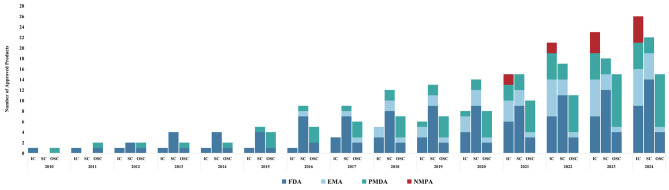
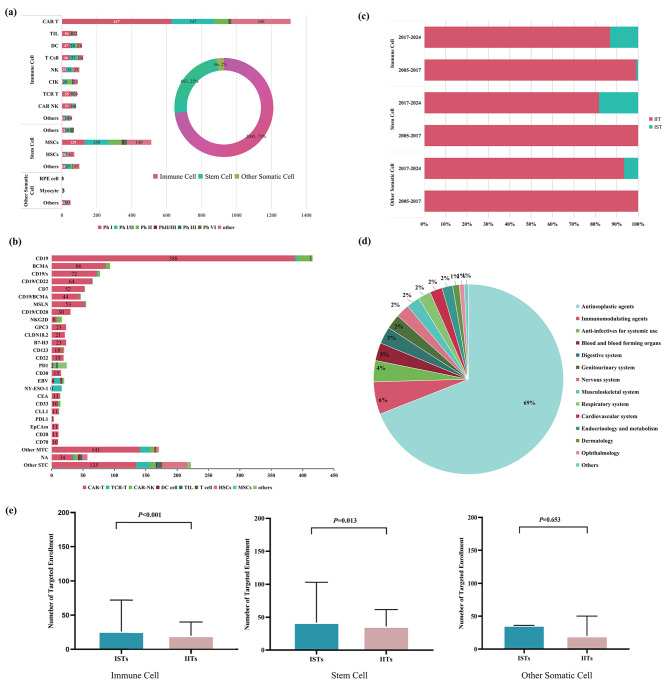
In recent years, cell therapy research and commercialization have significantly accelerated, especially after the US FDA approved CAR-T therapy. While cell therapy now leads immuno-oncology in clinical trials, challenges such as redundant R&D, target clustering, and unmet clinical need remain. Since 2017, China has established a dual-track regulatory framework, facilitating rapid growth in its cell therapy pipeline, making it the second largest in the world. Despite this progress, China faces similar global challenges. Our study covers 2,794 registered cell therapy clinical trials in China, including 2,045 for immune cell, 683 for stem cell, and 66 for other somatic cell. It compares cell therapy products approved in China, the US, EU, and Japan, analyzes the evolving clinical trials landscape, and highlights the characteristics of investigator-initiated trials (IITs) and industry-sponsored trials (ISTs) in China. Our findings indicate that despite the high disease burden and unmet clinical needs for solid tumors in China, over 38% of trials between 2021 and 2023 focused on hematologic malignancies with established targets like CD19 and BCMA. Over 90% of trials are IITs, which show notable clinical differences from ISTs. We recommend that Chinese regulators establish specific guidelines to promote clinical-value-driven research. Stricter regulatory standards should also be implemented to minimize redundant R&D. Additionally, a value-based reimbursement system for within-class targeted cell therapy products may further reduce duplicated R&D efforts. Given the prevalence of IITs, specifying requirements for IITs could create a new pathway to accelerate product development and better address unmet clinical needs in China.
近年来,细胞治疗的研究和商业化进程显著加快,尤其是在美国 FDA 批准 CAR-T 疗法之后。虽然细胞治疗目前在临床试验中引领免疫肿瘤学,但仍存在研发重复、靶点集中和临床需求未得到满足等挑战。自 2017 年以来,中国建立了双轨监管框架,促进了细胞治疗管线的快速增长,使其成为世界上第二大细胞治疗管线。尽管取得了这些进展,中国仍面临着类似的全球挑战。我们的研究涵盖了中国 2794 项注册的细胞治疗临床试验,包括 2045 项免疫细胞、683 项干细胞和 66 项其他体细胞。我们比较了中国、美国、欧盟和日本批准的细胞治疗产品,分析了不断发展的临床试验格局,并强调了中国研究者发起的试验(IITs)和工业赞助的试验(ISTs)的特点。我们的研究结果表明,尽管中国实体瘤的疾病负担高,临床需求未得到满足,但在 2021 年至 2023 年期间,超过 38%的试验集中在血液恶性肿瘤上,这些恶性肿瘤有明确的靶点,如 CD19 和 BCMA。超过 90%的试验是 IITs,它们与 ISTs 存在显著的临床差异。我们建议中国监管机构制定具体的指南,以促进以临床价值为导向的研究。还应实施更严格的监管标准,以最大限度地减少重复研发。此外,针对同类靶向细胞治疗产品的基于价值的报销制度可能会进一步减少重复研发工作。鉴于 IITs 的普遍性,为 IITs 制定要求可能会为加速产品开发和更好地满足中国的临床需求开辟新途径。