AlEidan Fahad A S, AlManea Reem K, AlMoneef Alyah T, Shalash Nada A, AlRajhi Norah A, AlMousa Sarah F, Al Raizah Abdulrahman, Abuelgasim Khadega A
King Abdulaziz Medical City, Ministry of National Guard Health Affairs, Riyadh, Saudi Arabia.
College of Medicine, King Saud bin Abdulaziz University for Health Sciences, Riyadh, Saudi Arabia.
Int J Gen Med. 2022 Sep 28;15:7559-7568. doi: 10.2147/IJGM.S359893. eCollection 2022.
Little is written about recurrence and mortality rates after a first episode of venous thromboembolism (VTE) among Saudi population.
Determine incidence rates and assess predictors of recurrence and mortality following the first VTE event.
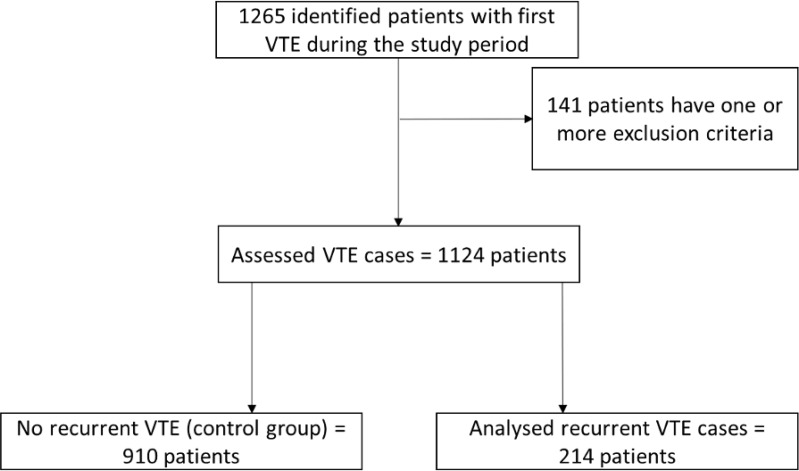
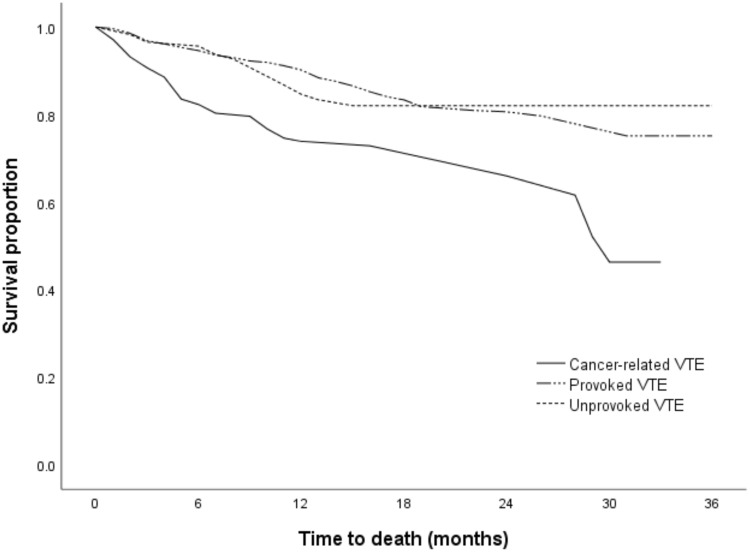
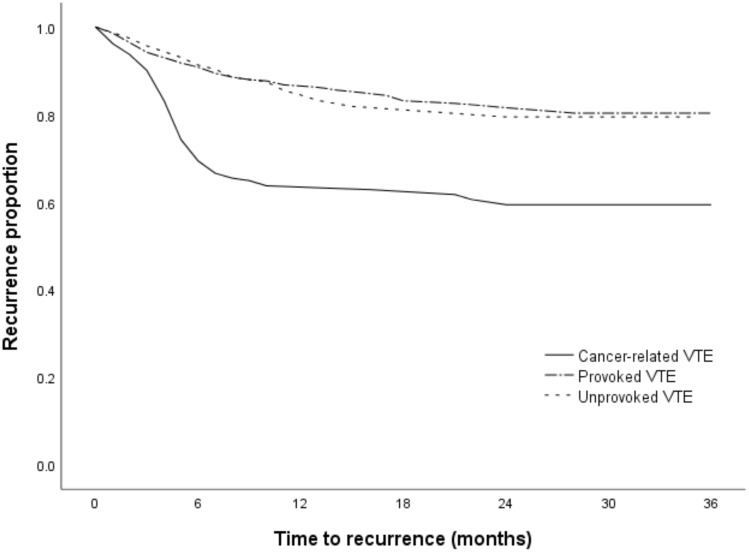
A total of 1124 patients aged ≥18 years with symptomatic VTE confirmed by imaging tests were evaluated. The incidence of VTE recurrence and mortality were assessed. The association between patient characteristics, and VTE recurrence and mortality was explored by estimating the hazard ratio (HR) and 95% confidence interval (CI). The difference between cancer-related, provoked and unprovoked VTE in terms of recurrence and mortality was explored using Kaplan-Meier curves.
The annual incidence rate of the first VTE was 1.7 per 1000 patients. Of 1124 patients with first VTE, 214 (19%) developed recurrent VTE, and 192 (17%) died with overall incidence rates of 15.8 per 100 person-years (95% CI, 13.8-18.0) and 10.0 per 100 person-years (95% CI, 8.7-11.5). Intensive care unit (ICU) admission (HR, 2.15; 95% CI, 1.67-3.10), presence of active cancer (HR, 2.97; 95% CI, 1.87-3.95), immobilization (HR, 2.52; 95% CI, 1.79-3.67), infection (HR, 2.32; 95% CI, 1.94-3.45), and pulmonary embolism ± deep venous thrombosis (HR, 2.22; 95% CI, 1.56-3.16) were found to be independent predictors of recurrent VTE. Recurrence carries a high hazard of mortality (HR, 5.21; 95% CI, 3.61-7.51). The estimated median time to VTE recurrence was lower in cancer-related VTE (18.7 months) compared with provoked (29.0 months) and unprovoked VTE (28.4 months). The estimated survival median time was lower in cancer-related VTE (21.8 months) compared with provoked (30.5 months) and unprovoked VTE (29.8 months).
Immobilization and presence of active cancer, infection, and PE ± DVT were significant predictors of recurrent VTE. Patients who developed recurrent VTE had a 5.2-fold higher hazard of mortality compared with patients with no VTE recurrence.
关于沙特人群首次发生静脉血栓栓塞症(VTE)后的复发率和死亡率的文献报道较少。
确定首次VTE事件后的发病率,并评估复发和死亡的预测因素。
对1124例年龄≥18岁、经影像学检查确诊为有症状VTE的患者进行评估。评估VTE复发率和死亡率。通过估计风险比(HR)和95%置信区间(CI),探讨患者特征与VTE复发和死亡率之间的关联。使用Kaplan-Meier曲线探讨癌症相关、诱发和非诱发VTE在复发和死亡率方面的差异。
首次VTE的年发病率为每1000例患者1.7例。在1124例首次发生VTE的患者中,214例(19%)发生了复发性VTE,192例(17%)死亡,总发病率分别为每100人年15.8例(95%CI,13.8 - 18.0)和每100人年10.0例(95%CI,8.7 - 11.5)。入住重症监护病房(ICU)(HR,2.15;95%CI,1.67 - 3.10)、存在活动性癌症(HR,2.97;95%CI,1.87 - 3.95)、制动(HR,2.52;95%CI,1.79 - 3.67)、感染(HR,2.32;95%CI,1.94 - 3.45)以及肺栓塞±深静脉血栓形成(HR,2.22;95%CI,1.56 - 3.16)被发现是复发性VTE的独立预测因素。复发具有较高的死亡风险(HR,5.21;95%CI,3.61 - 7.51)。与诱发VTE(29.0个月)和非诱发VTE(28.4个月)相比,癌症相关VTE的VTE复发估计中位时间较低(18.7个月)。与诱发VTE(30.5个月)和非诱发VTE(29.8个月)相比,癌症相关VTE的估计生存中位时间较低(21.8个月)。
制动、存在活动性癌症、感染以及肺栓塞±深静脉血栓形成是复发性VTE的重要预测因素。发生复发性VTE的患者的死亡风险是未发生VTE复发患者的5.2倍。