Division of Pulmonary and Critical Care Medicine, Department of Medicine, The Johns Hopkins University School of Medicine, Baltimore, Maryland.
Department of Neurosurgery, The Johns Hopkins University School of Medicine, Baltimore, Maryland.
J Appl Physiol (1985). 2022 Dec 1;133(6):1284-1294. doi: 10.1152/japplphysiol.00386.2022. Epub 2022 Oct 6.
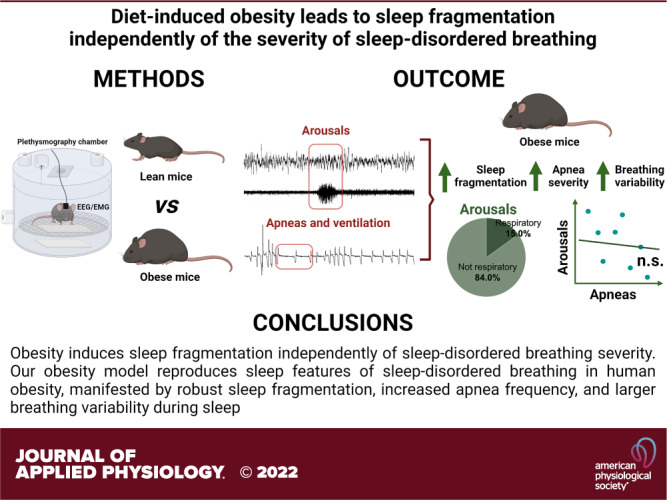
Obesity is associated with sleep-disordered breathing (SDB) and unrefreshing sleep. Residual daytime sleepiness and sleep impairments often persist after SDB treatment in patients with obesity, which suggests an independent effect of obesity on breathing and sleep. However, examining the relationship between sleep architecture and SDB in patients with obesity is complex and can be confounded by multiple factors. The main goal of this study was to examine the relationship between obesity-related changes in sleep architecture and SDB. Sleep recordings were performed in 15 lean C57BL/6J and 17 diet-induced obesity (DIO) mice of the same genetic background. Arousals from sleep and apneas were manually scored. Respiratory arousals were classified as events associated with ≥30% drops in minute ventilation (V) from baseline. We applied Poincaré analysis of V during sleep to estimate breathing variability. Obesity augmented the frequency of arousals by 45% and this increase was independent of apneas. Respiratory arousals comprised only 15% of the arousals in both groups of mice. Breathing variability during non-rapid-eye-movment (NREM) sleep was significantly higher in DIO mice, but it was not associated with arousal frequency. Our results suggest that obesity induces sleep fragmentation independently of SDB severity. Our diet-induced obesity (DIO) model reproduces sleep features of human obesity, including sleep fragmentation, increased apnea frequency, and larger breathing variability. DIO induces sleep fragmentation independently of apnea severity. Sleep fragmentation in DIO mice is mainly attributed to non-respiratory arousals. Increased breathing variability during sleep did not account for the higher arousal frequency in DIO. Our results provide a rationale to examine sleep in patients with obesity even when they are adequately treated for sleep-disordered breathing.
肥胖与睡眠呼吸紊乱(SDB)和睡眠质量差有关。肥胖患者的 SDB 治疗后,白天仍存在嗜睡和睡眠障碍,这表明肥胖对呼吸和睡眠有独立的影响。然而,检查肥胖患者睡眠结构与 SDB 之间的关系是复杂的,可能受到多种因素的影响。本研究的主要目的是检查肥胖相关睡眠结构变化与 SDB 之间的关系。在相同遗传背景下,对 15 只瘦 C57BL/6J 和 17 只饮食诱导肥胖(DIO)小鼠进行睡眠记录。手动评分睡眠中的觉醒和呼吸暂停。呼吸觉醒被分类为与基线时分钟通气量(V)下降≥30%相关的事件。我们应用睡眠时 V 的 Poincaré 分析来估计呼吸变异性。肥胖使觉醒频率增加了 45%,这种增加与呼吸暂停无关。在两组小鼠中,呼吸觉醒仅占觉醒的 15%。DIO 小鼠的非快速眼动(NREM)睡眠期间的呼吸变异性显著升高,但与觉醒频率无关。我们的研究结果表明,肥胖独立于 SDB 严重程度引起睡眠碎片化。我们的饮食诱导肥胖(DIO)模型再现了人类肥胖的睡眠特征,包括睡眠碎片化、呼吸暂停频率增加和呼吸变异性增大。DIO 独立于呼吸暂停严重程度引起睡眠碎片化。DIO 小鼠的睡眠碎片化主要归因于非呼吸觉醒。睡眠时呼吸变异性增加并不能解释 DIO 中更高的觉醒频率。我们的研究结果为即使肥胖患者的睡眠呼吸障碍得到充分治疗,也需要检查其睡眠情况提供了依据。