Department of Conservation Ecology and Entomology, Faculty of AgriSciences, University of Stellenbosch, Stellenbosch, South Africa.
Department of Animal Sciences, Faculty of AgriSciences, University of Stellenbosch, Stellenbosch, South Africa.
Sci Rep. 2022 Oct 6;12(1):16768. doi: 10.1038/s41598-022-20920-2.
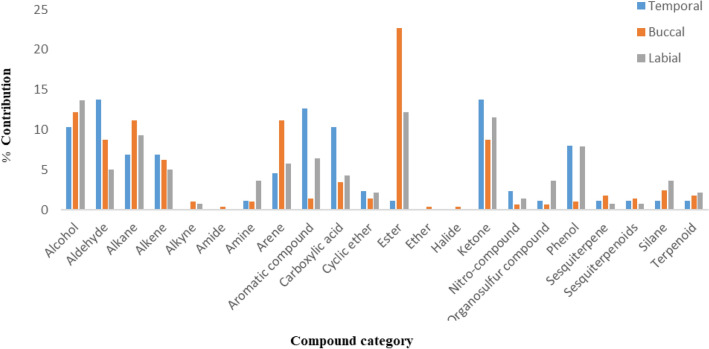
Group-living animals that live in complex social systems require effective modes of communication to maintain social cohesion, and several acoustic, olfactory and visual signaling systems have been described. Individuals need to discriminate between in- and out-group odour to both avoid inbreeding and to identify recipients for reciprocal behaviour. The presence of a unique group odour, identified in several social mammals, is a proposed mechanism whereby conspecifics can distinguish group from non-group members. African elephants (Loxodonta africana) live in stable, socially complex, multi-female, fission-fusion groups, characterized by female philopatry, male dispersal and linear dominance hierarchies. Elephant social behaviour suggests that individuals use odour to monitor the sex, reproductive status, location, health, identity and social status of conspecifics. To date, it is not clear what fixed or variable information is contained in African elephant secretions, and whether odour encodes kinship or group membership information. Here we use SPME GC-MS generated semiochemical profiles for temporal, buccal and genital secretions for 113 wild African elephants and test their relationship with measures of genetic relatedness. Our results reveal the existence of individual identity odour profiles in African elephants as well as a signature for age encoded in temporal gland and buccal secretions. Olfactory signatures for genetic relatedness were found in labial secretions of adult sisters. While group odour was not correlated with group genetic relatedness, our analysis identified "group membership" as a significant factor explaining chemical differences between social groups. Saturated and short-chain fatty acids (SCFAs), derived from key volatile compounds from bacterial fermentation, were identified in temporal, buccal and genital secretions suggesting that group odour in African elephants may be the result of bacterial elements of the gut microbiome. The frequent affiliative behavior of African elephants is posited as a likely mechanism for bacterial transmission. Our findings favour flexible group-specific bacterial odours, which have already been proposed for other social mammals and present a useful form of olfactory communication that promotes bond group cohesion among non-relatives in fission-fusion mammals.
群居动物生活在复杂的社会系统中,需要有效的交流方式来维持社会凝聚力,已经描述了几种声学、嗅觉和视觉信号系统。个体需要区分内外群体的气味,既要避免近亲繁殖,又要识别互惠行为的接受者。在几种社会性哺乳动物中发现的独特群体气味的存在,是一种假设的机制,通过这种机制,同种个体可以区分群体和非群体成员。非洲象(Loxodonta africana)生活在稳定的、社会结构复杂的、多雌性的、分裂融合的群体中,其特征是雌性亲缘关系、雄性扩散和线性优势等级。大象的社会行为表明,个体利用气味来监测同种个体的性别、繁殖状况、位置、健康、身份和社会地位。到目前为止,还不清楚非洲象分泌物中包含哪些固定或可变的信息,以及气味是否编码亲缘关系或群体成员信息。在这里,我们使用 SPME GC-MS 生成的 113 头野生非洲象的瞬态、口腔和生殖器分泌物的半化学特征图谱,并测试它们与遗传相关性测量值的关系。我们的结果表明,非洲象存在个体身份气味特征,并且在瞬态腺和口腔分泌物中存在年龄编码的特征。在成年姐妹的唇部分泌物中发现了与遗传相关性相关的嗅觉特征。虽然群体气味与群体遗传相关性没有相关性,但我们的分析确定了“群体成员身份”是解释社会群体之间化学差异的一个重要因素。在瞬态、口腔和生殖器分泌物中发现了来自细菌发酵的关键挥发性化合物的饱和和短链脂肪酸(SCFA),这表明非洲象的群体气味可能是肠道微生物组中细菌成分的结果。非洲象频繁的亲昵行为被认为是细菌传播的一种可能机制。我们的研究结果支持灵活的群体特异性细菌气味,这已经在其他社会性哺乳动物中提出,并提供了一种有用的嗅觉交流形式,促进了非亲属在分裂融合哺乳动物中的群体凝聚力。