Delpeuch Pauline, Jabbour Florian, Damerval Catherine, Schönenberger Jürg, Pamperl Susanne, Rome Maxime, Nadot Sophie
Université Paris-Saclay, CNRS, AgroParisTech, Ecologie Systématique et Evolution, Orsay, France.
Institut de Systématique, Evolution, Biodiversité (ISYEB), Muséum National d'Histoire Naturelle, CNRS, Sorbonne Université, EPHE, Université des Antilles, Paris, France.
Front Plant Sci. 2022 Sep 21;13:961906. doi: 10.3389/fpls.2022.961906. eCollection 2022.
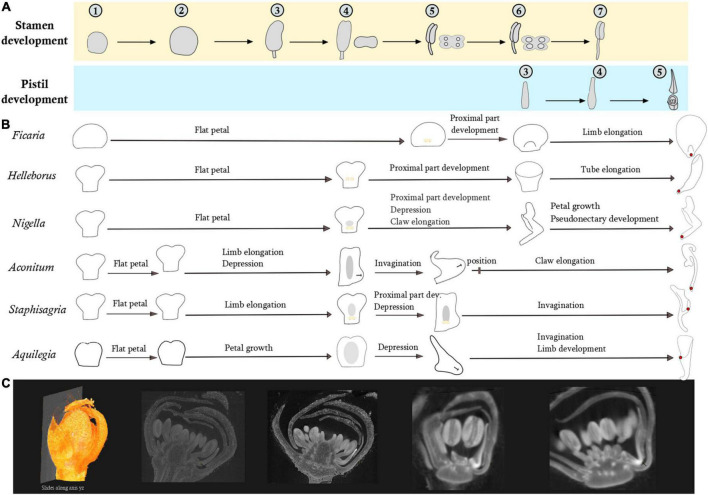
Ranunculaceae comprise 2,500 species ( 55 genera) that display a broad range of floral diversity, particularly at the level of the perianth. Petals, when present, are often referred to as "elaborate" because they have a complex morphology. In addition, the petals usually produce and store nectar, which gives them a crucial functional role in the interaction with pollinators. Its morphological diversity and species richness make this family a particularly suitable model group for studying the evolution of complex morphologies. Our aims are (1) to reconstruct the ancestral form of the petal and evolutionary stages at the scale of Ranunculaceae, (2) to test the hypothesis that there are morphogenetic regions on the petal that are common to all species and that interspecific morphological diversity may be due to differences in the relative proportions of these regions during development. We scored and analyzed traits (descriptors) that characterize in detail the complexity of mature petal morphology in 32 genera. Furthermore, we described petal development using high resolution X-Ray computed tomography (HRX-CT) in six species with contrasting petal forms (). Ancestral state reconstruction was performed using a robust and dated phylogeny of the family, allowing us to produce new hypotheses for petal evolution in Ranunculaceae. Our results suggest a flat ancestral petal with a short claw for the entire family and for the ancestors of all tribes except Adonideae. The elaborate petals that are present in different lineages have evolved independently, and similar morphologies are the result of convergent evolution.
毛茛科包含2500个物种(55个属),展现出广泛的花部多样性,尤其是在花被片层面。花瓣若存在,通常被称为“精致的”,因为它们具有复杂的形态。此外,花瓣通常分泌并储存花蜜,这使其在与传粉者的相互作用中发挥关键的功能作用。其形态多样性和物种丰富度使该科成为研究复杂形态演化的特别合适的模式类群。我们的目标是:(1)在毛茛科的尺度上重建花瓣的祖先形态和演化阶段;(2)检验如下假说,即花瓣上存在所有物种共有的形态发生区域,种间形态多样性可能是由于这些区域在发育过程中相对比例的差异所致。我们对32个属中详细表征成熟花瓣形态复杂性的性状(描述符)进行了评分和分析。此外,我们使用高分辨率X射线计算机断层扫描(HRX - CT)描述了6种具有不同花瓣形态的物种的花瓣发育情况。利用该科可靠且标定了时间的系统发育树进行祖先状态重建,使我们能够提出毛茛科花瓣演化的新假说。我们的结果表明,除了银莲花亚科外,整个毛茛科及其所有部落的祖先花瓣是扁平的,具短爪。不同谱系中出现的精致花瓣是独立演化而来的,相似的形态是趋同演化的结果。