Sapochnik Daiana, Raimondi Ana R, Medina Victoria, Naipauer Julian, Mesri Enrique A, Coso Omar
CONICET-Universidad de Buenos Aires, Instituto de Fisiología, Biología Molecular y Neurociencias (IFIBYNE), Buenos Aires, Argentina.
Departamento de Fisiología, Biología Molecular y Celular, Universidad de Buenos Aires, Facultad de Ciencias Exactas y Naturales, Buenos Aires, Argentina.
Front Oncol. 2022 Sep 21;12:890825. doi: 10.3389/fonc.2022.890825. eCollection 2022.
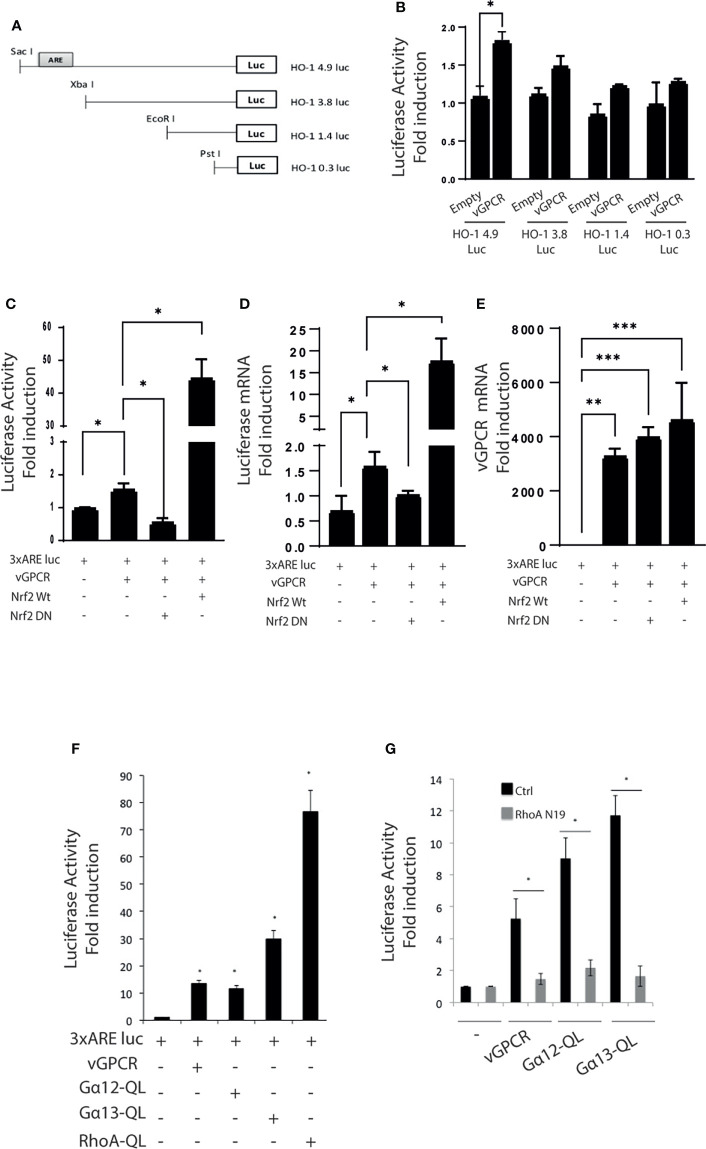
Kaposi's sarcoma (KS) is the most common tumor in AIDS patients. The highly vascularized patient's skin lesions are composed of cells derived from the endothelial tissue transformed by the KSHV virus. Heme oxygenase-1 (HO-1) is an enzyme upregulated by the Kaposi´s sarcoma-associated herpesvirus (KSHV) and highly expressed in human Kaposi Sarcoma (KS) lesions. The oncogenic G protein-coupled receptor (KSHV-GPCR or vGPCR) is expressed by the viral genome in infected cells. It is involved in KS development, HO-1 expression, and vascular endothelial growth factor (VEGF) expression. vGPCR induces HO-1 expression and HO-1 dependent transformation through the Ga13 subunit of heterotrimeric G proteins and the small GTPase RhoA. We have found several lines of evidence supporting a role for Nrf2 transcription factors and family members in the vGPCR-Ga13-RhoA signaling pathway that converges on the HO-1 gene promoter. Our current information assigns a major role to ERK1/2MAPK pathways as intermediates in signaling from vGPCR to Nrf2, influencing Nrf2 translocation to the cell nucleus, Nrf2 transactivation activity, and consequently HO-1 expression. Experiments in nude mice show that the tumorigenic effect of vGPCR is dependent on Nrf2. In the context of a complete KSHV genome, we show that the lack of vGPCR increased cytoplasmic localization of Nrf2 correlated with a downregulation of HO-1 expression. Moreover, we also found an increase in phospho-Nrf2 nuclear localization in mouse KS-like KSHV (positive) tumors compared to KSHV (negative) mouse KS-like tumors. Our data highlights the fundamental role of Nrf2 linking vGPCR signaling to the HO-1 promoter, acting upon not only HO-1 gene expression regulation but also in the tumorigenesis induced by vGPCR. Overall, these data pinpoint this transcription factor or its associated proteins as putative pharmacological or therapeutic targets in KS.
卡波西肉瘤(KS)是艾滋病患者中最常见的肿瘤。患者高度血管化的皮肤病变由源自被卡波西肉瘤相关疱疹病毒(KSHV)转化的内皮组织的细胞组成。血红素加氧酶-1(HO-1)是一种由卡波西肉瘤相关疱疹病毒(KSHV)上调并在人类卡波西肉瘤(KS)病变中高表达的酶。致癌性G蛋白偶联受体(KSHV-GPCR或vGPCR)由病毒基因组在受感染细胞中表达。它参与KS的发展、HO-1的表达以及血管内皮生长因子(VEGF)的表达。vGPCR通过异三聚体G蛋白的Ga13亚基和小GTP酶RhoA诱导HO-1表达和HO-1依赖性转化。我们已经发现了几条证据支持Nrf2转录因子及其家族成员在汇聚于HO-1基因启动子的vGPCR-Ga13-RhoA信号通路中发挥作用。我们目前的信息表明ERK1/2 MAPK通路作为从vGPCR到Nrf2信号传导的中间体发挥主要作用,影响Nrf2向细胞核的转位、Nrf2的反式激活活性以及因此的HO-1表达。裸鼠实验表明vGPCR的致瘤作用依赖于Nrf2。在完整KSHV基因组的背景下,我们表明vGPCR的缺失增加了Nrf2的细胞质定位,这与HO-1表达的下调相关。此外,我们还发现与KSHV(阴性)小鼠KS样肿瘤相比,在小鼠KS样KSHV(阳性)肿瘤中磷酸化Nrf2的核定位增加。我们的数据突出了Nrf2将vGPCR信号传导与HO-1启动子联系起来的基本作用,不仅作用于HO-1基因表达调控,还作用于vGPCR诱导的肿瘤发生。总体而言,这些数据指出该转录因子或其相关蛋白是KS中假定的药理学或治疗靶点。