Somnuke Pawit, Limprapassorn Peleen, Srinonprasert Varalak, Wongviriyawong Titima, Suraarunsumrit Patumporn, Morkphrom Ekkaphop, Sura-Amonrattana Unchana, Phannarus Harisd, Choorerk Duangcheewan, Radtke Finn M, Chaiwat Onuma
Department of Anesthesiology, Faculty of Medicine Siriraj Hospital, Mahidol University, Bangkok, Thailand.
Division of Geriatric Medicine, Department of Medicine, Faculty of Medicine Siriraj Hospital, Mahidol University, Bangkok, Thailand.
Front Med (Lausanne). 2022 Sep 23;9:956435. doi: 10.3389/fmed.2022.956435. eCollection 2022.
The Nursing Delirium Screening Scale (Nu-DESC) is an effective instrument for assessing postoperative delirium (POD). This study translated the Nu-DESC into Thai ("Nu-DESC-Thai"), validated it, and compared its accuracy with the Diagnostic and Statistical Manual of Mental Disorders-5 (DSM-5).
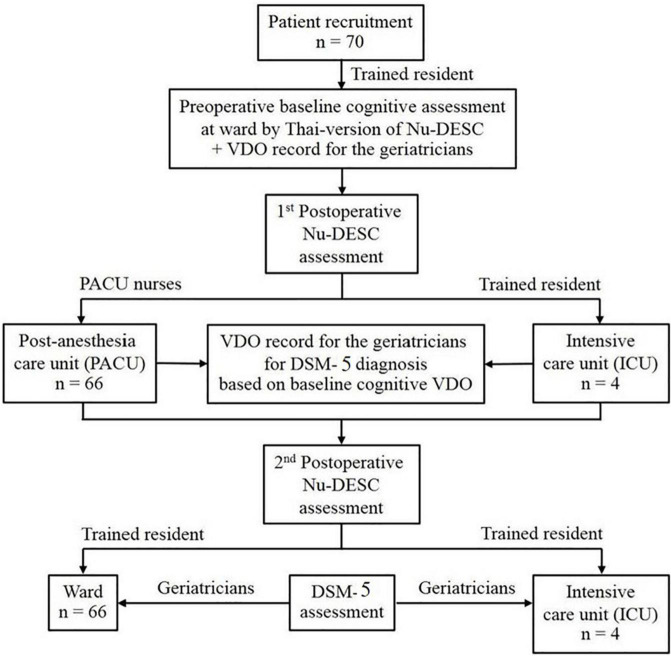
The translation process followed the International Society for Pharmacoeconomics Outcome Research guidelines. Recruited participants were ≥ 70 years old, fluent in Thai, and scheduled for surgery. The exclusion criteria were cancellation or postponement of an operation, severe visual or auditory impairment, and patients with a Richmond Agitation Sedation Scale score of -4 or less before delirium assessment. Post-anesthesia care unit (PACU) nurses and residents on wards each used the Nu-DESC to assess delirium in 70 participants (i.e., 140 assessments) after the operation and after patient arrival at wards, respectively. Geriatricians confirmed the diagnoses using video observations and direct patient contact.
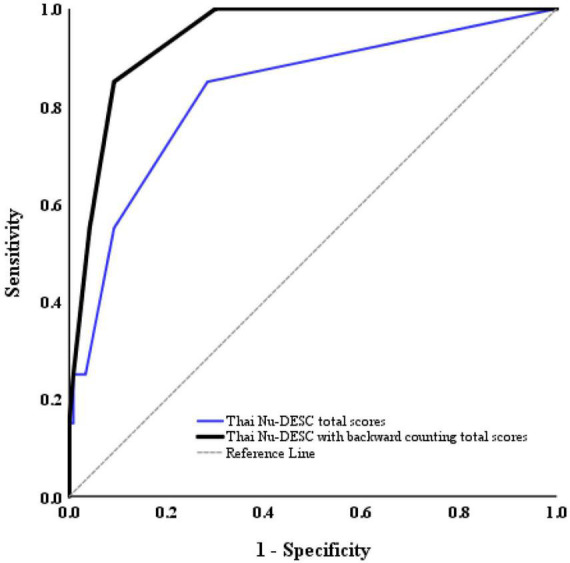
The participants' mean age was 76.5 ± 4.6 years. The sensitivity and specificity of the Nu-DESC-Thai at a threshold of ≥ 2 were 55% (95% CI, 31.5-76.9%) and 90.8% (84.2-95.3%), respectively, with an area under a receiver operating characteristic curve (AUC) of 0.73. At a threshold of ≥ 1, the sensitivity and specificity were 85% (62.1-96.8%) and 71.7% (62.7-79.5%), respectively (AUC, 0.78). Adding 1 point for failing backward-digit counting (30-1) to the Nu-DESC-Thai and screening at a threshold of ≥ 2 increased its sensitivity to 85% (62.1-96.8%) with the same specificity of 90.8% (84.2-95.3%).
The Nu-DESC-Thai showed good validity and reliability for postoperative use. Its sensitivity was inadequate at a cutoff ≥ 2. However, the sensitivity improved when the threshold was ≥ 1 or with the addition of backward counting to Nu-DESC-Thai and screening at a threshold of ≥ 2.
护理谵妄筛查量表(Nu-DESC)是评估术后谵妄(POD)的有效工具。本研究将Nu-DESC翻译成泰语(“Nu-DESC-泰语”),对其进行验证,并将其准确性与《精神疾病诊断与统计手册》第5版(DSM-5)进行比较。
翻译过程遵循国际药物经济学与结果研究学会的指南。招募的参与者年龄≥70岁,泰语流利,且计划接受手术。排除标准为手术取消或推迟、严重视力或听力障碍,以及在谵妄评估前Richmond躁动镇静量表评分为-4或更低的患者。麻醉后护理单元(PACU)的护士和病房的住院医师分别在术后和患者到达病房后使用Nu-DESC对70名参与者进行谵妄评估(即140次评估)。老年病科医生通过视频观察和直接接触患者来确诊。
参与者的平均年龄为76.5±4.6岁。Nu-DESC-泰语在阈值≥2时的敏感性和特异性分别为55%(95%CI,31.5-76.9%)和90.8%(84.2-95.3%),受试者工作特征曲线(AUC)下面积为0.73。在阈值≥1时,敏感性和特异性分别为85%(62.1-96.8%)和71.7%(62.7-79.5%)(AUC,0.78)。在Nu-DESC-泰语中加入1分用于倒序数字计数失败(30-1)并在阈值≥2时进行筛查,可将其敏感性提高到85%(62.1-96.8%),特异性保持在90.8%(84.2-95.3%)不变。
Nu-DESC-泰语在术后使用时显示出良好的有效性和可靠性。在截断值≥2时其敏感性不足。然而,当阈值≥1或在Nu-DESC-泰语中加入倒序计数并在阈值≥2时进行筛查时,敏感性得到改善。