Thoracic Oncology Unit, Department of Medical Oncology and Molecular Immunology Unit, Department of Research; Fondazione IRCCS Istituto Nazionale dei Tumori, Milan, Italy.
Tumor Genomics Unit, Department of Research, Fondazione IRCCS Istituto Nazionale dei Tumori, Milan, Italy.
J Exp Med. 2022 Dec 5;219(12). doi: 10.1084/jem.20221449. Epub 2022 Oct 10.
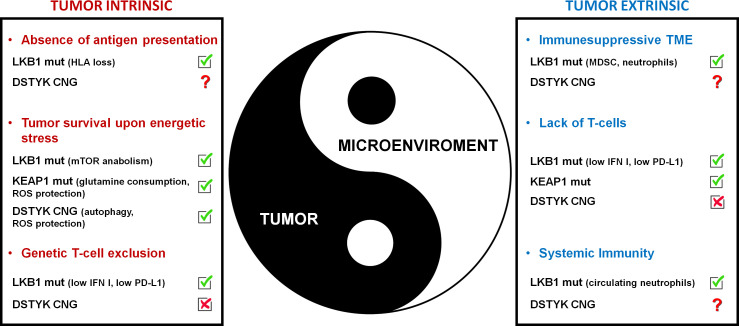
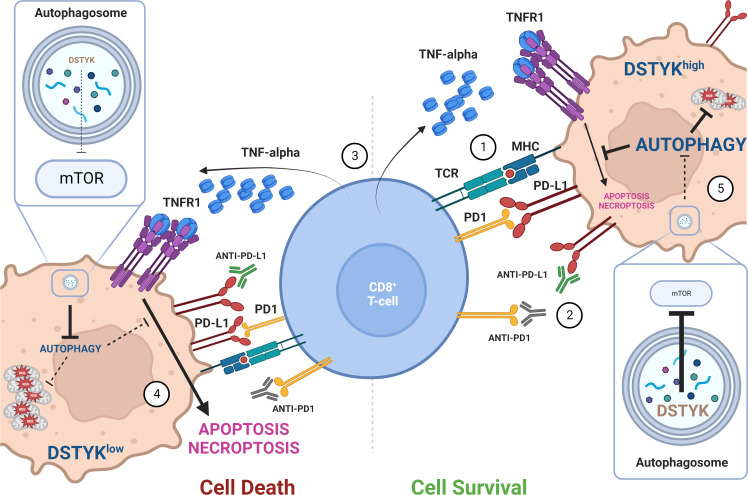
Despite evidence for clinical benefit in patients suffering from lung cancer following treatment with immune checkpoint inhibitors (ICI), it is still uncertain how to predict which patients are likely to experience a significant response. In their work, Valencia et al. (2022. J. Exp. Med.https://doi.org/10.1084/jem.20220726) identify the DSTYK kinase as a cancer cell-intrinsic modulator of response to immunotherapy. Through regulation of the mTOR pathway and stimulation of protective autophagy, DSTYK blunts CD8+ T cell-mediated killing of cancer cells. Accordingly, lung cancers with increased expression of DSTYK are less responsive to ICI treatment. These observations could be useful in the clinic towards the development of predictive biomarkers and novel therapeutic strategies.
尽管免疫检查点抑制剂(ICI)治疗肺癌患者具有临床获益的证据,但仍不确定如何预测哪些患者可能会有显著的反应。在他们的工作中,Valencia 等人(2022. J. Exp. Med. https://doi.org/10.1084/jem.20220726)确定 DSTYK 激酶是对免疫疗法反应的肿瘤细胞内在调节剂。通过调节 mTOR 途径和刺激保护性自噬,DSTYK 削弱了 CD8+T 细胞介导的癌细胞杀伤。因此,表达 DSTYK 增加的肺癌对 ICI 治疗的反应性较低。这些观察结果在临床上可能有助于开发预测生物标志物和新的治疗策略。