Zheng Shuai, Wang Fumin, Cheng Linggang, Li Rui, Zhang Dong, He Wen, Zhang Wei
Department of Ultrasound, Beijing Tiantan Hospital, Capital Medical University, No. 119, West Road of South Fourth Ring, Fengtai District, Beijing, 100070, People's Republic of China.
Department of Ultrasound, Peking University First Hospital, No. 8, Xishiku street, Xicheng District, Beijing, 100034, People's Republic of China.
Chin Neurosurg J. 2022 Oct 11;8(1):32. doi: 10.1186/s41016-022-00300-5.
Moyamoya disease can lead to stroke with devastating consequences, it is necessary to find a non-invasive and effective approach to identify the occurrence of stroke. In this study, we aim to analyze the association between ultrasound parameters and ipsilateral cerebral hemisphere stroke in patients with moyamoya disease by logistic regression analysis.
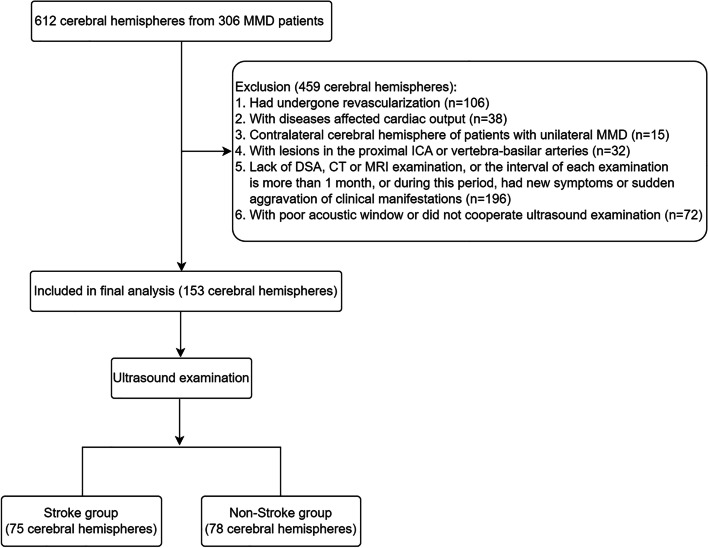
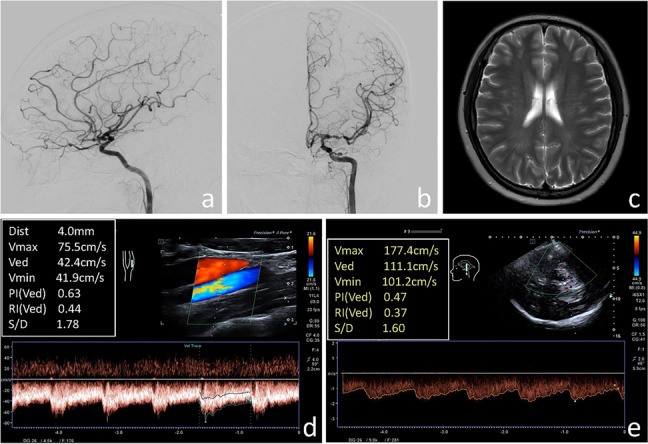
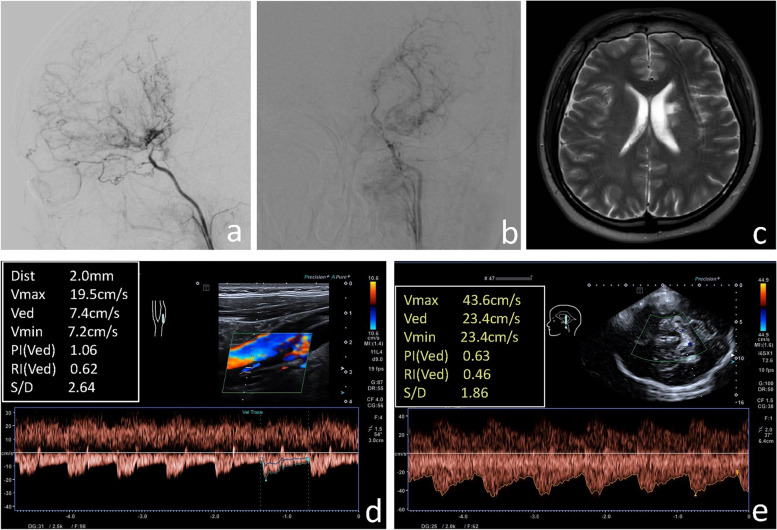
In this retrospective case-control study, 88 patients with MMD (153 cerebral hemispheres) hospitalized in Beijing Tiantan Hospital, Capital Medical University from November 2020 to October 2021 were analyzed. According to the occurrence of stroke, the 153 cerebral hemispheres were divided into a stroke group and a non-stroke group. Clinical data and ultrasound parameters of the ipsilateral internal carotid artery, superficial temporal artery, maxillary artery, and posterior cerebral artery were recorded. The ultrasound parameters were divided into four groups according to interquartile range, and then they were compared between the stroke group and the non-stroke group. Those with significant differences were scored by multivariate logistic regression analysis.
There were 75 cerebral hemispheres (49.0%) in the stroke group and 78 cerebral hemispheres (51.0%) in the non-stroke group. Logistic regression analysis showed that the internal diameter of the internal carotid artery, peak systolic velocity of the internal carotid artery and peak systolic velocity of the posterior cerebral artery were independently correlated factors for stroke in patients with MMD. The fourth quartile group of the above three ultrasound parameters was taken as the reference group, and the odds ratio of the first quartile group were 11.679 (95% CI 2.918-46.749, P = 0.001), 19.594 (95% CI 4.973-77.193, P < 0.001), and 11.657 (95% CI 3.221-42.186, P < 0.001), respectively.
Ultrasound parameters are independently correlated with ipsilateral cerebral stroke in patients with MMD. Ultrasound provides a new way to identify stroke in MMD patients. Future prospective cohort studies are needed to verify the clinical value of ultrasound in identifying patients with MMD at high risk of stroke.
烟雾病可导致具有毁灭性后果的中风,因此有必要找到一种非侵入性且有效的方法来识别中风的发生。在本研究中,我们旨在通过逻辑回归分析来分析烟雾病患者超声参数与同侧脑半球中风之间的关联。
在这项回顾性病例对照研究中,分析了2020年11月至2021年10月在北京天坛医院住院的88例烟雾病患者(153个脑半球)。根据中风的发生情况,将这153个脑半球分为中风组和非中风组。记录同侧颈内动脉、颞浅动脉、上颌动脉和大脑后动脉的临床资料和超声参数。超声参数根据四分位数间距分为四组,然后在中风组和非中风组之间进行比较。对有显著差异的参数进行多因素逻辑回归分析评分。
中风组有75个脑半球(49.0%),非中风组有78个脑半球(51.0%)。逻辑回归分析表明,颈内动脉内径、颈内动脉收缩期峰值流速和大脑后动脉收缩期峰值流速是烟雾病患者中风的独立相关因素。以上述三个超声参数的第四四分位数组作为参照组,第一四分位数组的比值比分别为11.679(95%CI 2.918 - 46.749,P = 0.001)、19.594(95%CI 4.973 - 77.193,P < 0.001)和11.657(95%CI 3.221 - 42.186,P < 0.001)。
超声参数与烟雾病患者同侧脑中风独立相关。超声为识别烟雾病患者的中风提供了一种新方法。未来需要进行前瞻性队列研究来验证超声在识别有中风高风险的烟雾病患者中的临床价值。