Department of Neurosurgery, University Medical Center Mainz, Langenbeckstr. 1, 55131, Mainz, Germany.
Neurosurg Rev. 2022 Dec;45(6):3647-3655. doi: 10.1007/s10143-022-01874-5. Epub 2022 Oct 12.
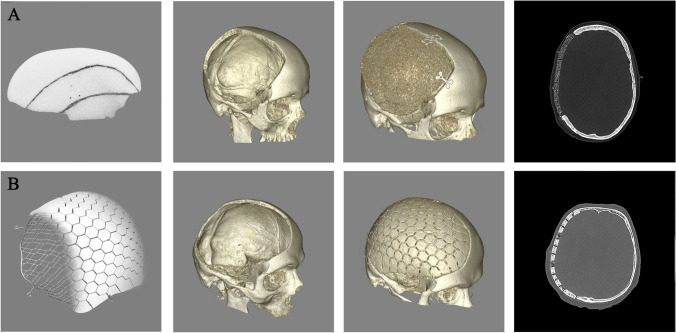
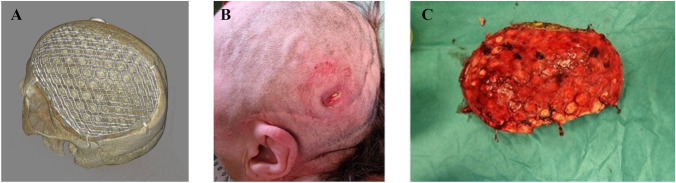
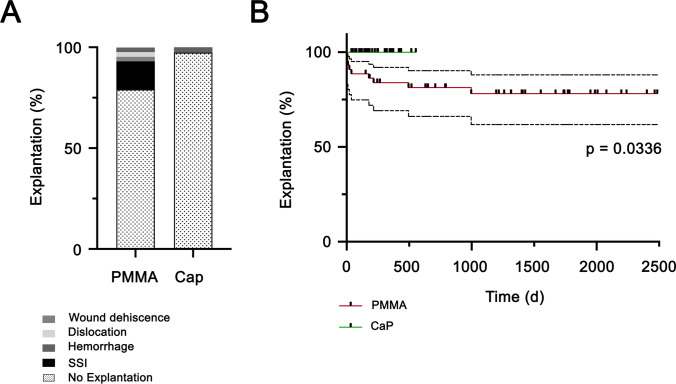
Numerous materials of implants used for cranioplasty after decompressive craniectomy (DC) have been investigated to meet certain demanded key features, such as stability, applicability, and biocompatibility. We aimed to evaluate the feasibility and safety of biocompatible calcium-phosphate (CaP) implants for cranioplasty compared to polymethylmethacrylate (PMMA) implants. In this retrospective observational cohort study, the medical records of all patients who underwent cranioplasty between January 1st, 2015, and January 1st, 2022, were reviewed. Demographic, clinical, and diagnostic data were collected. Eighty-two consecutive patients with a mean age of 52 years (range 22-72 years) who received either a PMMA (43/82; 52.4%) or CaP (39/82; 47.6%) cranial implant after DC were included in the study. Indications for DC were equally distributed in both groups. Time from DC to cranioplasty was 143.8 ± 17.5 days (PMMA) versus 98.5 ± 10.4 days (CaP). The mean follow-up period was 34.9 ± 27.1 months. Postoperative complications occurred in 13 patients with PMMA and 6 in those with CaP implants (13/43 [30.2%] vs. 6/39 [15.4%]; p = 0.115). Revision surgery with implant removal was necessary for 9 PMMA patients and in 1 with a CaP implant (9/43 [20.9%] vs. 1/39 [2.6%]; p = 0.0336); 6 PMMA implants were removed due to surgical site infection (SSI) (PMMA 6/43 [14%] vs. CaP 0/39 [0%]; p = 0.012). In this study, a biocompatible CaP implant seems to be superior to a PMMA implant in terms of SSI and postoperative complications. The absence of SSI supports the idea of the biocompatible implant material with its ability for osseointegration.
大量用于去骨瓣减压术后颅骨修补术 (DC) 的植入物材料已被研究,以满足某些特定的关键特性,如稳定性、适用性和生物相容性。我们旨在评估生物相容性钙磷 (CaP) 植入物与聚甲基丙烯酸甲酯 (PMMA) 植入物相比用于颅骨修补术的可行性和安全性。在这项回顾性观察队列研究中,回顾了 2015 年 1 月 1 日至 2022 年 1 月 1 日期间接受颅骨修补术的所有患者的病历。收集了人口统计学、临床和诊断数据。纳入了 82 例连续患者,平均年龄 52 岁(22-72 岁),其中 43 例(52.4%)接受 PMMA 颅骨植入物,39 例(47.6%)接受 CaP 颅骨植入物。两组的 DC 指征分布均等。从 DC 到颅骨修补术的时间为 143.8 ± 17.5 天(PMMA)和 98.5 ± 10.4 天(CaP)。平均随访时间为 34.9 ± 27.1 个月。术后并发症发生在 13 例 PMMA 患者和 6 例 CaP 植入物患者中(13/43 [30.2%] vs. 6/39 [15.4%];p=0.115)。9 例 PMMA 患者和 1 例 CaP 植入物患者需要进行翻修手术并取出植入物(9/43 [20.9%] vs. 1/39 [2.6%];p=0.0336);6 例 PMMA 植入物因手术部位感染 (SSI) 而取出(PMMA 6/43 [14%] vs. CaP 0/39 [0%];p=0.012)。在这项研究中,与 PMMA 植入物相比,生物相容性 CaP 植入物在 SSI 和术后并发症方面似乎具有优势。没有 SSI 支持具有骨整合能力的生物相容性植入物材料的想法。