Wassink Lydia, Huerta Belinda, Larson Doug, Li Weiming, Scribner Kim
Department of Integrative Biology, Michigan State University, 288 Farm Lane, East Lansing MI 48824, USA.
Department of Fisheries and Wildlife, Michigan State University, 480 Wilson Road, East Lansing MI 48824, USA.
Conserv Physiol. 2022 Oct 7;10(1):coac062. doi: 10.1093/conphys/coac062. eCollection 2022.
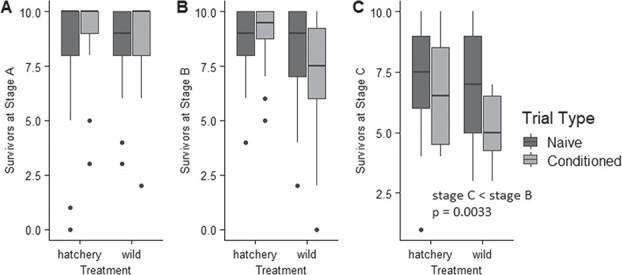
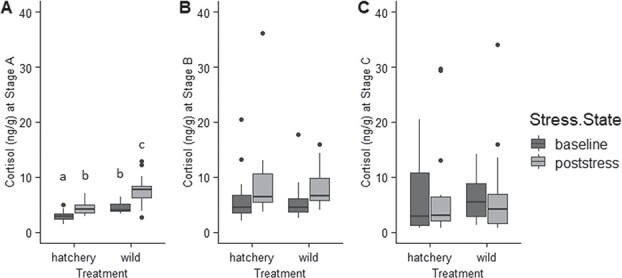
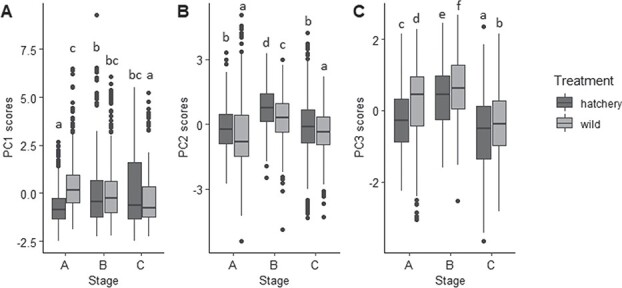
Reintroduction programs are important tools for wildlife conservation. However, captive rearing environments may lead to maladaptive behavior and physiological alterations that reduce survival probability after release. For captive rearing programs that raise individuals captured from the wild during early ontogeny for later release, there is a lack of information about when during ontogeny the detrimental effects of captive rearing may become evident. In this study we compared cortisol levels, predation rates and swimming behavior between hatchery-produced and wild-caught larval lake sturgeon (), a threatened fish species, at three times over 9 days. Cortisol levels did not indicate that hatchery-produced individuals were more stressed, but cortisol reactivity to an acute stressor disappeared for both hatchery-produced and wild-caught larvae after 9 days in the hatchery. Swimming activity levels decreased over time for hatchery-produced larvae but increased over time for wild-caught larvae, suggesting that behavioral trajectories may be programmed prior to the larval stage. Neither increasing nor decreasing activity levels was advantageous for survival, as predation rates increased over time in captivity for larvae from both treatments. Results suggest that physiological and behavioral phenotypes may not accurately predict survival for individuals released from reintroduction programs and that the captive environment may inhibit transition to the wild even if cortisol levels do not indicate high stress. Findings emphasize that even a short amount of time in captivity during early ontogeny can affect phenotypes of individuals captured from wild populations, which may impact the success of reintroduction programs.
重新引入计划是野生动物保护的重要工具。然而,圈养环境可能导致适应不良行为和生理改变,从而降低放归后的生存概率。对于那些在个体发育早期从野外捕获个体进行圈养,随后放归的圈养计划而言,目前缺乏关于在个体发育的哪个阶段圈养的有害影响可能变得明显的信息。在本研究中,我们在9天内分三次比较了人工孵化的和野生捕获的湖鲟幼鱼(一种受威胁的鱼类)的皮质醇水平、被捕食率和游泳行为。皮质醇水平并未表明人工孵化的个体压力更大,但在孵化场饲养9天后,人工孵化的和野生捕获的幼鱼对急性应激源的皮质醇反应性均消失了。人工孵化的幼鱼游泳活动水平随时间下降,而野生捕获的幼鱼游泳活动水平随时间上升,这表明行为轨迹可能在幼体阶段之前就已被设定。活动水平的增加或减少对生存都没有好处,因为两种处理方式下的幼鱼在圈养环境中的被捕食率都随时间增加。结果表明,生理和行为表型可能无法准确预测重新引入计划中放归个体的生存情况,并且即使皮质醇水平未表明高压力,圈养环境也可能抑制向野外环境的过渡。研究结果强调,即使在个体发育早期在圈养环境中待很短时间,也会影响从野生种群捕获个体的表型,这可能会影响重新引入计划的成功。