Song Sang-Hoon, Jang Won-Jun, Jang Eun Young, Kim Oc-Hee, Kim Haesoo, Son Taekwon, Choi Dong-Young, Lee Sooyeun, Jeong Chul-Ho
College of Pharmacy, Keimyung University, Daegu, South Korea.
Pharmacology and Drug Abuse Research Group, Korea Institute of Toxicology, Daejeon, South Korea.
Front Pharmacol. 2022 Sep 26;13:997701. doi: 10.3389/fphar.2022.997701. eCollection 2022.
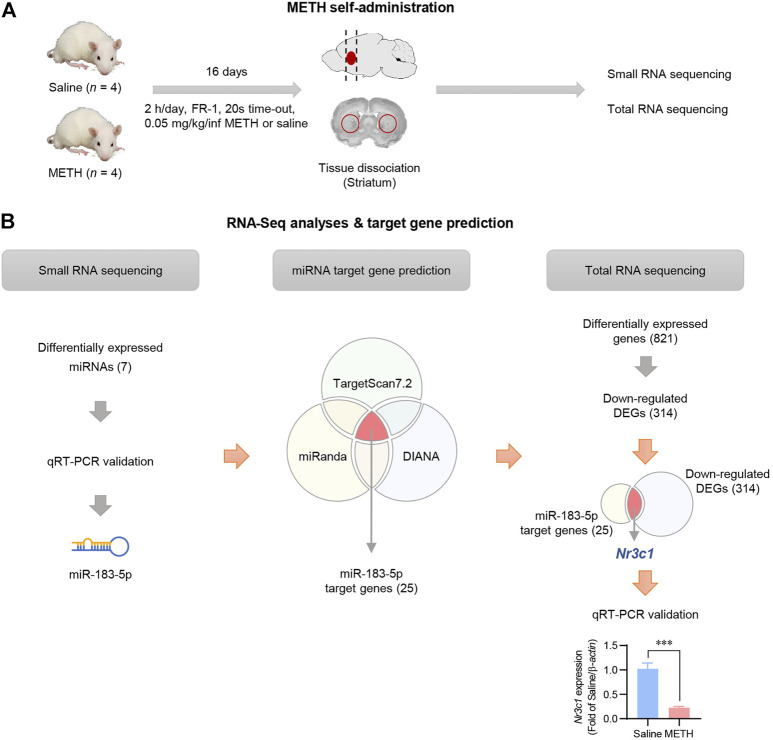
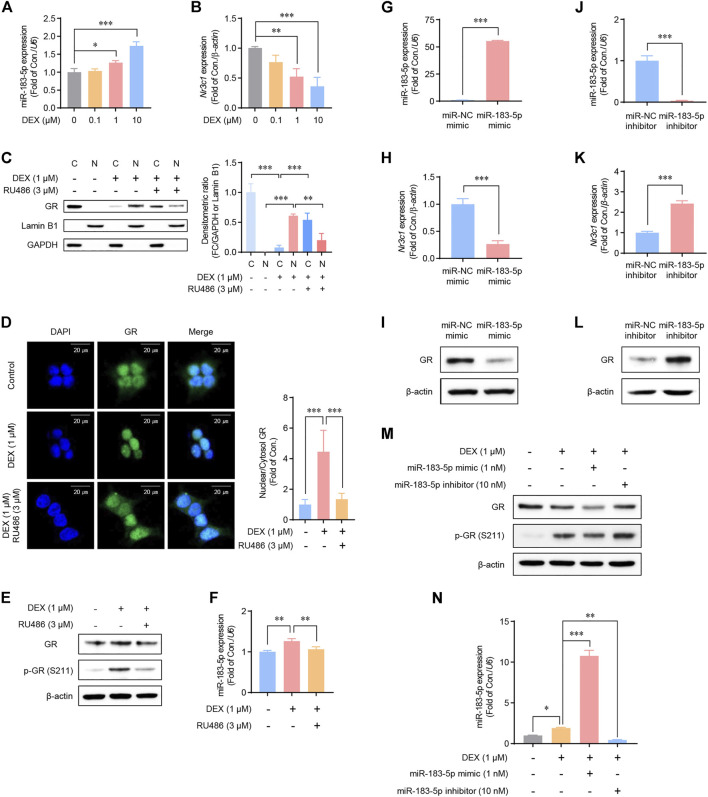
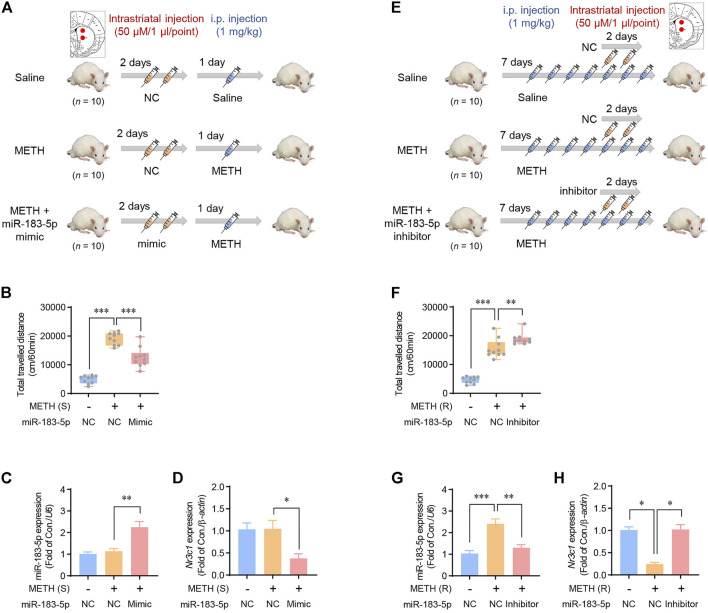
MicroRNA (miRNA)-mediated striatal gene regulation may play an important role in methamphetamine (METH) addiction. This study aimed to identify changes in novel miRNAs and their target genes during METH self-administration and investigate their roles in METH-induced locomotion. RNA sequencing analysis revealed that mir-183-5p was upregulated in the striatum of METH self-administered rats, and target gene prediction revealed that the glucocorticoid receptor (GR) gene, , was a potential target gene for mir-183-5p. We confirmed that single and repeated METH administrations increased METH-induced locomotion and plasma corticosterone levels in rats. Additionally, increased miR-185-5p expression and decreased GR gene expression were observed only in the repeated-METH-injection group but not in the single-injection group. We then investigated the effects of miR-183-5p on METH-induced locomotion using a miR-183-5p mimic and inhibitor. Injection of a mir-183-5p mimic in the striatum of rats attenuated METH-induced locomotion, whereas injection of a miR-183-5p inhibitor enhanced the locomotor activity in METH-administered rats. Furthermore, the miR-183-5p mimic reduced the phosphorylation of tyrosine hydroxylase (TH) whereas the inhibitor increased it. Taken together, these results indicate that repeated METH injections increase striatal miR-183-5p expression and regulate METH-induced locomotion by regulating GR expression in rats, thereby suggesting a potential role of miR-183-5p as a novel regulator of METH-induced locomotion.
微小RNA(miRNA)介导的纹状体基因调控可能在甲基苯丙胺(METH)成瘾中起重要作用。本研究旨在确定METH自我给药过程中新型miRNA及其靶基因的变化,并研究它们在METH诱导的运动中的作用。RNA测序分析显示,mir-183-5p在METH自我给药大鼠的纹状体中上调,靶基因预测显示糖皮质激素受体(GR)基因是mir-183-5p的潜在靶基因。我们证实,单次和重复给予METH可增加大鼠METH诱导的运动和血浆皮质酮水平。此外,仅在重复给予METH的注射组中观察到miR-185-5p表达增加和GR基因表达降低,而在单次注射组中未观察到。然后,我们使用miR-183-5p模拟物和抑制剂研究了miR-183-5p对METH诱导的运动的影响。在大鼠纹状体中注射mir-183-5p模拟物可减弱METH诱导的运动,而注射miR-183-5p抑制剂可增强METH给药大鼠的运动活性。此外,miR-183-5p模拟物降低了酪氨酸羟化酶(TH)的磷酸化,而抑制剂则增加了其磷酸化。综上所述,这些结果表明,重复注射METH可增加大鼠纹状体中miR-183-5p的表达,并通过调节GR表达来调节METH诱导的运动,从而提示miR-183-5p作为METH诱导运动的新型调节因子的潜在作用。