Ventorp Filip, Lindahl Jesper, van Westen Danielle, Jensen Jimmy, Björkstrand Johannes, Lindqvist Daniel
Department of Clinical Sciences Lund, Psychiatry, Faculty of Medicine Lund University Lund Sweden.
Office for Psychiatry and Habilitation, Psychiatric Clinic Lund Lund Sweden.
Psychiatr Res Clin Pract. 2022 Apr 30;4(2):42-47. doi: 10.1176/appi.prcp.20210042. eCollection 2022 Summer.
To investigate feasibility and target engagement of high-dose, add-on pramipexole treatment in anhedonic depression.
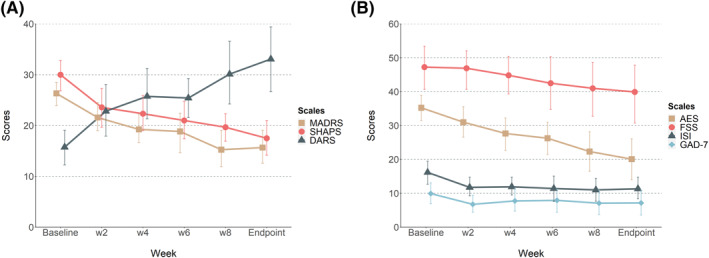
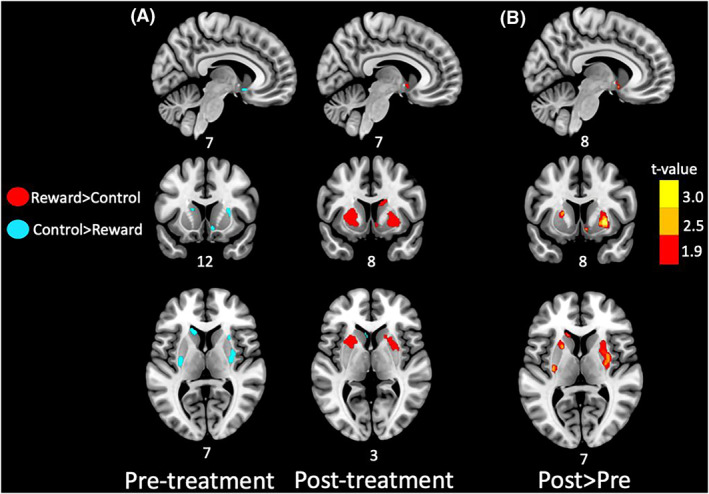
In this open-label pilot study, we included 12 patients with unipolar or bipolar, moderate-to-severe depression and with significant anhedonia symptoms. All patients were on a stable dose of one or a combination of antidepressants and/or mood stabilizers and received 10 weeks of adjunctive pramipexole titrated to a maximum dose of 4.5 mg salt/day. All patients were rated with the Dimensional Anhedonia Rating Scale (DARS), the Montgomery Åsberg Depression Rating (MADRS) and the Snaith Hamilton Pleasure Scale (SHAPS). Serum high-sensitivity C-reactive protein (hs-CRP) was analyzed pre- and post-treatment. Eight patients underwent fMRI pre- and post-treatment and a simplified version of the monetary incentive delay task was used to investigate the effect of treatment on striatal activity during reward anticipation.
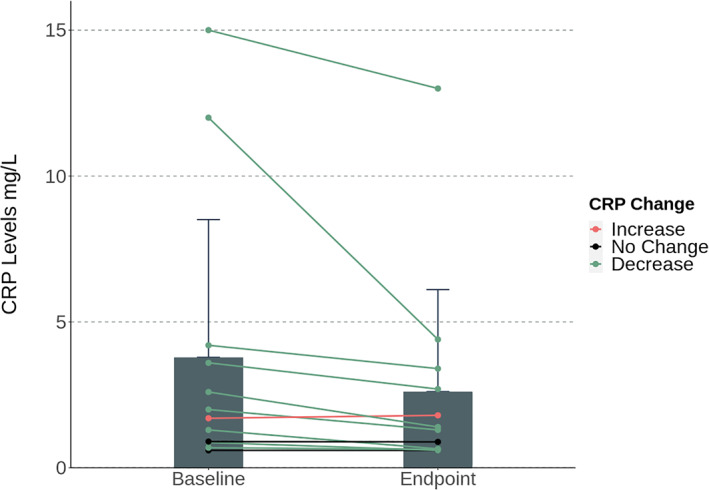
DARS, MADRS and SHAPS scores all improved significantly over 10 weeks of pramipexole treatment (<0.01). Mean levels of hs-CRP decreased significantly over the course of treatment from mean 3.8 mg/L at baseline to 2.6 mg/L at endpoint (<0.01). There were significant treatment-associated increases in reward related activity in several brain areas including the right lateral putamen, anterior left caudate, left posterior putamen, right dorsal caudate, left anterior putamen, and the right nucleus accumbens.
This is the first study to suggest efficacy and target engagement of pramipexole in anhedonic depression. Larger randomized controlled trials are needed to confirm or refute these preliminary findings.
研究高剂量附加普拉克索治疗快感缺失性抑郁症的可行性及靶点参与情况。
在这项开放标签的试点研究中,我们纳入了12例患有单相或双相、中度至重度抑郁症且有明显快感缺失症状的患者。所有患者均服用稳定剂量的一种或多种抗抑郁药和/或心境稳定剂,并接受为期10周的附加普拉克索治疗,滴定至最大剂量4.5毫克盐/天。所有患者均采用维度快感缺失评定量表(DARS)、蒙哥马利-Åsberg抑郁评定量表(MADRS)和斯奈斯-汉密尔顿愉悦量表(SHAPS)进行评定。治疗前后分析血清高敏C反应蛋白(hs-CRP)。8例患者在治疗前后接受功能磁共振成像(fMRI)检查,并使用简化版的金钱激励延迟任务来研究治疗对奖励预期期间纹状体活动的影响。
在普拉克索治疗的10周内,DARS、MADRS和SHAPS评分均显著改善(<0.01)。hs-CRP的平均水平在治疗过程中显著下降,从基线时的平均3.8毫克/升降至终点时的2.6毫克/升(<0.01)。在包括右侧壳核、左侧尾状核前部、左侧壳核后部、右侧背侧尾状核、左侧壳核前部和右侧伏隔核在内的几个脑区,与奖励相关的活动出现了与治疗相关的显著增加。
这是第一项表明普拉克索在快感缺失性抑郁症中具有疗效和靶点参与情况的研究。需要更大规模的随机对照试验来证实或反驳这些初步发现。