Department of Mathematics and Information Technology, The Education University of Hong Kong, Hong Kong SAR, China.
Faculty of Education, The University of Hong Kong, Hong Kong SAR, China.
BMC Med Educ. 2022 Oct 13;22(1):720. doi: 10.1186/s12909-022-03782-0.
During the COVID-19 pandemic, some instructors transitioned their courses into a fully online environment by adopting flipped learning. In this context, this review examined the challenges to fully online flipped learning and identified useful course-design elements for practicing this instructional approach in health professions education.
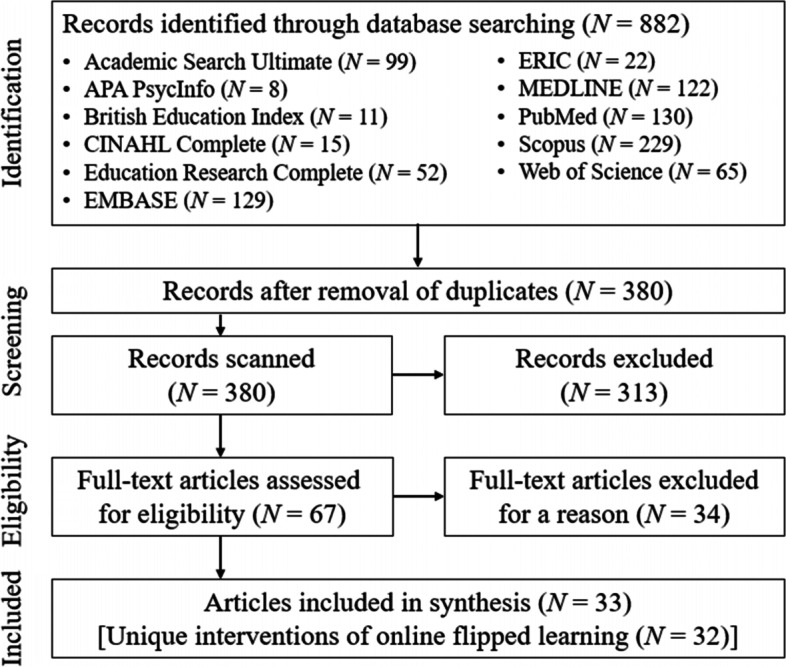
We followed the Preferred Reporting Items for Systematic Reviews and Meta-Analysis (PRISMA) statement for selecting relevant articles. Thirty-three empirical studies (with 32 unique interventions) published between 2020 and 2021 (i.e., the first 2 years of the pandemic) were selected for analysis.
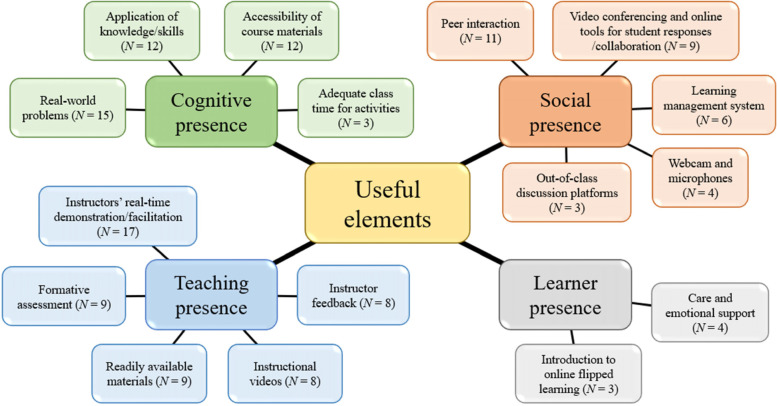
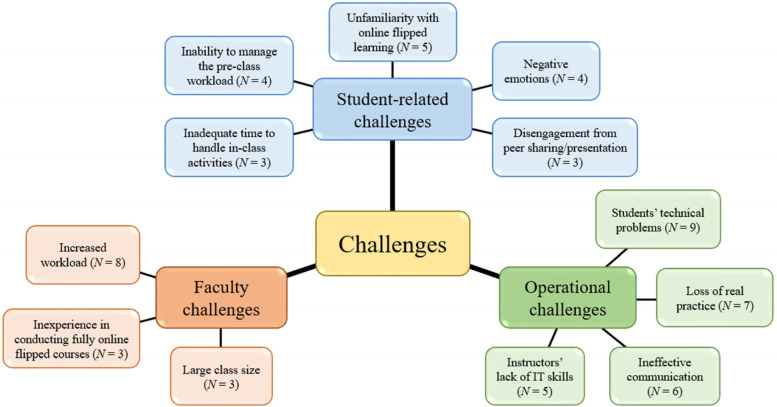
When the instructors in the reviewed studies designed and implemented their online flipped courses, numerous challenges emerged, which could be broadly categorized into student-related challenges (e.g., unfamiliarity with online flipped learning; N = 5), faculty challenges (e.g., increased workload; N = 8), and operational challenges (e.g., students' technical problems; N = 9). Nevertheless, we identified various useful elements for online flipped learning practice and organized them based on the following components of the Revised Community of Inquiry (RCoI) framework: cognitive presence (e.g., application of knowledge/skills; N = 12), social presence (e.g., peer interaction; N = 11), teaching presence (e.g., instructors' real-time demonstration/facilitation; N = 17), and learner presence (e.g., care and emotional support; N = 4).
Based on the findings from the review and the RCoI framework, we developed nine principles for the effective practice of online flipped learning. These principles appear crucial for sustaining quality health professions education in a fully online flipped learning environment.
在 COVID-19 大流行期间,一些教师通过采用翻转学习将课程完全转移到在线环境中。在这种背景下,本综述考察了完全在线翻转学习所面临的挑战,并确定了在健康专业教育中实践这种教学方法的有用课程设计要素。
我们按照系统评价和荟萃分析的首选报告项目 (PRISMA) 声明选择相关文章。选择了 2020 年至 2021 年(即大流行的头 2 年)发表的 33 项实证研究(具有 32 项独特干预措施)进行分析。
在对研究中教师设计和实施在线翻转课程时,出现了许多挑战,可以大致分为学生相关挑战(例如,对在线翻转学习不熟悉;N=5)、教师挑战(例如,工作量增加;N=8)和运营挑战(例如,学生的技术问题;N=9)。尽管如此,我们确定了在线翻转学习实践的各种有用要素,并根据修订后的社区调查(RCoI)框架的以下组成部分对其进行了组织:认知存在(例如,知识/技能的应用;N=12)、社会存在(例如,同伴互动;N=11)、教学存在(例如,教师的实时演示/促进;N=17)和学习者存在(例如,关怀和情感支持;N=4)。
根据综述和 RCoI 框架的发现,我们制定了在线翻转学习有效实践的九条原则。这些原则对于在完全在线翻转学习环境中维持高质量的健康专业教育似乎至关重要。