
机械化学合成法制备的CuFeS/TiO纳米复合材料的性能
Properties of CuFeS/TiO Nanocomposite Prepared by Mechanochemical Synthesis.
作者信息
Dutkova Erika, Baláž Matej, Daneu Nina, Tatykayev Batukhan, Karakirova Yordanka, Velinov Nikolay, Kostova Nina, Briančin Jaroslav, Baláž Peter
机构信息
Department of Mechanochemistry, Institute of Geotechnics, Slovak Academy of Sciences, Watsonova 45, 04001 Košice, Slovakia.
Advanced Materials Department, Jožef Stefan Institute, 1000 Ljubljana, Slovenia.
出版信息
Materials (Basel). 2022 Oct 5;15(19):6913. doi: 10.3390/ma15196913.
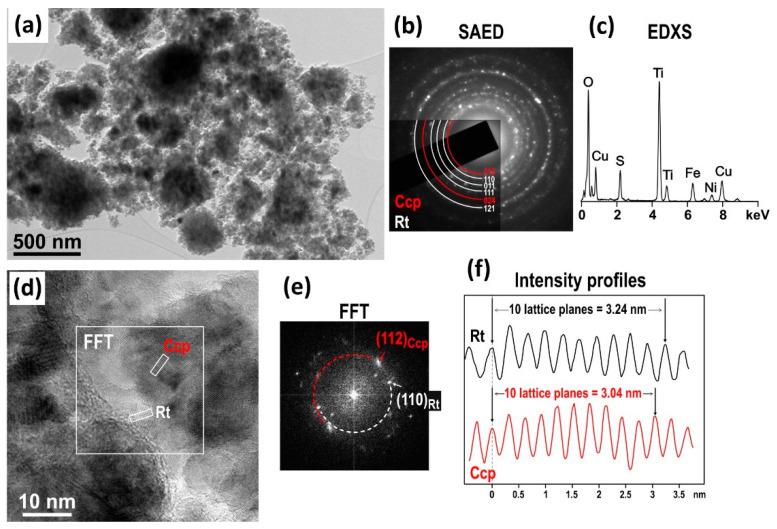
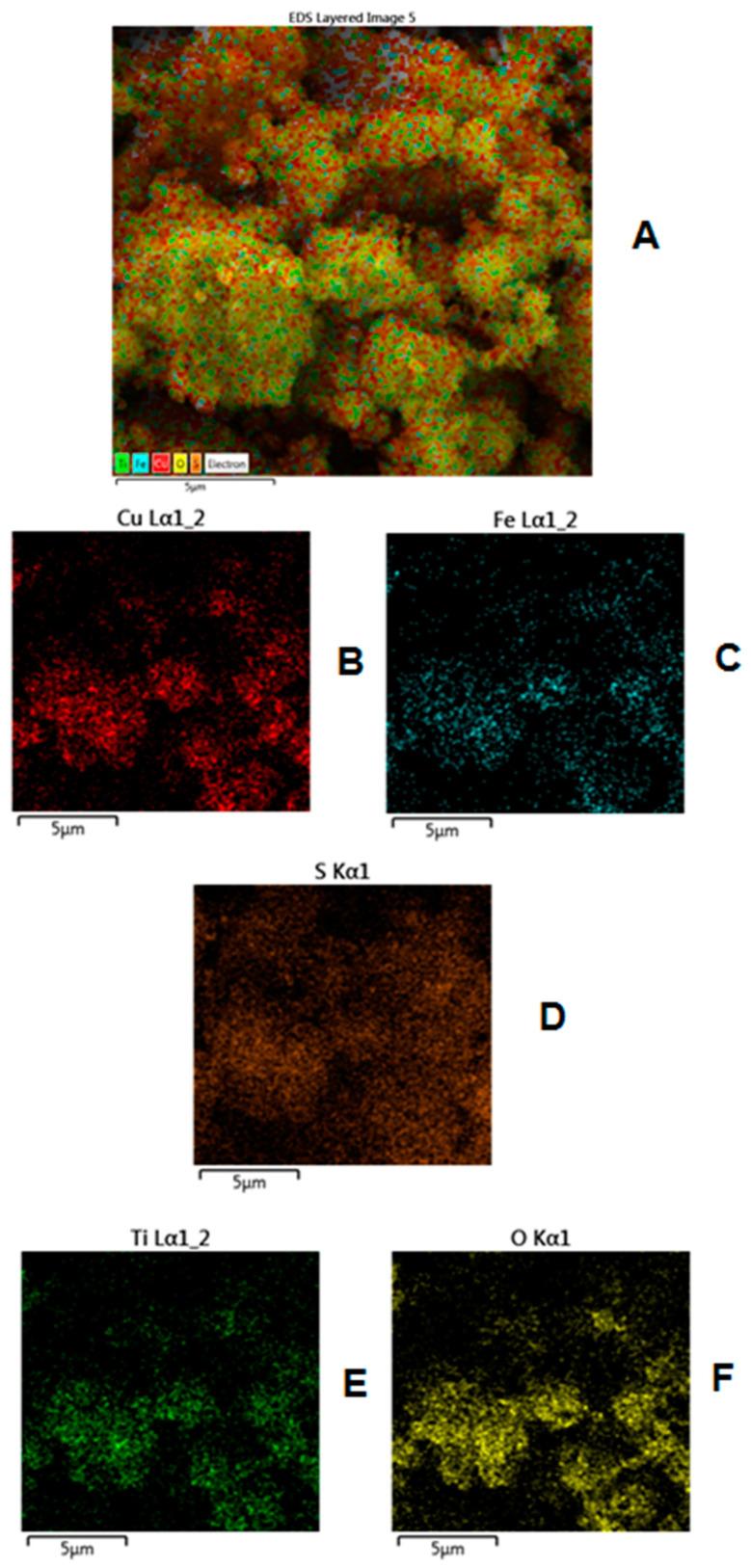
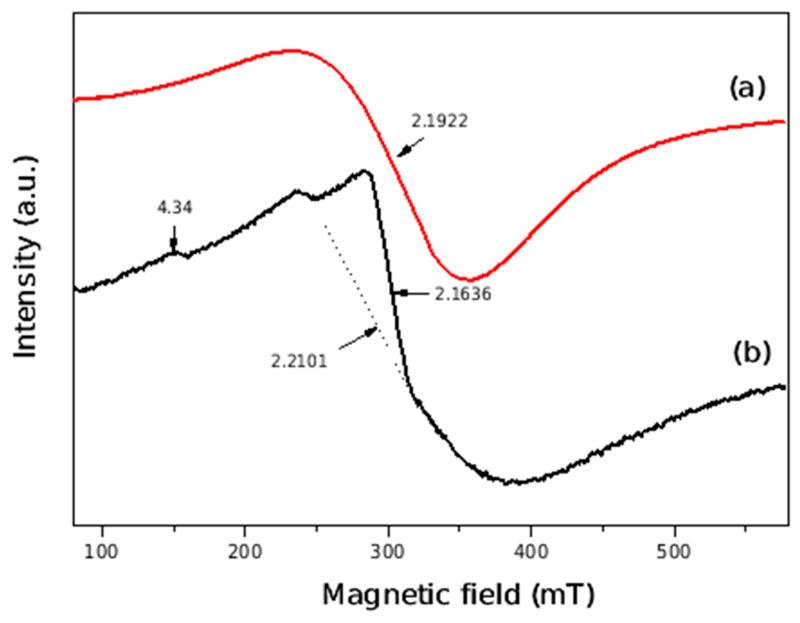
CuFeS/TiO nanocomposite has been prepared by a simple, low-cost mechanochemical route to assess its visible-light-driven photocatalytic efficiency in Methyl Orange azo dye decolorization. The structural and microstructural characterization was studied using X-ray diffraction and high-resolution transmission electron microscopy. The presence of both components in the composite and a partial anatase-to-rutile phase transformation was proven by X-ray diffraction. Both components exhibit crystallite size below 10 nm. The crystallite size of both phases in the range of 10-20 nm was found and confirmed by TEM. Surface and morphological properties were characterized by scanning electron microscopy and nitrogen adsorption measurement. Scanning electron microscopy has shown that the nanoparticles are agglomerated into larger grains. The specific surface area of the nanocomposite was determined to be 21.2 mg. Optical properties using UV-Vis and photoluminescence spectroscopy were also investigated. CuFeS/TiO nanocomposite exhibits strong absorption with the determined optical band gap 2.75 eV. Electron paramagnetic resonance analysis has found two types of paramagnetic ions in the nanocomposite. Mössbauer spectra showed the existence of antiferromagnetic and paramagnetic spin structure in the nanocomposite. The CuFeS/TiO nanocomposite showed the highest discoloration activity with a MO conversion of ~ 74% after 120 min irradiation. This study has shown the possibility to prepare nanocomposite material with enhanced photocatalytic activity of decoloration of MO in the visible range by an environmentally friendly manner.
通过一种简单、低成本的机械化学路线制备了CuFeS/TiO纳米复合材料,以评估其在可见光驱动下对偶氮染料甲基橙的光催化脱色效率。使用X射线衍射和高分辨率透射电子显微镜对其结构和微观结构进行了表征。X射线衍射证实了复合材料中两种组分的存在以及部分锐钛矿相向金红石相的转变。两种组分的微晶尺寸均小于10nm。通过透射电子显微镜发现并证实了两相的微晶尺寸在10-20nm范围内。通过扫描电子显微镜和氮吸附测量对表面和形态特性进行了表征。扫描电子显微镜显示纳米颗粒团聚成较大的颗粒。测定该纳米复合材料的比表面积为21.2mg。还研究了使用紫外可见光谱和光致发光光谱的光学性质。CuFeS/TiO纳米复合材料表现出强烈的吸收,其确定的光学带隙为2.75eV。电子顺磁共振分析发现该纳米复合材料中有两种类型的顺磁性离子。穆斯堡尔光谱表明该纳米复合材料中存在反铁磁和顺磁自旋结构。CuFeS/TiO纳米复合材料在照射120分钟后表现出最高的脱色活性,甲基橙转化率约为74%。这项研究表明,有可能通过环境友好的方式制备在可见光范围内具有增强的甲基橙脱色光催化活性的纳米复合材料。







 Zotero 插件