Chen Yujing, Hu Kui, Yu Caihua, Yuan Dongdong, Ban Xiaoyi
School of Highway, Chang'an University, Xi'an 710064, China.
College of Civil Engineering, Henan University of Technology, Zhengzhou 450001, China.
Polymers (Basel). 2022 Sep 29;14(19):4087. doi: 10.3390/polym14194087.
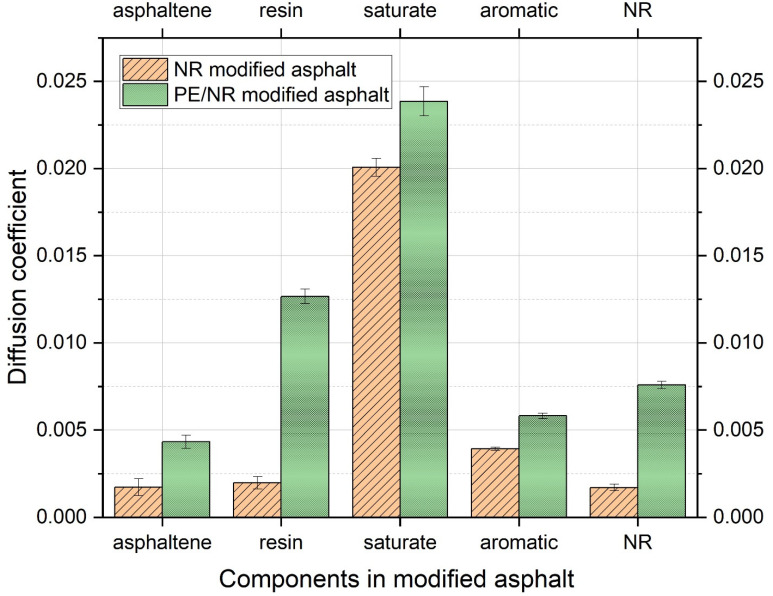
This paper aims to study the interaction mechanism of waste tire/plastic modified asphalt from the microscopic perspective of molecules. Based on BIOVIA Materials Studio, a classic four-component asphalt model consisting of asphaltene (CHNOS), resin (CHNOS), aromatic (C46H50S), and saturate (CH) was constructed. Waste tires are represented by natural rubber (NR), which uses cis-1, 4-polyisoprene as a repeating unit. In contrast, waste plastics are characterized by polyethylene (PE), whose optimum degree of polymerization is determined by the difference in solubility parameters. Then, the above molecular models are changed to a stable equilibrium state through the molecular dynamics process. Finally, the interaction process is analyzed and inferred using the indexes of radial distribution function, diffusion coefficient, and concentration distribution; further, the interaction mechanism is revealed. The results show that the optimal degree of polymerization of PE is 12, so the solubility parameter between PE and NR-modified asphalt is the lowest at 0.14 (J/cm) . These models are in agreement with the characteristics of amorphous materials with the structures ordered in the short-range and long-range disordered. For NR-modified asphalt, the saturate moves fastest, and its diffusion coefficient reaches 0.0201, followed by that of the aromatic (0.0039). However, the molecule of NR ranks the slowest in the NR-modified asphalt. After the addition of PE, the diffusion coefficient of resin increased most significantly from 0.0020 to 0.0127. NR, PE, and asphaltene have a particular attraction with the lightweight components, thus changing to a more stable spatial structure. Therefore, using NR and PE-modified asphalt can change the interaction between asphalt molecules to form a more stable system. This method not only reduces the large waste disposal task but also provides a reference for the application of polymer materials in modified asphalt.
本文旨在从分子微观角度研究废轮胎/塑料改性沥青的相互作用机理。基于BIOVIA Materials Studio构建了一个由沥青质(CHNOS)、树脂(CHNOS)、芳香烃(C46H50S)和饱和烃(CH)组成的经典四组分沥青模型。废轮胎用天然橡胶(NR)表示,其以顺式-1,4-聚异戊二烯为重复单元。相比之下,废塑料以聚乙烯(PE)为特征,其最佳聚合度由溶解度参数的差异确定。然后,通过分子动力学过程将上述分子模型转变为稳定的平衡状态。最后,利用径向分布函数、扩散系数和浓度分布等指标对相互作用过程进行分析和推断;进而揭示相互作用机理。结果表明,PE的最佳聚合度为12,因此PE与NR改性沥青之间的溶解度参数最低,为0.14(J/cm)。这些模型与具有短程有序和长程无序结构的非晶态材料的特征相符。对于NR改性沥青,饱和烃移动最快,其扩散系数达到0.0201,其次是芳香烃(0.0039)。然而,NR分子在NR改性沥青中移动最慢。添加PE后,树脂的扩散系数从0.0020显著增加到0.0127。NR、PE和沥青质与轻质组分有特殊吸引力,从而转变为更稳定的空间结构。因此,使用NR和PE改性沥青可以改变沥青分子间的相互作用,形成更稳定的体系。该方法不仅减少了大量的废物处理任务,还为聚合物材料在改性沥青中的应用提供了参考。