Zhu Kehui, Jiang Hang, Huo Yuchong, Yu Qin, Li Jianfeng
College of Electronic Information Engineering, Nanjing University of Aeronautics and Astronautics, Nanjing 211106, China.
Hai Hua Electronic Enterprise (China) Corporation, Guangzhou 510670, China.
Sensors (Basel). 2022 Sep 24;22(19):7245. doi: 10.3390/s22197245.
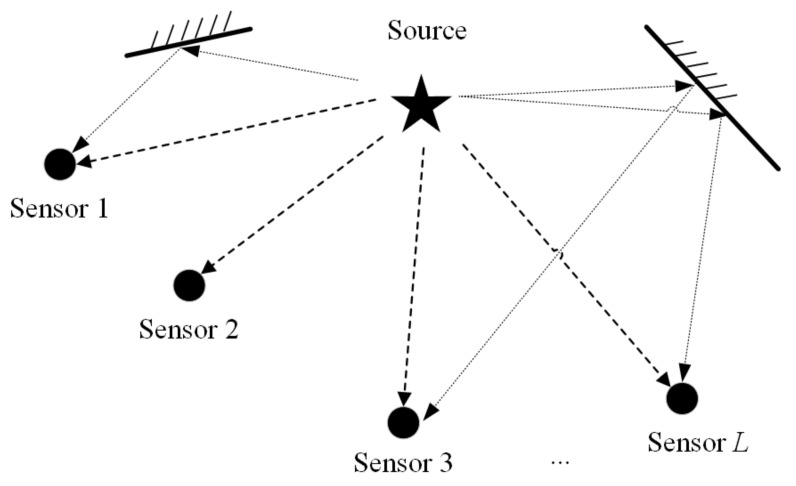
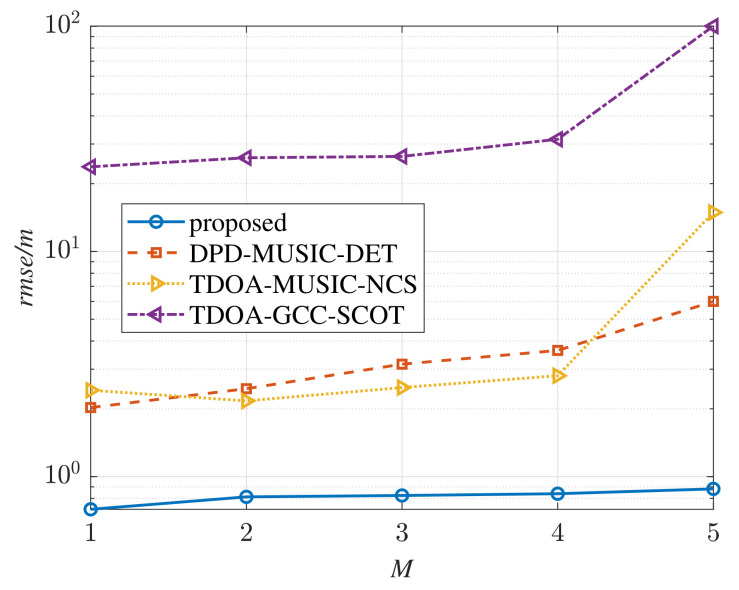
Without the estimation of the intermediate parameters, the direct position determination (DPD) method can achieve higher localization accuracy than conventional two-step methods. However, multipath environments are still a key problem, and complex high-dimensional matrix operations are required in most DPD methods. In this paper, a time-difference-of-arrival-based (TDOA-based) DPD method is proposed based on the subspace orthogonality in the cross-spectra between the different sensors. Firstly, the cross-spectrum between the segmented received signal and reference signal is calculated and eigenvalue decomposition is performed to obtain the subspaces. Then, the cost functions are constructed by using the orthogonality of subspace. Finally, the location of the radiation source is obtained by searching the superposition of these cost functions in the target area. Compared with other DPD methods, our proposed DPD method leads to better localization accuracy with less complexity. The superiority of this method is verified by both simulated and real measured data when compared to other TDOA and DPD algorithms.
在不估计中间参数的情况下,直接定位(DPD)方法能够比传统的两步法实现更高的定位精度。然而,多径环境仍然是一个关键问题,并且大多数DPD方法都需要进行复杂的高维矩阵运算。本文基于不同传感器之间互谱中的子空间正交性,提出了一种基于到达时间差(TDOA)的DPD方法。首先,计算分段接收信号与参考信号之间的互谱,并进行特征值分解以获得子空间。然后,利用子空间的正交性构造代价函数。最后,通过在目标区域搜索这些代价函数的叠加来获得辐射源的位置。与其他DPD方法相比,我们提出的DPD方法以更低的复杂度实现了更好的定位精度。与其他TDOA和DPD算法相比,该方法的优越性在模拟数据和实际测量数据中均得到了验证。