Guo Hong-Li, Zhao Yue-Tao, Wang Wei-Jun, Dong Na, Hu Ya-Hui, Zhang Yuan-Yuan, Chen Feng, Zhou Li, Li Tao
Pharmaceutical Sciences Research Center, Department of Pharmacy, Children's Hospital of Nanjing Medical University, Nanjing, China.
School of Basic Medicine and Clinical Pharmacy, China Pharmaceutical University, Nanjing, China.
Front Pharmacol. 2022 Sep 27;13:941182. doi: 10.3389/fphar.2022.941182. eCollection 2022.
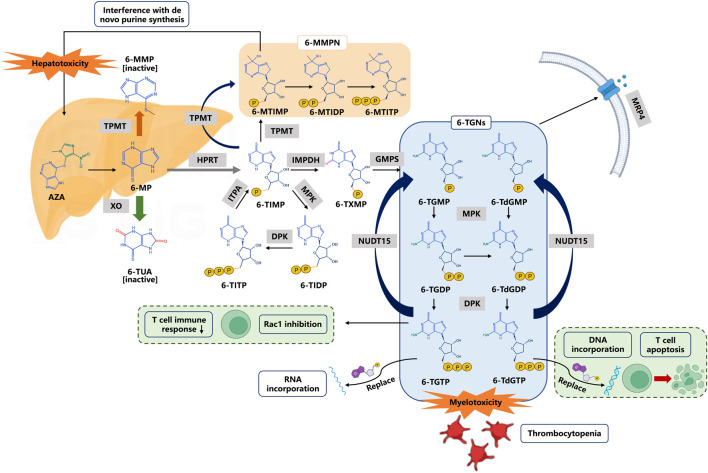
Thiopurines, including thioguanine (TG), 6-mercaptopurine (6-MP), and azathioprine (AZA), are extensively used in clinical practice in children with acute lymphoblastic leukemia (ALL) and inflammatory bowel diseases. However, the common adverse effects caused by myelosuppression and hepatotoxicity limit their application. Metabolizing enzymes such as thiopurine S-methyltransferase (TPMT), nudix hydrolase 15 (NUDT15), inosine triphosphate pyrophosphohydrolase (ITPA), and drug transporters like multidrug resistance-associated protein 4 (MRP4) have been reported to mediate the metabolism and transportation of thiopurine drugs. Hence, the single nucleotide polymorphisms (SNPs) in those genes could theoretically affect the pharmacokinetics and pharmacological effects of these drugs, and might also become one of the determinants of clinical efficacy and adverse effects. Moreover, long-term clinical practices have confirmed that thiopurine-related adverse reactions are associated with the systemic concentrations of their active metabolites. In this review, we mainly summarized the pharmacogenetic studies of thiopurine drugs. We also evaluated the therapeutic drug monitoring (TDM) research studies and focused on those active metabolites, hoping to continuously improve monitoring strategies for thiopurine therapy to maximize therapeutic efficacy and minimize the adverse effects or toxicity. We proposed that tailoring thiopurine dosing based on , , , and genotypes, defined as "MINT" panel sequencing strategy, might contribute toward improving the efficacy and safety of thiopurines. Moreover, the DNA-incorporated thioguanine nucleotide (DNA-TG) metabolite level was more suitable for red cell 6-thioguanine nucleotide (6-TGNs) monitoring, which can better predict the efficacy and safety of thiopurines. Integrating the panel "MINT" sequencing strategy with therapeutic "DNA-TG" monitoring would offer a new insight into the precision thiopurine therapy for pediatric acute lymphoblastic leukemia patients.
硫嘌呤类药物,包括硫鸟嘌呤(TG)、6-巯基嘌呤(6-MP)和硫唑嘌呤(AZA),在儿童急性淋巴细胞白血病(ALL)和炎症性肠病的临床实践中被广泛应用。然而,由骨髓抑制和肝毒性引起的常见不良反应限制了它们的应用。据报道,代谢酶如硫嘌呤S-甲基转移酶(TPMT)、Nudix水解酶15(NUDT15)、肌苷三磷酸焦磷酸水解酶(ITPA)以及药物转运体如多药耐药相关蛋白4(MRP4)介导硫嘌呤类药物的代谢和转运。因此,这些基因中的单核苷酸多态性(SNP)理论上可能影响这些药物的药代动力学和药理作用,也可能成为临床疗效和不良反应的决定因素之一。此外,长期临床实践证实,硫嘌呤相关不良反应与它们活性代谢产物的全身浓度有关。在这篇综述中,我们主要总结了硫嘌呤类药物的药物遗传学研究。我们还评估了治疗药物监测(TDM)研究,并关注那些活性代谢产物,希望不断改进硫嘌呤治疗的监测策略,以最大限度地提高治疗效果并最小化不良反应或毒性。我们提出,根据TPMT、NUDT15、ITPA和MRP4基因型调整硫嘌呤剂量,定义为“MINT”面板测序策略,可能有助于提高硫嘌呤的疗效和安全性。此外,DNA掺入的硫鸟嘌呤核苷酸(DNA-TG)代谢物水平更适合用于红细胞6-硫鸟嘌呤核苷酸(6-TGNs)监测,其能够更好地预测硫嘌呤的疗效和安全性。将“MINT”面板测序策略与治疗性“DNA-TG”监测相结合,将为儿童急性淋巴细胞白血病患者的精准硫嘌呤治疗提供新的见解。