Jia Jia, Anderson Jason S, Jiang Jian-Ping, Wu Wenhao, Shubin Neil H, Gao Ke-Qin
School of Earth and Space Sciences, Peking University, 5 Yiheyuan Road, Beijing 100871, China.
Department of Comparative Biology and Experimental Medicine, University of Calgary, 3330 Hospital Drive, Calgary, Alberta T2N 1N4, Canada.
Sci Adv. 2022 Oct 14;8(41):eabq7669. doi: 10.1126/sciadv.abq7669.
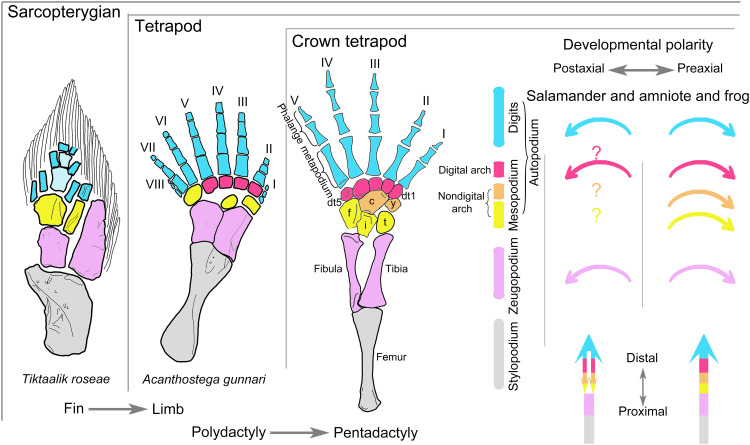
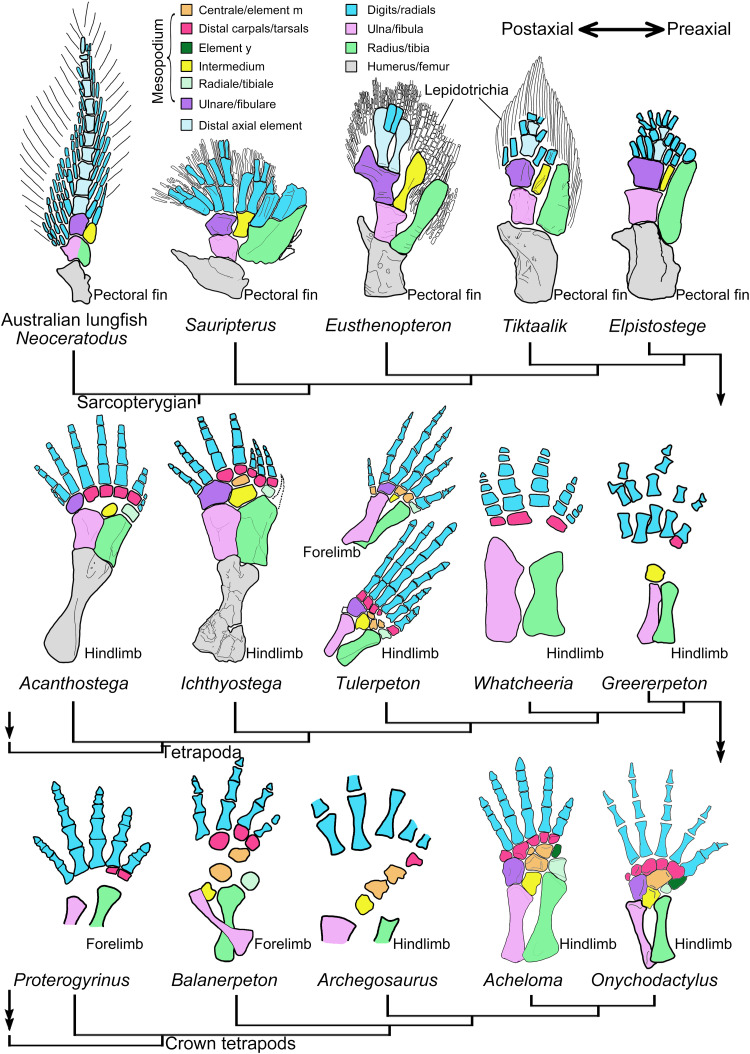
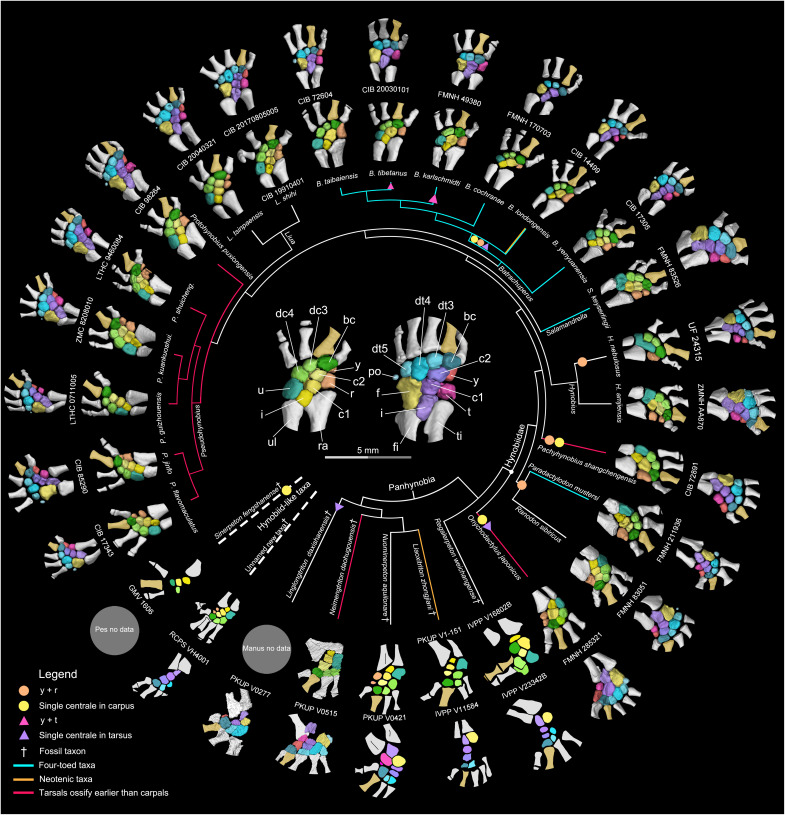
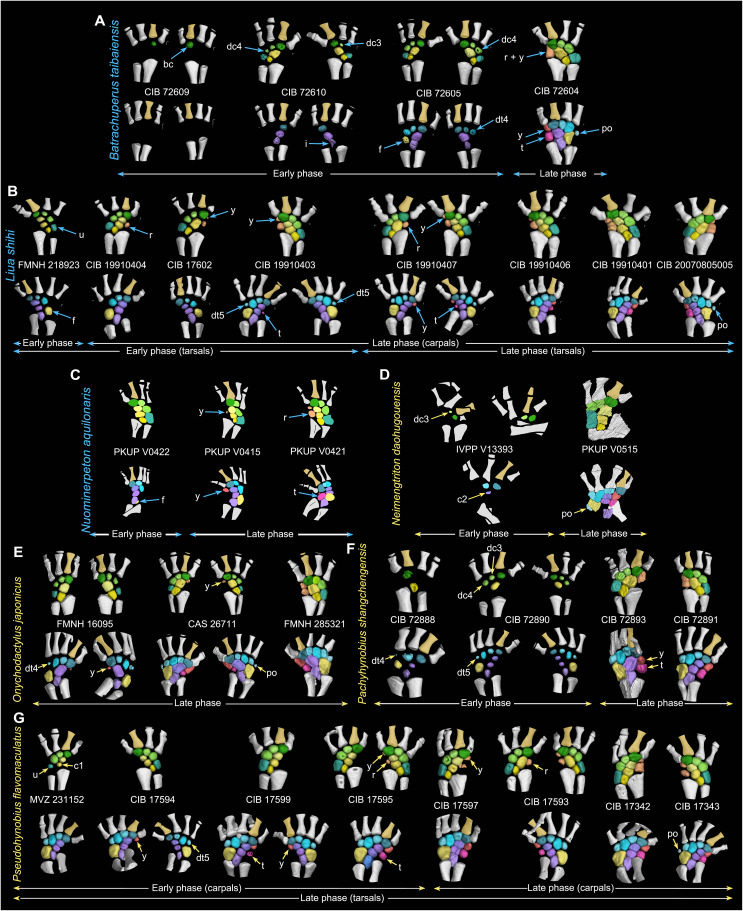
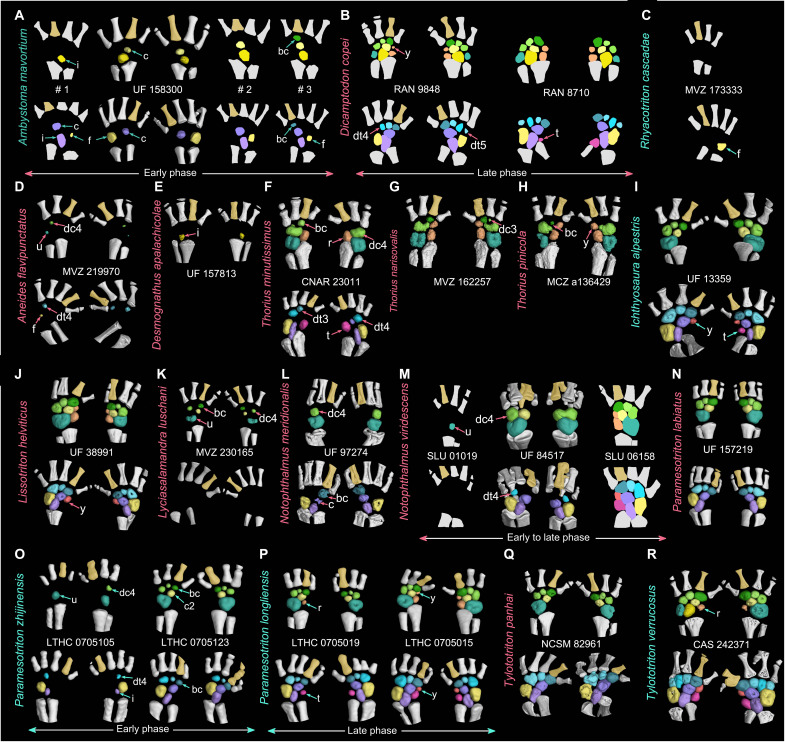
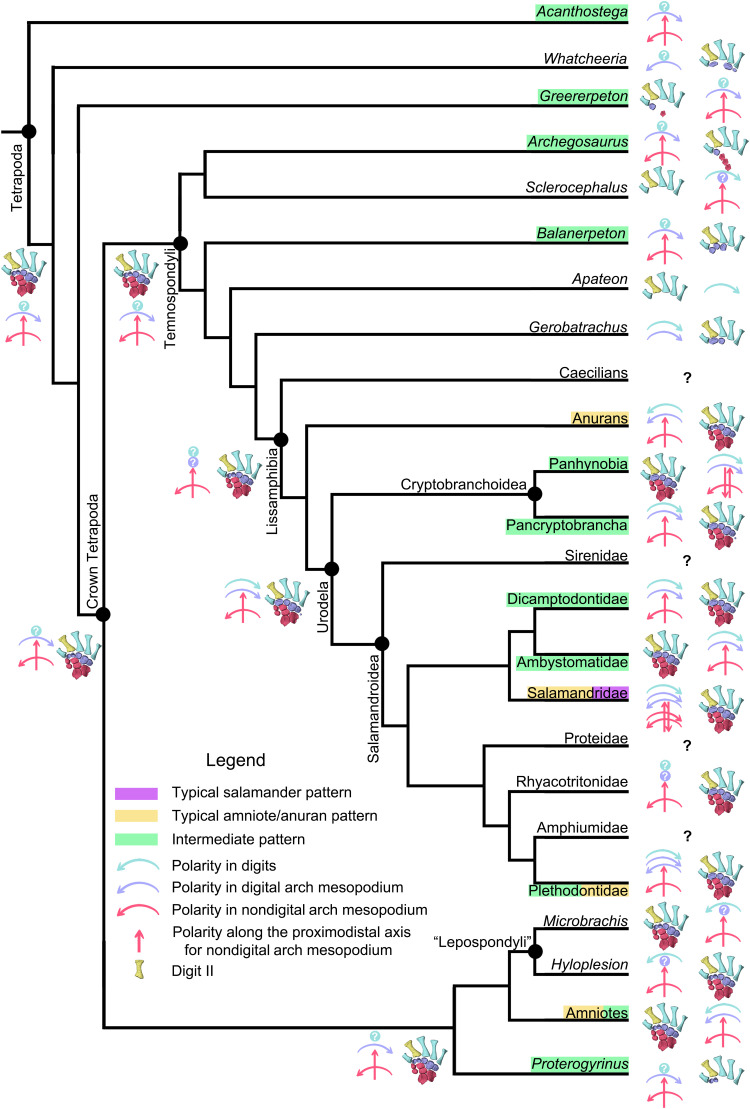
Early limb skeletogenesis in salamanders is characterized by preaxial elements, digits I and II forming earlier than their postaxial counterparts (digits III to V), a phenomenon known as preaxial dominance, whereas in amniotes and anurans, these developmental sequences are reversed. This pattern characterizes the late skeletogenesis of digits and zeugopodium of anamniote tetrapods but remains unknown in carpals/tarsals. To correct this gap in knowledge, we investigate the ossification patterns of the carpals/tarsals in six salamander families/clades based on micro-computed tomography scans. We found that preaxial dominance is seen in the distal carpals/tarsals of several salamander clades and diverse early tetrapods, such as temnospondyls and amniotes. This distribution suggests that preaxial dominance is a primitive developmental pattern in tetrapods. Our results demonstrate that the distal carpals/tarsals are developmentally and evolutionarily independent in the autopodium, and preaxial dominance facilitates stabilization of the number of distal carpals/tarsals during fin-to-limb transition and digit reduction in early tetrapods.
蝾螈早期肢体骨骼生成的特征是轴前元素,即第一和第二指比它们的轴后对应指(第三至第五指)形成得更早,这种现象被称为轴前优势,而在羊膜动物和无尾两栖动物中,这些发育顺序是相反的。这种模式是无羊膜四足动物指骨和上肢骨晚期骨骼生成的特征,但在腕骨/跗骨中尚不清楚。为了填补这一知识空白,我们基于微计算机断层扫描研究了六个蝾螈科/类群中腕骨/跗骨的骨化模式。我们发现,在几个蝾螈类群以及多样化的早期四足动物(如离片椎类和羊膜动物)的远端腕骨/跗骨中都观察到了轴前优势。这种分布表明轴前优势是四足动物的一种原始发育模式。我们的研究结果表明,远端腕骨/跗骨在 autopodium 中在发育和进化上是独立的,并且轴前优势有助于在早期四足动物的鳍到肢体过渡和指骨减少过程中稳定远端腕骨/跗骨的数量。