Sugar Alan, Hussain Munira, Chamberlain Winston, Dana Reza, Kelly David Patrick, Ta Christopher, Irvine John, Daluvoy Melissa, Perez Victor, Olson Joshua, Jhanji Vishal, Walts Terence A, Stulting Robert Doyle, Waller Edmund K, Jagirdar Neera
WK Kellogg Eye Center, University of Michigan, Ann Arbor, Michigan.
Casey Eye Institute, and Department of Ophthalmology, Oregon Health and Science University, Portland, Oregon.
Ophthalmol Sci. 2022 Jun 2;2(3):100176. doi: 10.1016/j.xops.2022.100176. eCollection 2022 Sep.
The purpose of the study was to evaluate, as a pilot trial, safety and tolerability of CAM-101 10% and 30% topical ophthalmic fibrinogen-depleted human platelet lysate (FD hPL) solution in patients with dry eye disease (DED) secondary to graft-versus-host disease (GvHD) after 6 weeks of treatment.
A phase I/II, pilot, prospective, multicenter, randomized, double-masked clinical trial.
Patients with DED secondary to GvHD.
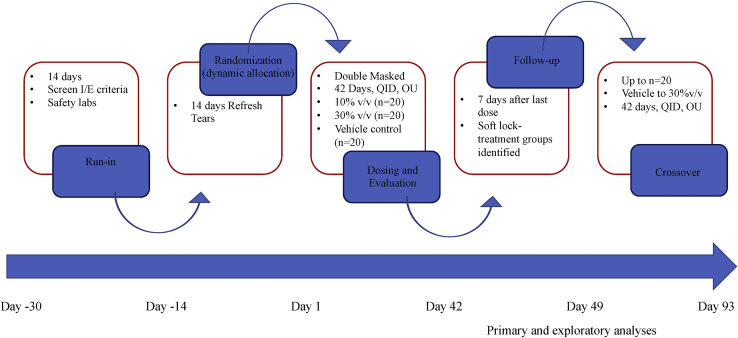
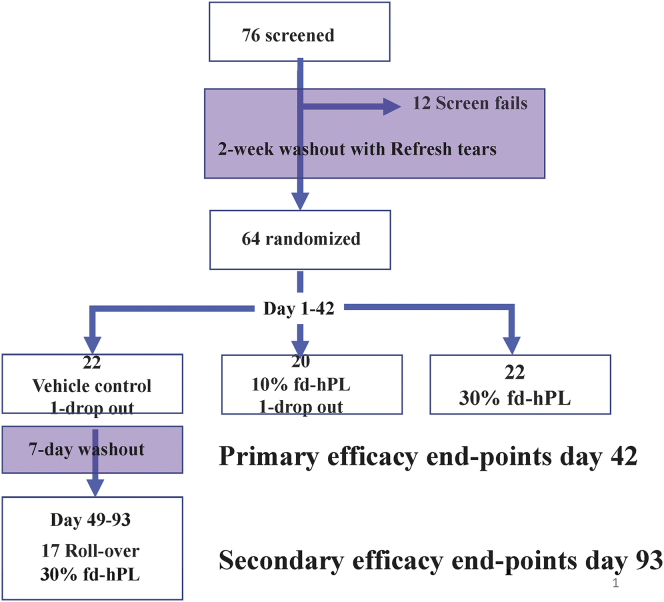
Sixty-four adult patients were stratified by "symptom severity" (Ocular Surface Disease Index [OSDI], ocular discomfort Visual Analog Scale (VAS), ocular symptom frequency, and use of artificial tears) and then randomized 1:1:1 to CAM-101 (FD hPL) at 10% or 30% concentration or an electrolyte (Plasma-Lyte A) vehicle control, 1 drop in both eyes, 4 times daily, for 42 days. After 42 days, control patients were offered 42 days of open-label treatment with 30% FD hPL.
Primary outcome safety measures were ocular and systemic adverse events and the number of patients in each group with clinically significant change from normal to abnormal in any ocular findings. Secondary outcomes were changes from baseline to day 42 in ocular discomfort, OSDI, fluorescein corneal staining, and lissamine green conjunctival staining relative to the vehicle control. The ocular symptom frequency was assessed on a 100-point VAS.
FD hPL 10% and 30% were safe and well tolerated. Relative to the vehicle control, significant decreases from baseline to day 42 were seen in the FD hPL 30% group with regard to ocular discomfort (mean decrease = -18.04; = 0.018), frequency of burning/stinging (-20.23; = 0.022), eye discomfort (-32.97; < 0.001), eye dryness (-21.61; = 0.020), pain (-15.12; = 0.044), photophobia (-24.33; = 0.0125), and grittiness (-20.08; = 0.0185). Decreases were also seen for itching and foreign body sensation, though not statistically significant. Improvements were seen in tear breakup time (mean increase = 1.30 seconds; = 0.082) and the investigator's global evaluation 4-point scale (mean decrease = -0.86; = 0.026). Corneal fluorescein staining was not improved. The OSDI had a mean decrease of -8.88 compared to the vehicle, although not statistically significant.
Fibrinogen-depleted human platelet lysate appears to be well tolerated, with no significant toxicity at concentrations of 10% and 30%. These initial data suggest some efficacy, especially for subjective outcome measures relative to baseline assessments and treatment with the vehicle, but larger studies are needed to confirm these effects.
本研究旨在作为一项试点试验,评估10%和30%浓度的CAM - 101局部眼科纤维蛋白原缺失人血小板裂解液(FD hPL)溶液治疗移植物抗宿主病(GvHD)继发的干眼症(DED)患者6周后的安全性和耐受性。
一项I/II期、试点、前瞻性、多中心、随机、双盲临床试验。
GvHD继发的DED患者。
64名成年患者按“症状严重程度”(眼表疾病指数[OSDI]、眼部不适视觉模拟量表[VAS]、眼部症状频率和人工泪液使用情况)分层,然后按1:1:1随机分配至10%或30%浓度的CAM - 101(FD hPL)组或电解质(Plasma - Lyte A)载体对照组,双眼各滴1滴,每日4次,共42天。42天后,为对照组患者提供为期42天的30% FD hPL开放标签治疗。
主要结局安全性指标为眼部和全身不良事件以及每组中任何眼部检查结果从正常变为异常且具有临床意义变化的患者数量。次要结局为相对于载体对照组,从基线到第42天眼部不适、OSDI、荧光素角膜染色和丽丝胺绿结膜染色的变化。眼部症状频率通过100分VAS进行评估。
10%和30%的FD hPL安全且耐受性良好。相对于载体对照组,30% FD hPL组从基线到第42天在眼部不适(平均下降=-18.04;P = 0.018)、灼烧/刺痛频率(-20.23;P = 0.022)、眼部不适(-32.97;P < 0.001)、眼干(-21.61;P = 0.020)、疼痛(-15.12;P = 0.044)、畏光(-24.33;P = 0.0125)和异物感(-20.08;P = 0.0185)方面均有显著下降。瘙痒和异物感也有下降,尽管无统计学意义。泪膜破裂时间有所改善(平均增加 = 1.30秒;P = 0.082),研究者整体评估4分制也有改善(平均下降=-0.86;P = 0.026)。角膜荧光素染色未改善。与载体对照组相比,OSDI平均下降-8.88,尽管无统计学意义。
纤维蛋白原缺失人血小板裂解液似乎耐受性良好,在10%和30%浓度下无明显毒性。这些初步数据表明有一定疗效,尤其是相对于基线评估和载体对照组治疗的主观结局指标,但需要更大规模的研究来证实这些效果。