Department of Bone and Mineral Research, Research Institute, Osaka Women's and Children's Hospital, Osaka Prefectural Hospital Organization, Izumi, Japan.
Front Endocrinol (Lausanne). 2022 Sep 29;13:1005189. doi: 10.3389/fendo.2022.1005189. eCollection 2022.
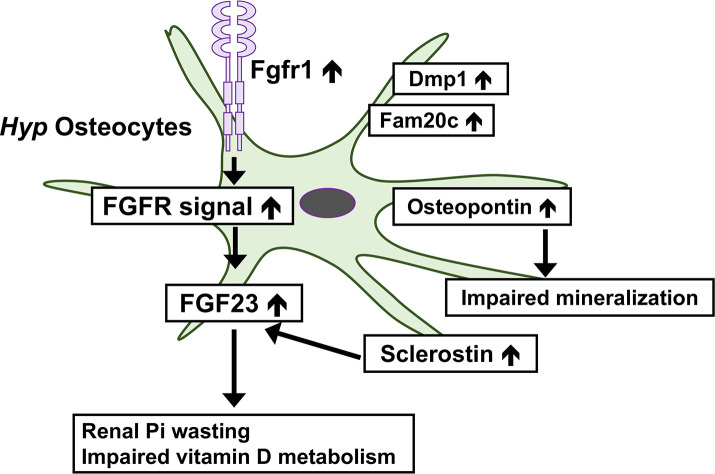
Since phosphorus is a component of hydroxyapatite, its prolonged deprivation affects bone mineralization. Fibroblast growth factor 23 (FGF23) is essential for maintaining phosphate homeostasis and is mainly produced by osteocytes. FGF23 increases the excretion of inorganic phosphate (Pi) and decreases the production of 1,25-dihydroxyvitamin D in the kidneys. Osteocytes are cells of osteoblastic lineage that have undergone terminal differentiation and become embedded in mineralized bone matrix. Osteocytes express and other multiple genes responsible for hereditary hypophosphatemic rickets, which include (), (), and (). Since inactivating mutations in , , and boost the production of FGF23, these molecules might be considered as local negative regulators of FGF23. Mouse studies have suggested that enhanced FGF receptor (FGFR) signaling is involved in the overproduction of FGF23 in -deficient X-linked hypophosphatemic rickets (XLH) and -deficient autosomal recessive hypophosphatemic rickets type 1. Since FGFR is involved in the transduction of signals evoked by extracellular Pi, Pi sensing in osteocytes may be abnormal in these diseases. Serum levels of sclerostin, an inhibitor Wnt/β-catenin signaling secreted by osteocytes, are increased in XLH patients, and mouse studies have suggested the potential of inhibiting sclerostin as a new therapeutic option for the disease. The elucidation of complex abnormalities in the osteocytes of FGF23-related hypophosphatemic diseases will provide a more detailed understanding of their pathogenesis and more effective treatments.
由于磷是羟磷灰石的组成部分,其长期缺乏会影响骨矿化。成纤维细胞生长因子 23(FGF23)对于维持磷稳态至关重要,主要由骨细胞产生。FGF23 增加无机磷(Pi)的排泄,减少肾脏中 1,25-二羟维生素 D 的产生。骨细胞是成骨细胞谱系的细胞,已经经历了终末分化并嵌入矿化的骨基质中。骨细胞表达 和其他多个与遗传性低磷血症性佝偻病有关的基因,包括 (), (), 和 (). 由于 、 和 的失活突变会增加 FGF23 的产生,这些分子可能被视为 FGF23 的局部负调节因子。小鼠研究表明,增强的 FGF 受体(FGFR)信号参与了 -缺陷性 X 连锁低磷血症性佝偻病(XLH)和 -缺陷性常染色体隐性低磷血症性佝偻病 1 型中 FGF23 的过度产生。由于 FGFR 参与细胞外 Pi 诱发信号的转导,这些疾病中骨细胞的 Pi 感知可能异常。XLH 患者的血清中骨细胞分泌的 Wnt/β-catenin 信号抑制剂骨硬化蛋白的水平升高,小鼠研究表明抑制骨硬化蛋白可能成为该疾病的一种新的治疗选择。阐明与 FGF23 相关的低磷血症性疾病中骨细胞的复杂异常将提供对其发病机制的更详细理解,并提供更有效的治疗方法。