de Breuk Anita, Lechanteur Yara T E, Heesterbeek Thomas J, Fauser Sascha, Klaver Caroline C W, Hoyng Carel B, den Hollander Anneke I
Department of Ophthalmology, Donders Institute for Brain, Cognition and Behaviour, Radboud University Medical Center, Nijmegen, The Netherlands.
Department of Ophthalmology, University Hospital of Cologne, Cologne, Germany.
Ophthalmol Sci. 2021 Dec 6;1(4):100087. doi: 10.1016/j.xops.2021.100087. eCollection 2021 Dec.
To determine the contribution of common and rare genetic risk variants in families with age-related macular degeneration (AMD).
Case-control study.
A family cohort (355 affected and 342 unaffected family members from 144 families with AMD) and an unrelated case-control cohort (1078 patients, 952 controls), recruited from the European Genetic Database.
Genetic data of both cohorts were filtered for carriership of rare genetic variants in the coding and splice-site regions of the complement factor H () and complement factor I () genes, and 52 AMD-associated variants were extracted for calculation of genetic risk scores (GRS). To compare GRSs between familial and nonfamilial rare and variant carriers and noncarriers and between AMD disease stages, we performed a 2-way analysis of variance, with Bonferroni correction for multiple testing. Within families with AMD carrying rare and variants, we analyzed segregation patterns by calculating the proportion of affected among carriers.
GRSs and segregation of rare and variants.
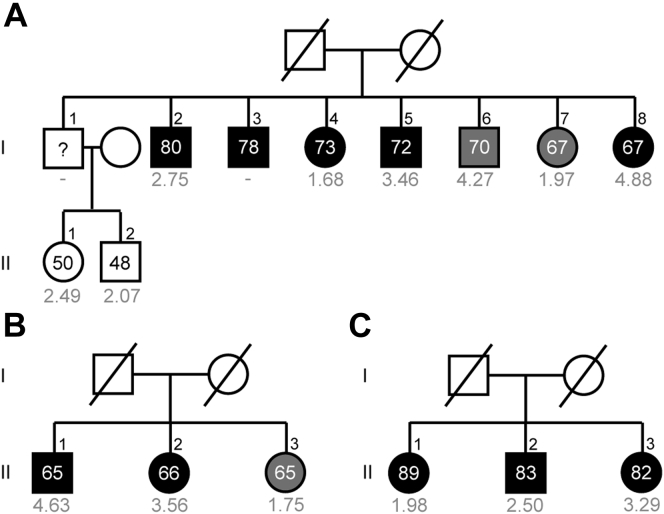
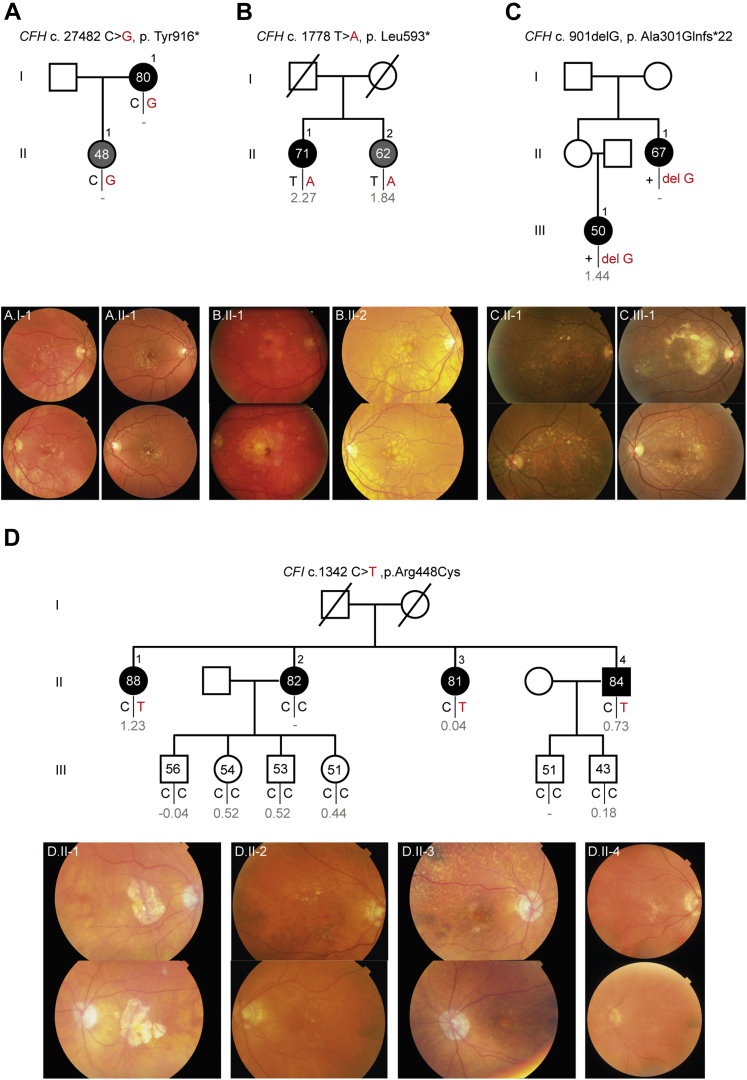
We observed higher GRSs in familial versus nonfamilial individuals without rare and variants: mean GRS, 1.76 (standard error [SE], 0.08) versus 0.83 (SE, 0.03; < 0.001). In 51 of 144 families (35.4%), rare and variants were identified. Within the AMD family cohort, carriers of rare and variants showed lower GRSs compared with noncarriers (mean GRS, 1.05 [SE, 0.23] vs. 1.76 [SE, 0.08]; = 0.02). The proportion of affected family members with a high GRS was 57.3% (176/307). Of the affected family members with a low or intermediate GRS, 40.0% carried rare or variants. Among carriers of 11 rare or variants, the proportion affected by AMD was more than 75%.
Genetic risk in families with AMD often is attributed to high GRSs based on common variants. However, in part of the families with a low or intermediate GRS, rare and variants contributed to disease development. We recommend computing GRSs and sequencing the and genes in families with AMD, in particular in the light of ongoing gene-specific clinical trials.
确定年龄相关性黄斑变性(AMD)家族中常见和罕见遗传风险变异的作用。
病例对照研究。
一个家族队列(来自144个AMD家族的355名患病和342名未患病家族成员)以及一个非相关病例对照队列(1078例患者,952名对照),从欧洲遗传数据库招募。
对两个队列的遗传数据进行筛选,以查找补体因子H(CFH)和补体因子I(CFI)基因编码和剪接位点区域中罕见遗传变异的携带者,并提取52个与AMD相关的变异以计算遗传风险评分(GRS)。为了比较家族性和非家族性罕见CFH和CFI变异携带者与非携带者之间以及AMD疾病阶段之间的GRS,我们进行了双向方差分析,并采用Bonferroni校正进行多重检验。在携带罕见CFH和CFI变异的AMD家族中,我们通过计算携带者中受影响者的比例来分析分离模式。
GRS以及罕见CFH和CFI变异的分离情况。
我们观察到,在没有罕见CFH和CFI变异的家族性个体与非家族性个体中,家族性个体的GRS更高:平均GRS分别为1.76(标准误[SE],0.08)和0.83(SE,0.03;P<0.001)。在144个家族中的51个(35.4%)中鉴定出罕见的CFH和CFI变异。在AMD家族队列中,罕见CFH和CFI变异的携带者与非携带者相比,GRS较低(平均GRS分别为1.05[SE,0.23]和1.76[SE,0.08];P = 0.02)。GRS高的受影响家族成员比例为57.3%(176/307)。在GRS低或中等的受影响家族成员中,40.0%携带罕见的CFH或CFI变异。在11种罕见CFH或CFI变异的携带者中,受AMD影响的比例超过75%。
AMD家族中的遗传风险通常归因于基于常见变异的高GRS。然而,在部分GRS低或中等的家族中,罕见的CFH和CFI变异促成了疾病的发展。我们建议对AMD家族进行GRS计算并对CFH和CFI基因进行测序,特别是鉴于正在进行的基因特异性临床试验。