
冠心病患者体力活动客观测量的依从性:2010年和2020年世界卫生组织指南及每日步数的比较。
Objectively measured adherence to physical activity among patients with coronary artery disease: Comparison of the 2010 and 2020 World Health Organization guidelines and daily steps.
作者信息
Eser Prisca, Gonzalez-Jaramillo Nathalia, Weber Selina, Fritsche Jan, Femiano Riccardo, Werner Charlotte, Casanova Flurina, Bano Arjola, Franco Oscar H, Wilhelm Matthias
机构信息
Department of Cardiology, Inselspital, Bern University Hospital, University of Bern, Bern, Switzerland.
Institute of Social and Preventive Medicine, University of Bern, Bern, Switzerland.
出版信息
Front Cardiovasc Med. 2022 Sep 28;9:951042. doi: 10.3389/fcvm.2022.951042. eCollection 2022.
BACKGROUND
Tailored recommendations for patients after percutaneous coronary interventions (PCI) need physical activity (PA) to be objectively measured and assessed for adherence to guidelines. The recent WHO guidelines removed the daily recommended bout duration, while the potential impact of this change on patients after PCI remains unclear.
AIM
We evaluated prevalence estimates of adherence to PA recommendations among patients after PCI across the 2010 [≥30 min moderate- to vigorous-intensity PA (MVPA) at ≥ 10-min bout duration] and 2020 WHO guidelines (≥30 min of MVPA of any bout duration), as well as 7,500 and 10,000 steps.
METHODS
We conducted an observational longitudinal single-center study with patients after PCI for chronic or acute coronary syndrome (ACS); maximal age 80 years. Wrist-worn accelerometers recorded participants' PA data from the evening of hospital discharge over the next 18 days.
RESULTS
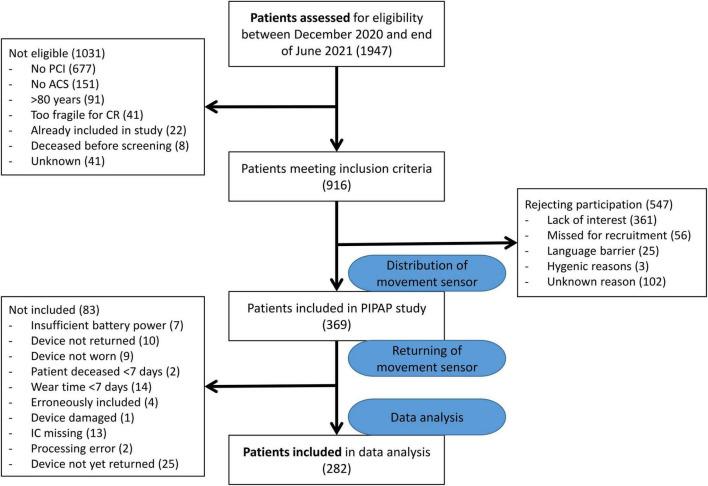
We analyzed data from 282 participants with sufficient minimum wear time (7 days of ≥12 h), including 45 (16%) women; and 249 (88%) with ACS. Median wear time was 18 (17, 18) days. Median participant age was 62 (55, 69) years. Fifty-two participants (18.4%) fulfilled 2010 WHO guidelines and 226 (80.1%) fulfilled the 2020 WHO guidelines. Further, 209 (74.1%) participants achieved ≥7,500 steps/day and 155 (55.0%) performed ≥10,000 steps/day.
CONCLUSION
Among participants after PCI, most MVPA was accumulated in bouts <10 min, leading to a fourfold discrepancy between participants fulfilling the 2010 and 2020 WHO PA recommendations. The number of steps/day may be a valid proxy to recent WHO PA recommendations as it is not dependent on the bout-length definition.
CLINICAL TRIAL REGISTRATION
[ClinicalTrials.gov], identifier [NCT04663373].
背景
经皮冠状动脉介入治疗(PCI)后为患者提供的个性化建议需要对体力活动(PA)进行客观测量,并评估其是否符合指南。世界卫生组织(WHO)最近的指南取消了每日推荐的运动时长,而这一变化对PCI术后患者的潜在影响仍不明确。
目的
我们评估了2010年(每天累计至少30分钟中等至剧烈强度的体力活动(MVPA),每次运动时长≥10分钟)和2020年WHO指南(任何运动时长的MVPA累计至少30分钟)以及7500步和10000步的情况下,PCI术后患者遵循PA建议的患病率估计值。
方法
我们对慢性或急性冠状动脉综合征(ACS)接受PCI治疗的患者进行了一项观察性纵向单中心研究;最大年龄80岁。佩戴在手腕上的加速度计记录了参与者从出院当晚起接下来18天的PA数据。
结果
我们分析了282名有足够最短佩戴时间(7天,每天≥12小时)参与者的数据,其中包括45名(16%)女性;249名(88%)患有ACS。中位佩戴时间为18(17,18)天。参与者的中位年龄为62(55,69)岁。52名参与者(18.4%)符合2010年WHO指南,226名(80.1%)符合2020年WHO指南。此外,209名(74.1%)参与者每天步数≥7500步,155名(55.0%)参与者每天步数≥10000步。
结论
在PCI术后参与者中,大多数MVPA是在每次运动时长小于10分钟的情况下积累的,这导致符合2010年和2020年WHO PA建议的参与者之间存在四倍的差异。由于每天步数不依赖于运动时长的定义,因此它可能是近期WHO PA建议的有效替代指标。
临床试验注册
[ClinicalTrials.gov],标识符[NCT04663373]。



 Zotero 插件