Ekwudo Millicent N, Malek Morad C, Anderson Cora E, Yampolsky Lev Y
Department of Biological Sciences East Tennessee State University Johnson City Tennessee USA.
Ann Romney Center for Neurologic Diseases, Brigham and Women's Hospital Harvard Medical School Boston Massachusetts USA.
Ecol Evol. 2022 Oct 9;12(10):e9319. doi: 10.1002/ece3.9319. eCollection 2022 Oct.
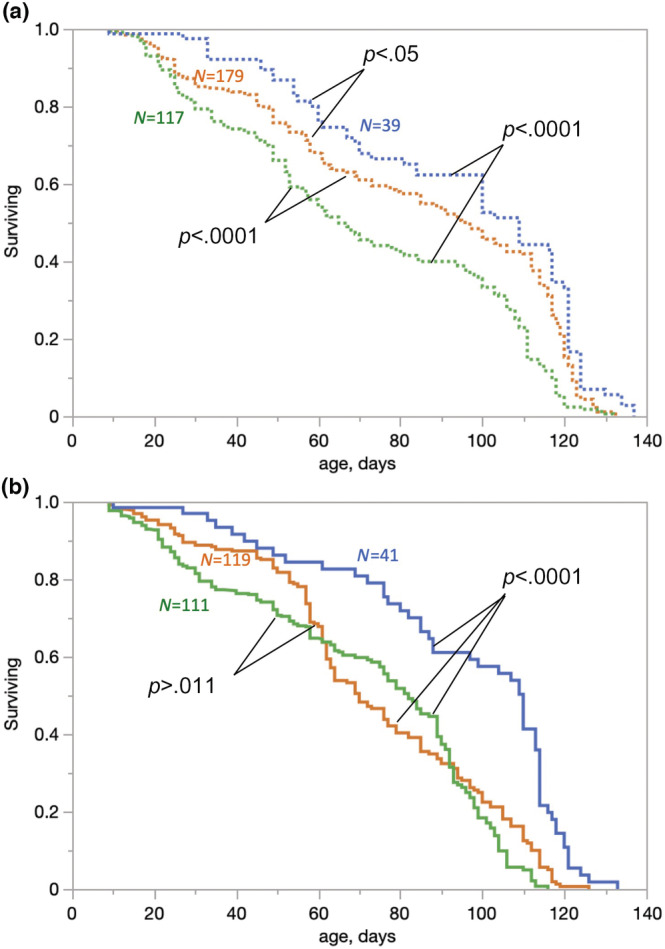
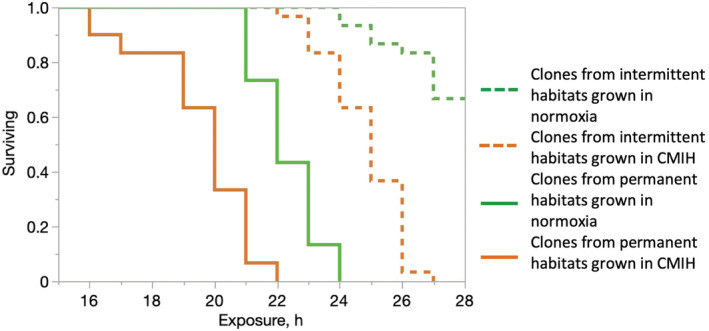
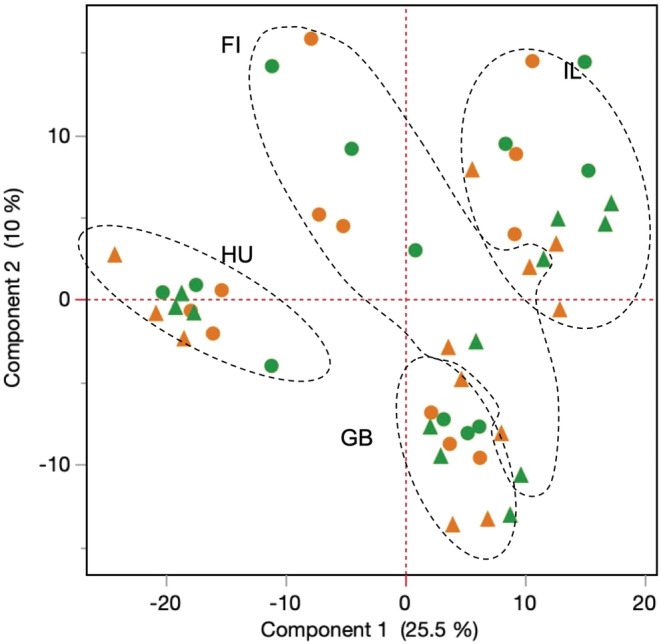
Hypoxia has profound and diverse effects on aerobic organisms, disrupting oxidative phosphorylation and activating several protective pathways. Predictions have been made that exposure to mild intermittent hypoxia may be protective against more severe exposure and may extend lifespan. Here we report the lifespan effects of chronic, mild, intermittent hypoxia, and short-term survival in acute severe hypoxia in four clones of originating from either permanent or intermittent habitats. We test the hypothesis that acclimation to chronic mild intermittent hypoxia can extend lifespan through activation of antioxidant and stress-tolerance pathways and increase survival in acute severe hypoxia through activation of oxygen transport and storage proteins and adjustment to carbohydrate metabolism. Unexpectedly, we show that chronic hypoxia extended the lifespan in the two clones originating from intermittent habitats but had the opposite effect in the two clones from permanent habitats, which also showed lower tolerance to acute hypoxia. Exposure to chronic hypoxia did not protect against acute hypoxia; to the contrary, from the chronic hypoxia treatment had lower acute hypoxia tolerance than normoxic controls. Few transcripts changed their abundance in response to the chronic hypoxia treatment in any of the clones. After 12 h of acute hypoxia treatment, the transcriptional response was more pronounced, with numerous protein-coding genes with functionality in oxygen transport, mitochondrial and respiratory metabolism, and gluconeogenesis, showing upregulation. While clones from intermittent habitats showed somewhat stronger differential expression in response to acute hypoxia than those from permanent habitats, contrary to predictions, there were no significant hypoxia-by-habitat of origin or chronic-by-acute treatment interactions. GO enrichment analysis revealed a possible hypoxia tolerance role by accelerating the molting cycle and regulating neuron survival through upregulation of cuticular proteins and neurotrophins, respectively.
缺氧对需氧生物具有深远而多样的影响,会破坏氧化磷酸化并激活多种保护途径。有人预测,暴露于轻度间歇性缺氧可能对更严重的暴露具有保护作用,并可能延长寿命。在此,我们报告了源自永久或间歇性栖息地的四个克隆体在慢性、轻度、间歇性缺氧条件下的寿命影响以及在急性严重缺氧条件下的短期存活率。我们检验了这样一个假设,即适应慢性轻度间歇性缺氧可通过激活抗氧化和应激耐受途径来延长寿命,并通过激活氧运输和储存蛋白以及调节碳水化合物代谢来提高急性严重缺氧条件下的存活率。出乎意料的是,我们发现慢性缺氧延长了源自间歇性栖息地的两个克隆体的寿命,但对源自永久栖息地的两个克隆体却产生了相反的效果,这两个克隆体对急性缺氧的耐受性也较低。暴露于慢性缺氧并不能预防急性缺氧;相反,经过慢性缺氧处理的克隆体对急性缺氧的耐受性低于常氧对照组。在任何一个克隆体中,很少有转录本因慢性缺氧处理而改变其丰度。经过12小时的急性缺氧处理后,转录反应更为明显,许多在氧运输、线粒体和呼吸代谢以及糖异生方面具有功能的蛋白质编码基因出现上调。虽然源自间歇性栖息地的克隆体对急性缺氧的反应显示出比源自永久栖息地的克隆体更强的差异表达,但与预测相反,不存在显著的缺氧与栖息地起源或慢性与急性处理的相互作用。基因本体富集分析揭示了通过分别上调表皮蛋白和神经营养素来加速蜕皮周期和调节神经元存活可能在缺氧耐受性中发挥的作用。