Faridzadeh Arezoo, Tabashiri Arefeh, Miri Hamid Heidarian, Mahmoudi Mahmoud
Immunology Research Center, Mashhad University of Medical Sciences, Mashhad, Iran.
Department of Immunology and Allergy, School of Medicine, Mashhad University of Medical Sciences, Mashhad, Iran.
Heliyon. 2022 Oct;8(10):e10906. doi: 10.1016/j.heliyon.2022.e10906. Epub 2022 Oct 7.
Since November 2019, the world has been grappling with the rapid spread of the Coronavirus disease 2019 (COVID-19). In response to this major health crisis, the first vaccination rollout was launched in December 2020. However, even fully vaccinated individuals are not completely immune to infection, albeit with less severe symptoms. Melatonin is known as an anti-oxidant, anti-inflammatory, and immunomodulatory agent whose anti-viral properties, cost-effectiveness, and relatively few side effects make it a potential adjuvant in the treatment of COVID-19. This systematic review aims to summarize the clinical studies on the effects of melatonin on COVID-19 patients.
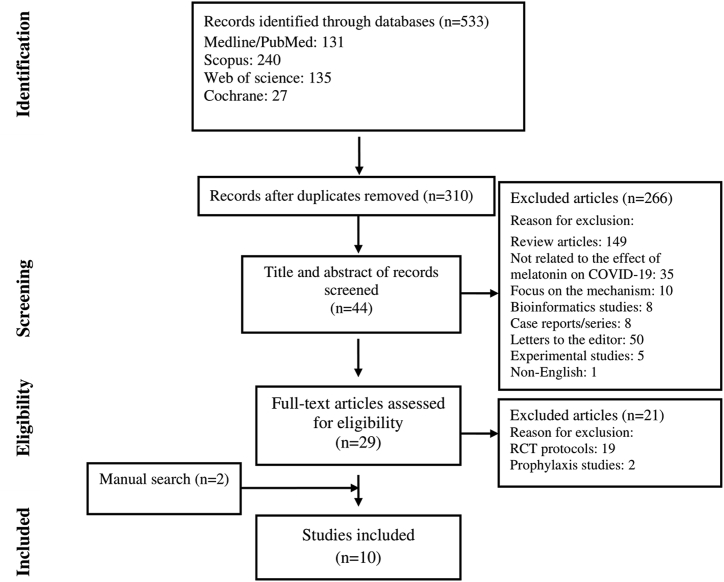
The search of articles was carried out in the Web of Science, PubMed/MEDLINE, Cochrane library, and Scopus databases up to January 2022.
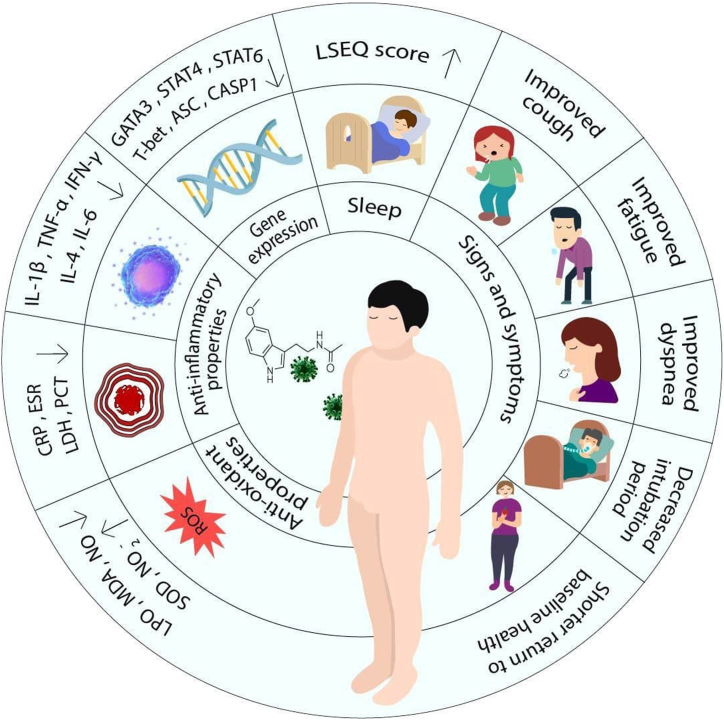
Ten articles were included in our study. It seems melatonin can decrease inflammatory markers, inflammatory cytokines, and the expression of some genes, including the signal transducer and activator of transcription (STAT)4, STAT6, T-box expressed in T cell (T-bet), GATA binding protein 3 (GATA3), apoptosis-associated speck-like protein containing a caspase recruitment domain (ASC), and caspase-1 (CASP1). In addition, melatonin appears to alleviate some clinical signs and symptoms and accelerate recovery. The use of melatonin in severe cases reduces thrombosis, sepsis, and mortality rate.
This systematic review highlights the probable role of melatonin as a potential adjuvant in the treatment of COVID-19 after about two weeks of consumption. However, further high-quality randomized clinical trials are required.
自2019年11月以来,全球一直在应对2019冠状病毒病(COVID-19)的迅速传播。为应对这一重大健康危机,2020年12月启动了首次疫苗接种。然而,即使是完全接种疫苗的个体也并非完全对感染免疫,尽管症状较轻。褪黑素是一种抗氧化、抗炎和免疫调节因子,其抗病毒特性、成本效益和相对较少的副作用使其成为治疗COVID-19的潜在佐剂。本系统综述旨在总结关于褪黑素对COVID-19患者影响的临床研究。
截至2022年1月,在科学网、PubMed/MEDLINE、考克兰图书馆和Scopus数据库中检索文章。
我们的研究纳入了10篇文章。褪黑素似乎可以降低炎症标志物、炎性细胞因子以及一些基因的表达,这些基因包括信号转导和转录激活因子(STAT)4、STAT6、T细胞表达的T盒(T-bet)、GATA结合蛋白3(GATA3)、含半胱天冬酶募集结构域的凋亡相关斑点样蛋白(ASC)和半胱天冬酶-1(CASP1)。此外,褪黑素似乎可以缓解一些临床体征和症状并加速康复。在重症病例中使用褪黑素可降低血栓形成、败血症和死亡率。
本系统综述强调了褪黑素在服用约两周后作为治疗COVID-19潜在佐剂的可能作用。然而,还需要进一步的高质量随机临床试验。