Department of Urology, Mayo Clinic, Rochester, MN, USA.
Department of Surgery, Division of Urology, University of Toronto, Toronto, ON, Canada.
JNCI Cancer Spectr. 2022 Nov 1;6(6). doi: 10.1093/jncics/pkac071.
Financial toxicity is emerging as an important patient-centered outcome and is understudied in prostate cancer patients. We sought to understand the association between financial burden and treatment regret in men with localized prostate cancer to better evaluate the role of financial discussions in patient counseling.
Utilizing the Comparative Effectiveness Analysis of Surgery and Radiation dataset, we identified all men accrued between 2011 and 2012 who underwent surgery, radiation, or active surveillance for localized prostate cancer. Financial burden and treatment regret were assessed at 3- and 5-year follow-up. The association between financial burden and regret was assessed using multivariable longitudinal logistic regression controlling for demographic and disease characteristics, treatment, functional outcomes, and patient expectations.
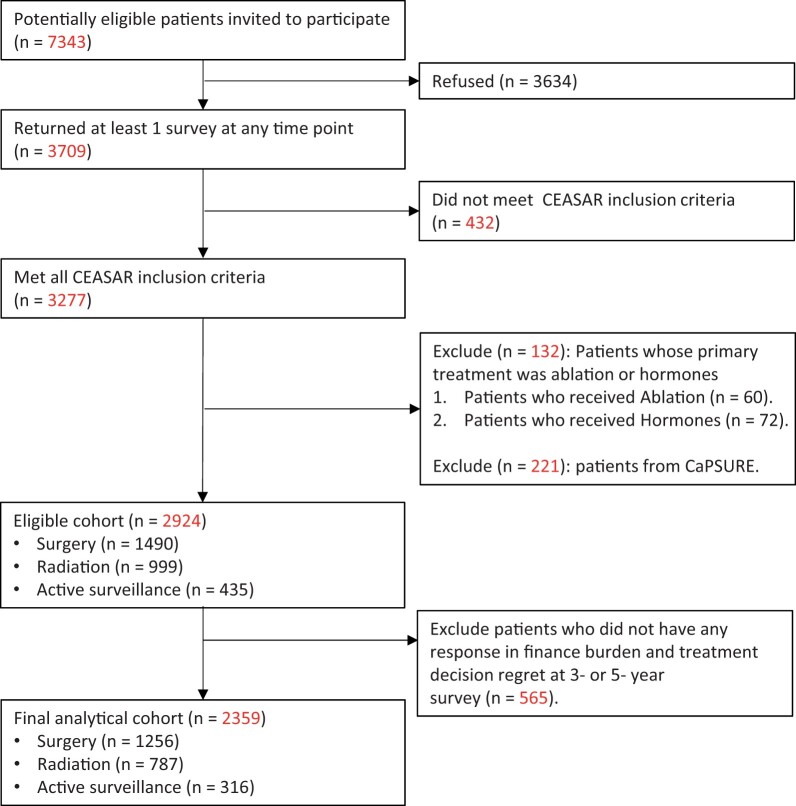
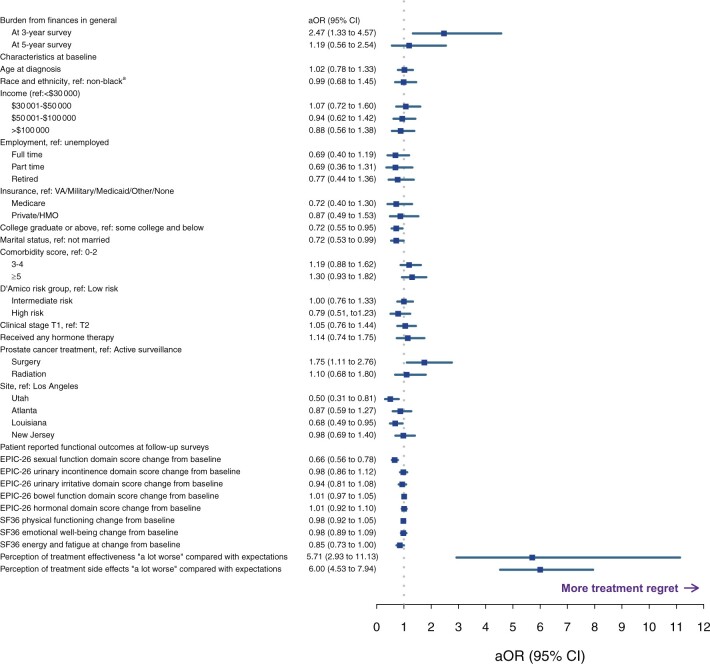
Of the 2924 eligible patients, regret and financial burden assessments for 3- and/or 5-year follow-up were available for 81% (n = 2359). After adjustment for relevant covariates, financial burden from "finances in general" was associated with treatment regret at 3 years (odds ratio [OR] = 2.47, 95% confidence interval [CI] = 1.33 to 4.57; P = .004); however, this association was no longer statistically significant at 5-year follow-up (OR = 1.19, 95% CI = 0.56 to 2.54; P = .7).
In this population-based sample of men with localized prostate cancer, we observed associations between financial burden and treatment regret. Our findings suggest indirect treatment costs, especially during the first 3 years after diagnosis, may impact patients more profoundly than direct costs and are important for inclusion in shared decision making.
经济毒性作为一个重要的以患者为中心的结局正在出现,并在前列腺癌患者中研究不足。我们试图了解经济负担与局限性前列腺癌患者治疗后悔之间的关系,以便更好地评估在患者咨询中进行经济讨论的作用。
利用手术和放疗的比较效果分析数据集,我们确定了在 2011 年至 2012 年期间接受手术、放疗或主动监测的局限性前列腺癌患者。在 3 年和 5 年随访时评估经济负担和治疗后悔。使用多变量纵向逻辑回归控制人口统计学和疾病特征、治疗、功能结果和患者期望,评估经济负担与后悔之间的关系。
在 2924 名符合条件的患者中,81%(n=2359)在 3 年和/或 5 年随访时可进行后悔和经济负担评估。在调整相关协变量后,“一般财务状况”的经济负担与 3 年时的治疗后悔相关(比值比[OR]为 2.47,95%置信区间[CI]为 1.33 至 4.57;P=0.004);然而,这种关联在 5 年随访时不再具有统计学意义(OR=1.19,95%CI=0.56 至 2.54;P=0.7)。
在本研究中,我们观察到局限期前列腺癌患者的经济负担与治疗后悔之间存在关联。我们的研究结果表明,间接治疗成本,尤其是在诊断后的头 3 年,可能比直接成本对患者的影响更大,这在共同决策中很重要。