Okazaki Yosuke, Sasaki Tatsuya, Kawai Kouji, Hosomoto Kakeru, Sasada Susumu, Yasuhara Takao, Akiyama Tomoyuki, Hanaoka Yoshiyuki, Date Isao
Department of Neurological Surgery, Okayama University Graduate School of Medicine, Dentistry and Pharmaceutical Sciences, Okayama, Okayama, Japan.
Department of Child Neurology, Okayama University Graduate School of Medicine, Dentistry and Pharmaceutical Sciences, Okayama, Okayama, Japan.
NMC Case Rep J. 2022 Sep 15;9:307-312. doi: 10.2176/jns-nmc.2022-0084. eCollection 2022.
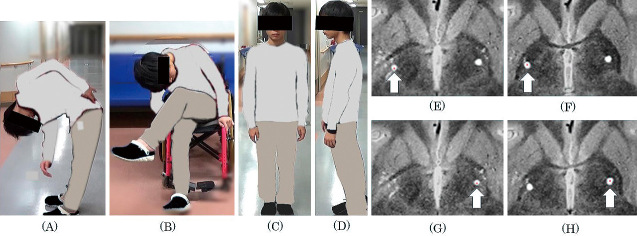
Early-onset isolated (DYT1) dystonia is one of the most common forms of primary dystonia in childhood, and deep brain stimulation of the globus pallidus internus (GPi-DBS) is a highly effective treatment for it. However, the effectiveness of GPi-DBS in monozygotic twins with DYT1 dystonia has never been reported globally. Here, we report the cases of monozygotic twins with DYT1 dystonia who were treated using GPi-DBS, and we include a literature review. The younger brother showed an abnormal gait, with external rotation of the right lower leg at 6 years old. The symptoms gradually became so severe that he had difficulty walking on his own at 9 years of age. Treatment with levodopa-carbidopa partially resolved his symptoms, but most of the symptoms remained. Meanwhile, the older brother developed dystonia in both upper limbs at 8 years of age, with gradual symptom progression. At 13 years of age, they were diagnosed with DYT1 dystonia. Bilateral GPi-DBS was performed in both patients at 16 years of age. Their symptoms remarkably improved after surgery. The Burke-Fahn-Marsden dystonia rating scale (BFMDRS) movement score was reduced from 52 to 2 points for the younger brother and from 35 to 1 point for the older brother. Even if monozygotic twins have the same genes, the onset and severity of symptoms might vary in accordance with differences in epigenomic profiles. However, GPi-DBS treatment was very effective for the two cases; thus, we should consider the surgical interventions for each patient.
早发性孤立性(DYT1)肌张力障碍是儿童期最常见的原发性肌张力障碍形式之一,而内侧苍白球深部脑刺激术(GPi-DBS)是治疗该病的一种高效方法。然而,全球范围内从未报道过GPi-DBS治疗DYT1肌张力障碍单卵双胞胎的有效性。在此,我们报告了采用GPi-DBS治疗的DYT1肌张力障碍单卵双胞胎病例,并进行了文献综述。弟弟6岁时出现异常步态,右小腿向外旋转。症状逐渐加重,9岁时他已难以独立行走。左旋多巴-卡比多巴治疗部分缓解了他的症状,但大部分症状仍存在。与此同时,哥哥8岁时双上肢出现肌张力障碍,症状逐渐进展。13岁时,他们被诊断为DYT1肌张力障碍。两名患者均于16岁时接受了双侧GPi-DBS手术。术后他们的症状显著改善。弟弟的伯克-法恩-马斯登肌张力障碍评定量表(BFMDRS)运动评分从52分降至2分,哥哥的评分从35分降至1分。即使单卵双胞胎拥有相同的基因,症状的发作和严重程度也可能因表观基因组特征的差异而有所不同。然而,GPi-DBS治疗对这两例患者非常有效;因此,我们应考虑对每位患者进行手术干预。