Nanba Yoshifumi, Kawashima Saori
Department of Rehabilitation Science, Kobe University Graduate School of Health Sciences, Kobe, JPN.
Cureus. 2022 Oct 17;14(10):e30384. doi: 10.7759/cureus.30384. eCollection 2022 Oct.
Since the 1950s, researchers have studied temperature changes in deep tissues caused by cooling stimuli. However, these changes have not been investigated non-invasively. Moreover, opinions are divided as to whether the temperature in the joints rises or falls. The present study investigated the effects of cooling on various tissues in the body, including muscles.
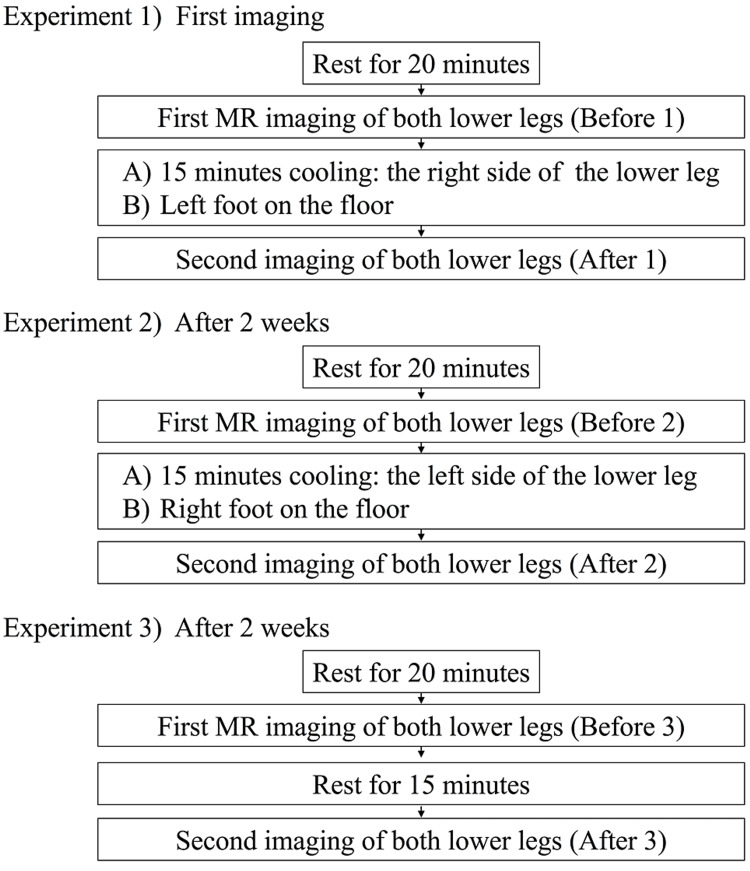
Seven healthy subjects (four males and three females) were enrolled (age, 21.5 ± 0.8 years; height, 165.2 ± 10.7 cm; weight, 63.1 ± 12.17 kg). The research was conducted at the Department of Radiology, Okubo Hospital (Akashi, Hyogo, Japan) between March 2015 and December 2020. Magnetic resonance imaging (MRI) was performed on both lower legs in a noncooled resting state. The right lower leg was cooled for 15 minutes using an ice bath, then both legs were examined by MRI (Experiment 1). After two weeks, the left lower leg was cooled, and MRI was performed on both legs (Experiment 2). After the subsequent two weeks, MRI was performed on both legs without cooling (Experiment 3). The target areas were subcutaneous and adipose tissues, muscle, bone, and cartilage. T signal intensity changes after cooling were examined for each tissue. Normality was confirmed by the Shapiro-Wilk test in advance, and the effect size (Cohen's d) was calculated as a post-test when a significant difference was found.
In Experiments 1 and 2, T signal intensities in subcutaneous tissue, lateral inframalleolar fat pad, the extensor digitorum longus, and abductor hallucis muscles were significantly higher in the cooled than in the noncooled leg (P < 0.05). No significant differences were observed in tissues on the noncooled side.
A 15-minute cold stimulation, such as that used for ankle sprains, reduced temperatures in subcutaneous adipose tissue, muscles, and the lateral inframalleolar fat pad. As the lateral inframalleolar fat pad was effectively cooled, the joint capsule and ligaments immediately below may have also been cooled. It is important to consider the tissue intended for cooling when performing cryotherapy. An ice bath below the lower leg is effective for promoting the recovery of damaged tissue.
自20世纪50年代以来,研究人员一直在研究冷却刺激引起的深部组织温度变化。然而,这些变化尚未进行非侵入性研究。此外,对于关节温度是升高还是降低,意见存在分歧。本研究调查了冷却对身体各种组织(包括肌肉)的影响。
招募了7名健康受试者(4名男性和3名女性)(年龄21.5±0.8岁;身高165.2±10.7厘米;体重63.1±12.17千克)。该研究于2015年3月至2020年12月在大久保医院放射科(日本兵库县明石市)进行。在非冷却的静息状态下对双下肢进行磁共振成像(MRI)检查。右下肢使用冰浴冷却15分钟,然后对双下肢进行MRI检查(实验1)。两周后,左下肢进行冷却,并对双下肢进行MRI检查(实验2)。在随后的两周后,对双下肢在未冷却的情况下进行MRI检查(实验3)。目标区域为皮下组织、脂肪组织、肌肉、骨骼和软骨。检查每个组织冷却后的T信号强度变化。预先通过Shapiro-Wilk检验确认正态性,当发现显著差异时,计算效应量(Cohen's d)作为事后检验。
在实验1和实验2中,冷却侧的皮下组织、外踝下脂肪垫、趾长伸肌和拇展肌的T信号强度显著高于未冷却侧(P<0.05)。未冷却侧的组织未观察到显著差异。
15分钟的冷刺激(如用于脚踝扭伤的刺激)可降低皮下脂肪组织、肌肉和外踝下脂肪垫的温度。由于外踝下脂肪垫得到有效冷却,其下方紧邻的关节囊和韧带可能也被冷却。在进行冷冻疗法时,考虑 intended for cooling的组织非常重要。小腿下方的冰浴对促进受损组织的恢复有效。
原文中“intended for cooling”表述有误,结合语境推测可能是“targeted for cooling”,但按要求未作修改。