
多孔石墨烯和MoS纳米片的海水淡化性能比较。
Comparison of water desalination performance of porous graphene and MoS nanosheets.
作者信息
Song Zailing, Niu Yunlong, Yang Juan, Chen Liang, Chen Junlang
机构信息
Department of Optical Engineering, College of Optical, Mechanical and Electrical Engineering, Zhejiang A&F University Lin'an 311300 China
The State Key Laboratory of Industry Control Technology, College of Control Science and Engineering Hangzhou 310027 China.
出版信息
RSC Adv. 2022 Sep 28;12(42):27641-27647. doi: 10.1039/d2ra04544c. eCollection 2022 Sep 22.
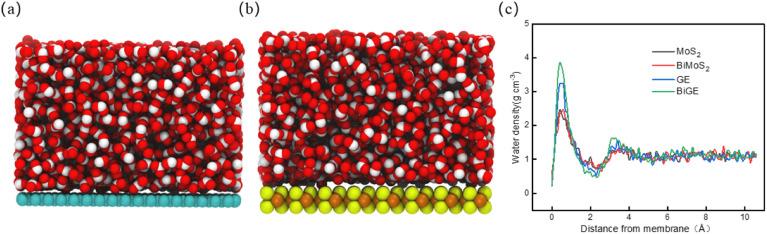
Following graphene and its derivatives, molybdenum disulfide (MoS) has become a research hotspot in two-dimensional materials. Both graphene and MoS exhibit great potential in water treatment. A variety of nanoporous graphene or MoS membranes have been designed for water desalination. In this work, we compared the water flux and ion rejection of MoS and graphene nanopores, using molecular dynamics simulations. The simulation results demonstrate that monolayer nanopores have higher water fluxes than bilayer nanopores with lower ion rejection rates. MoS nanopores perform better than graphene in terms of water permeability. Exploration of the underlying mechanism indicates that the water molecules in the MoS pores have faster velocity and higher mass density than those in the graphene pores, due to the outer hydrophobic and inner hydrophilic edges of MoS pores. In addition, increasing the polarity of the pore edge causes a decrease in water flux while enhancement of ion rejection. Our findings may provide theoretical guidance for the design of MoS membranes in water purification.
继石墨烯及其衍生物之后,二硫化钼(MoS)已成为二维材料中的研究热点。石墨烯和MoS在水处理方面均展现出巨大潜力。人们设计了各种纳米多孔石墨烯或MoS膜用于海水淡化。在这项工作中,我们使用分子动力学模拟比较了MoS和石墨烯纳米孔的水通量和离子截留率。模拟结果表明,单层纳米孔比双层纳米孔具有更高的水通量,但离子截留率较低。MoS纳米孔在水渗透性方面比石墨烯表现更好。对潜在机制的探索表明,由于MoS孔的外部疏水和内部亲水边缘,MoS孔中的水分子比石墨烯孔中的水分子具有更快的速度和更高的质量密度。此外,增加孔边缘的极性会导致水通量降低,同时离子截留率提高。我们的研究结果可能为水净化中MoS膜的设计提供理论指导。




 Zotero 插件