
肝脏组织工程中静电纺丝技术的发展
Evolution of Electrospinning in Liver Tissue Engineering.
作者信息
Vasudevan Ashwini, Tripathi Dinesh M, Sundarrajan Subramanian, Venugopal Jayarama Reddy, Ramakrishna Seeram, Kaur Savneet
机构信息
Department of Molecular and Cellular Medicine, Institute of Liver and Biliary Sciences, New Delhi 110070, India.
Department of Mechanical Engineering, National University of Singapore, Singapore 117581, Singapore.
出版信息
Biomimetics (Basel). 2022 Sep 30;7(4):149. doi: 10.3390/biomimetics7040149.
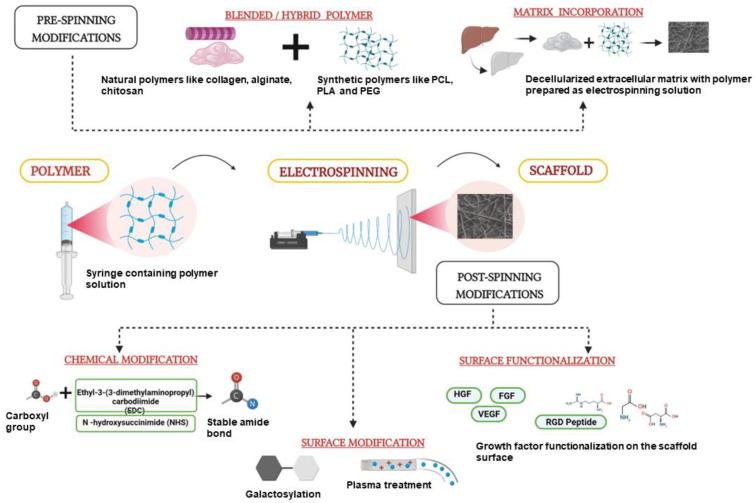
The major goal of liver tissue engineering is to reproduce the phenotype and functions of liver cells, especially primary hepatocytes ex vivo. Several strategies have been explored in the recent past for culturing the liver cells in the most apt environment using biological scaffolds supporting hepatocyte growth and differentiation. Nanofibrous scaffolds have been widely used in the field of tissue engineering for their increased surface-to-volume ratio and increased porosity, and their close resemblance with the native tissue extracellular matrix (ECM) environment. Electrospinning is one of the most preferred techniques to produce nanofiber scaffolds. In the current review, we have discussed the various technical aspects of electrospinning that have been employed for scaffold development for different types of liver cells. We have highlighted the use of synthetic and natural electrospun polymers along with liver ECM in the fabrication of these scaffolds. We have also described novel strategies that include modifications, such as galactosylation, matrix protein incorporation, etc., in the electrospun scaffolds that have evolved to support the long-term growth and viability of the primary hepatocytes.
肝组织工程的主要目标是在体外重现肝细胞,尤其是原代肝细胞的表型和功能。在过去几年中,人们探索了几种策略,利用支持肝细胞生长和分化的生物支架,在最适宜的环境中培养肝细胞。纳米纤维支架因其高比表面积、高孔隙率以及与天然组织细胞外基质(ECM)环境的高度相似性,已在组织工程领域得到广泛应用。静电纺丝是制备纳米纤维支架最常用的技术之一。在本综述中,我们讨论了静电纺丝的各种技术方面,这些技术已被用于不同类型肝细胞的支架开发。我们强调了在这些支架制造中使用合成和天然静电纺聚合物以及肝ECM。我们还描述了一些新策略,包括在静电纺支架中进行修饰,如半乳糖基化、掺入基质蛋白等,这些策略已发展到支持原代肝细胞的长期生长和存活。


 Zotero 插件