Department of Colorectal Surgery, Fudan University Shanghai Cancer Center, 270 Dong'an Road, Xuhui, Shanghai, 200032, China.
Department of Oncology, Shanghai Medical College, Fudan University, Shanghai, 200032, China.
BMC Cancer. 2022 Oct 24;22(1):1088. doi: 10.1186/s12885-022-10212-3.
To study the pattern and treatment outcome of rectal cancer (RC) with concurrent locoregional recurrence (LR) and distant metastasis (DM) after total mesorectal excision (TME) and to identify patient-, disease-, and treatment-related factors associated with differences in prognosis after concurrent LR and DM.
RC patients who were diagnosed with concurrent LR and DM after TME from May 2015 to June 2019 were included in our study. All patients received single or multiple treatment modalities under the guidance of multidisciplinary team (MDT) of colorectal cancer in Fudan University Shanghai Cancer Center. The prognostic value of various clinicopathological factors for survival were calculated by Kaplan-Meier curves and Cox regression analyses.
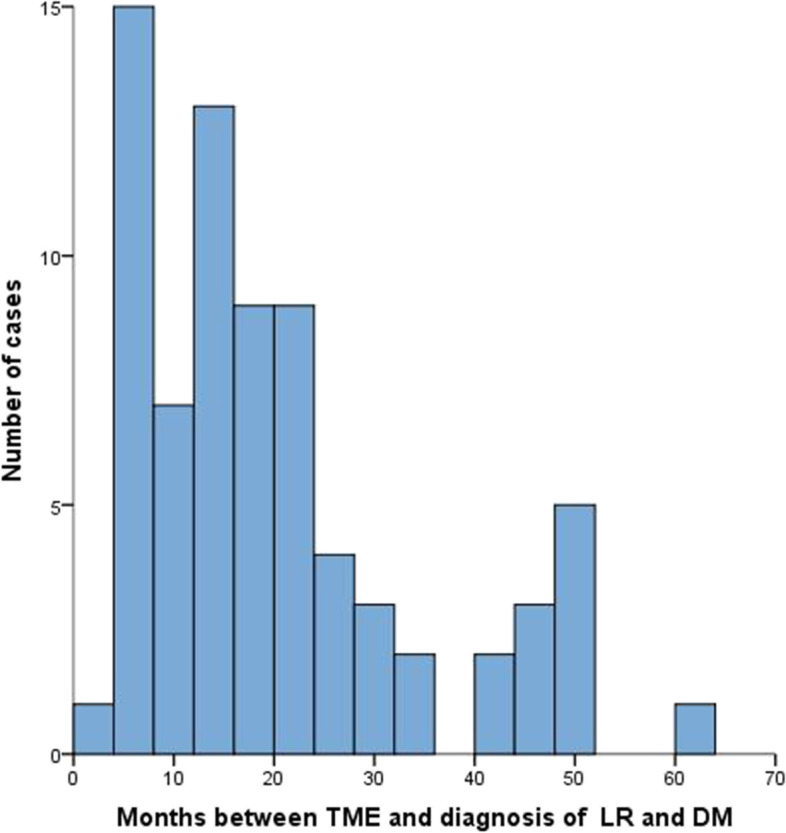
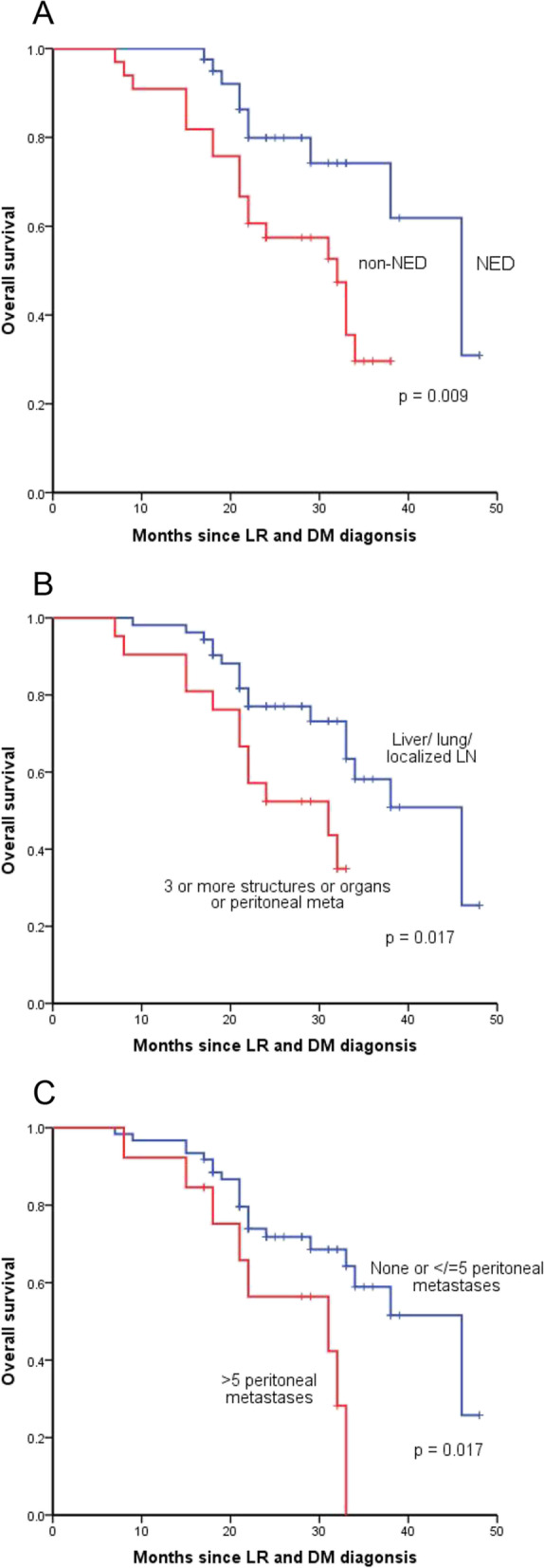
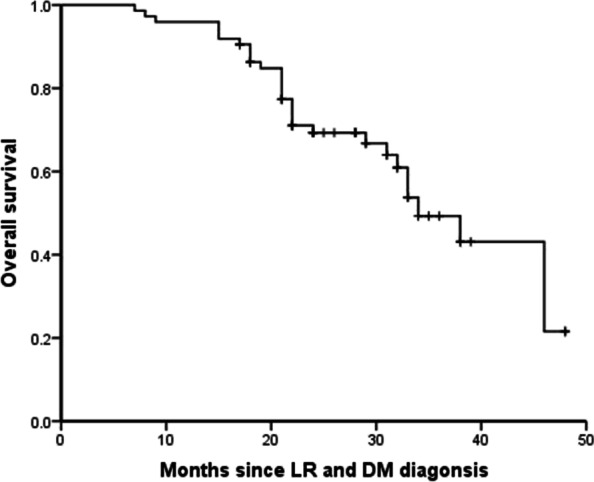
A total of 74 RC patients with concurrent LR and DM who had undergone TME with a median follow-up of 27 months were eligible for analysis. The median survival of the included patients was 34 months, and 30 patients (41%) died. Fifty-nine patients (80%) underwent comprehensive treatments. Patients with oligometastatic disease (OMD) achieved no evidence of disease (NED) status more frequently than those with multiple metastases (P = 0.003). In the univariate analysis, patients achieving NED, diagnosed with OMD and five or less peritoneal metastases tended to have longer survival after LR and DM diagnosis (P < 0.05). In the multivariate analysis, attaining NED status was the only independent factor for survival (hazard ratio (HR), 2.419; P = 0.032). Survival after concurrent LR and DM in the non-NED group was significantly shorter than that in the NED group (median survival, 32 vs. 46 months; HR, 2.7; P = 0.014).
The pattern and treatment outcome of RC with concurrent LR and DM after TME has changed with the development of multiple treatment modalities. Although the prognosis remains poor, pursuing NED status through comprehensive treatments may improve the survival of RC patients with concurrent LR and DM after TME.
研究直肠癌(RC)患者在接受全直肠系膜切除术(TME)后同时发生局部区域复发(LR)和远处转移(DM)的模式和治疗结果,并确定与同时发生 LR 和 DM 后预后差异相关的患者、疾病和治疗相关因素。
本研究纳入了 2015 年 5 月至 2019 年 6 月期间在复旦大学附属肿瘤医院接受 TME 治疗后同时发生 LR 和 DM 的 RC 患者。所有患者均在复旦大学附属肿瘤医院结直肠癌多学科团队(MDT)的指导下接受单一或多种治疗方式。通过 Kaplan-Meier 曲线和 Cox 回归分析计算各种临床病理因素对生存的预后价值。
共纳入 74 例接受 TME 治疗后同时发生 LR 和 DM 的 RC 患者,中位随访时间为 27 个月。纳入患者的中位总生存时间为 34 个月,30 例(41%)患者死亡。59 例(80%)患者接受了综合治疗。寡转移(OMD)患者比多发转移(P=0.003)患者更易达到无疾病证据(NED)状态。单因素分析显示,LR 和 DM 诊断后达到 NED、诊断为 OMD 且腹膜转移≤5 个的患者生存时间较长(P<0.05)。多因素分析显示,达到 NED 状态是生存的唯一独立因素(风险比(HR),2.419;P=0.032)。非 NED 组的 LR 和 DM 同时发生后的生存明显短于 NED 组(中位生存时间,32 与 46 个月;HR,2.7;P=0.014)。
随着多种治疗方式的发展,TME 后同时发生 LR 和 DM 的 RC 的模式和治疗结果已经发生了变化。尽管预后仍然较差,但通过综合治疗追求 NED 状态可能会改善 TME 后同时发生 LR 和 DM 的 RC 患者的生存。