Yale University School of Medicine, New Haven, CT, United States of America.
Yale University School of Public Health, New Haven, CT, United States of America.
PLoS One. 2022 Oct 25;17(10):e0276723. doi: 10.1371/journal.pone.0276723. eCollection 2022.
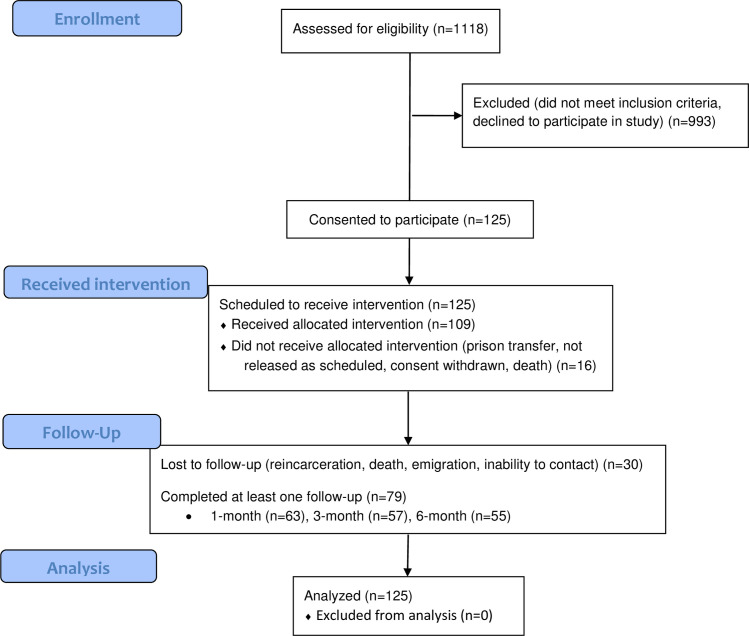
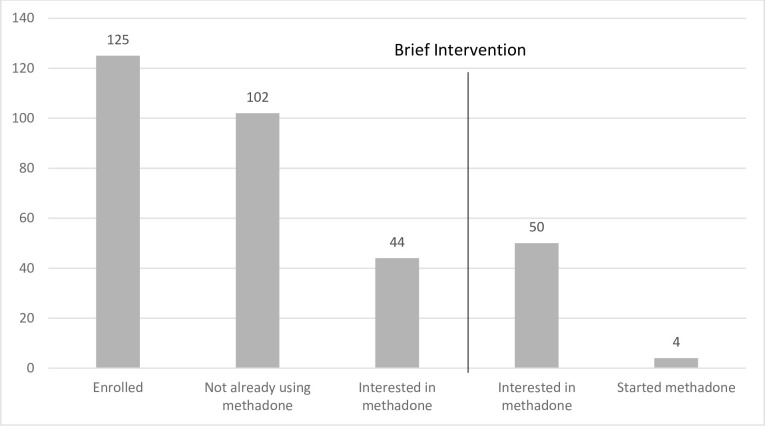
HIV incidence continues to increase in Eastern Europe and Central Asia (EECA), in large part due to non-sterile injection drug use, especially within prisons. Therefore, medication-assisted therapy with opioid agonists is an evidence-based HIV-prevention strategy. The Kyrgyz Republic offers methadone within its prison system, but uptake remains low. Screening, Brief Intervention, and Referral to Treatment (SBIRT) is a framework for identifying people who would potentially benefit from methadone, intervening to identify OUD as a problem and methadone as a potential solution, and providing referral to methadone treatment. Using an SBIRT framework, we screened for OUD in Kyrgyz prisons among people who were within six months of returning to the community (n = 1118). We enrolled 125 people with OUD in this study, 102 of whom were not already engaged in methadone treatment. We conducted a pre-release survey followed by a brief intervention (BI) to address barriers to methadone engagement. Follow-up surveys immediately after the intervention and at 1 month, 3 months, and 6 months after prison release assessed methadone attitudes and uptake. In-depth qualitative interviews with 12 participants explored factors influencing methadone utilization during and after incarceration. Nearly all participants indicated favorable attitudes toward methadone both before and after intervention in surveys; however, interest in initiating methadone treatment remained very low both before and after the BI. Qualitative findings identified five factors that negatively influence methadone uptake, despite expressed positive attitudes toward methadone: (1) interpersonal relationships, (2) interactions with the criminal justice system, (3) logistical concerns, (4) criminal subculture, and (5) health-related concerns.
艾滋病毒在东欧和中亚(EECA)的发病率继续上升,这在很大程度上是由于非无菌注射吸毒,尤其是在监狱内。因此,使用阿片类激动剂的药物辅助治疗是一种基于证据的艾滋病毒预防策略。吉尔吉斯斯坦在其监狱系统中提供美沙酮,但使用率仍然很低。筛查、简短干预和转介治疗(SBIRT)是一种识别可能受益于美沙酮的人的框架,干预以确定阿片类药物使用障碍(OUD)是一个问题,美沙酮是一个潜在的解决方案,并提供美沙酮治疗的转介。我们使用 SBIRT 框架,在吉尔吉斯斯坦监狱中对即将返回社区的六个月内的人进行了 OUD 筛查(n = 1118)。我们在这项研究中招募了 125 名 OUD 患者,其中 102 名患者尚未接受美沙酮治疗。我们进行了一项预释放调查,然后进行了简短干预(BI),以解决接受美沙酮治疗的障碍。干预后立即进行随访调查,并在监狱释放后 1 个月、3 个月和 6 个月时评估美沙酮态度和使用率。对 12 名参与者进行了深入的定性访谈,探讨了监禁期间和监禁后影响美沙酮利用的因素。几乎所有参与者在调查中都表示在干预前后对美沙酮持有利态度;然而,在 BI 前后,对开始美沙酮治疗的兴趣仍然非常低。定性发现有五个因素会对美沙酮的使用率产生负面影响,尽管对美沙酮持积极态度:(1)人际关系,(2)与刑事司法系统的互动,(3)后勤问题,(4)犯罪亚文化,以及(5)健康相关问题。