Empa, Swiss Federal Laboratories for Materials Science and Technology, Laboratory for Mechanics of Materials and Nanostructures, Feuerwerkerstrasse 39, Thun, 3602, Switzerland.
Department of Materials Science, Montanuniversität Leoben, Franz Josef-Strasse 18, Leoben, 8700, Austria.
Adv Sci (Weinh). 2022 Dec;9(34):e2203544. doi: 10.1002/advs.202203544. Epub 2022 Oct 26.
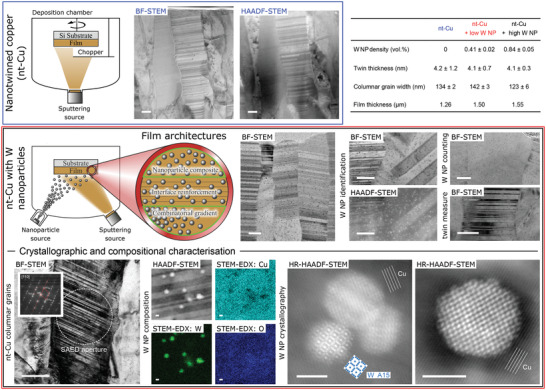
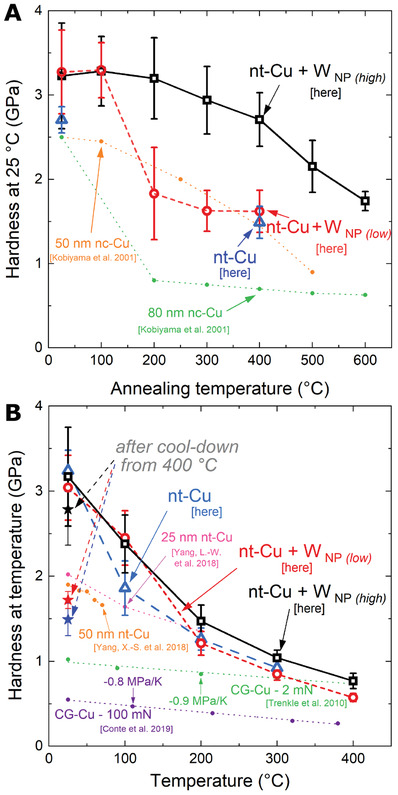
Nanocrystalline and nanotwinned materials achieve exceptional strengths through small grain sizes. Due to large areas of crystal interfaces, they are highly susceptible to grain growth and creep deformation, even at ambient temperatures. Here, ultrahigh strength nanotwinned copper microstructures have been stabilized against high temperature exposure while largely retaining electrical conductivity. By incorporating less than 1 vol% insoluble tungsten nanoparticles by a novel hybrid deposition method, both the ease of formation and the high temperature stability of nanotwins are dramatically enhanced up to at least 400 °C. By avoiding grain coarsening, improved high temperature creep properties arise as the coherent twin boundaries are poor diffusion paths, while some size-based nanotwin strengthening is retained. Such microstructures hold promise for more robust microchip interconnects and stronger electric motor components.
纳米晶和孪晶材料通过小晶粒尺寸实现了非凡的强度。由于晶体界面的面积较大,它们极易发生晶粒长大和蠕变变形,即使在环境温度下也是如此。在这里,通过一种新颖的混合沉积方法,将不到 1%体积的不溶性钨纳米颗粒掺入铜中,在很大程度上保留了导电性的同时,稳定了高温下的超强度纳米孪晶铜微观结构。通过避免晶粒粗化,改善了高温蠕变性能,因为共格孪晶界是较差的扩散路径,而保留了一些基于尺寸的纳米孪晶强化。这种微观结构有望用于更坚固的微芯片互连和更强的电机组件。