Goodrich Erin L, Behling-Kelly Erica
Department of Population Medicine and Diagnostic Sciences, Cornell University College of Veterinary Medicine, Ithaca, NY 14850, USA.
Animals (Basel). 2022 Oct 13;12(20):2746. doi: 10.3390/ani12202746.
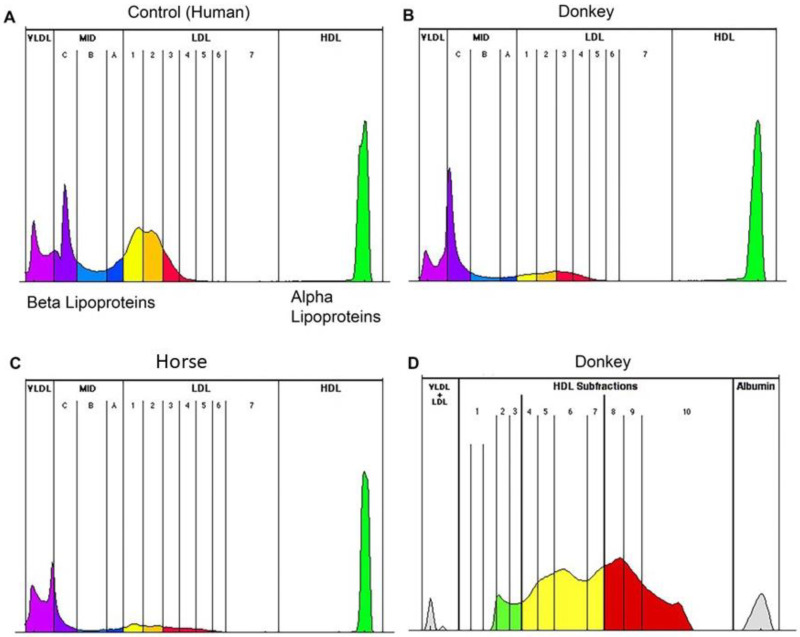
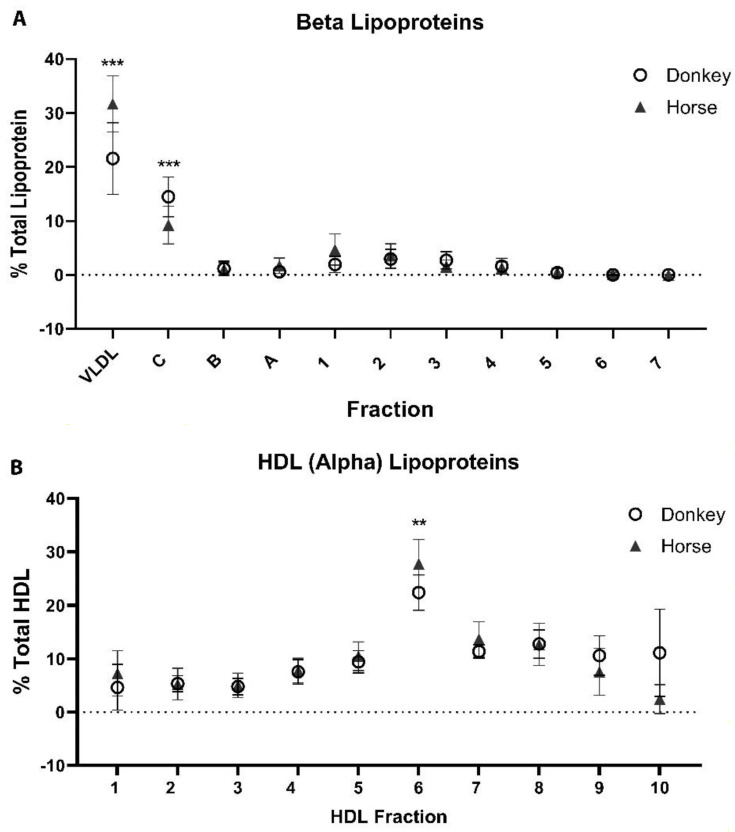
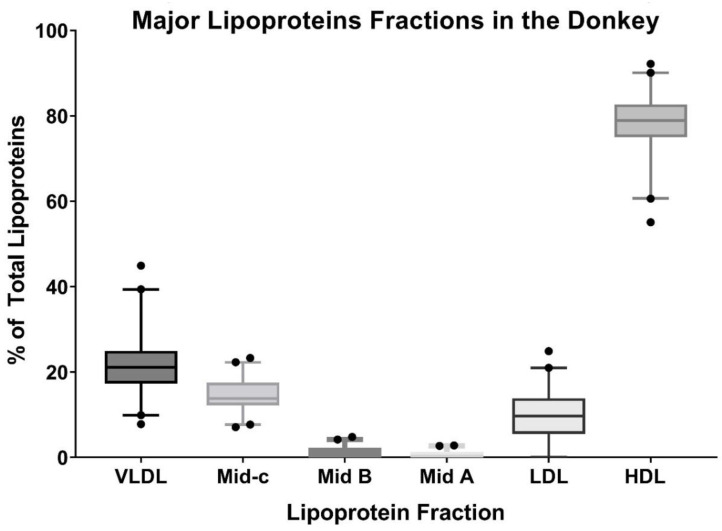
The clinical evaluation of lipid metabolism in equids is often limited to the measurement of total cholesterol and triglyceride concentrations. This provides a limited picture of metabolic state and general health, given the continuous exchange of lipid species between various lipoproteins. Major lipoprotein classes in equids include high-density lipoprotein (HDL), intermediate-density lipoprotein (IDL), low-density lipoprotein (LDL), very low-density lipoprotein (VLDL), and chylomicrons (CM). Unlike large breed horses, donkeys are highly susceptible to hepatic lipidosis. Currently, serum triglyceride concentrations serve as a surrogate marker of hepatic lipid exportation. Both VLDL, indicative of hepatic exportation, and its metabolic end-product, LDL, are rich in triglycerides, and contribute to this value. Diagnostic assays that distinguish VLDL from LDL could be useful in better recognizing the hepatic pathology in donkeys. The compositional differences of lipoproteins across species limit the use of commercially available assays developed for the measurement of human lipoproteins in domestic animals. In this study, we evaluated a high-resolution polyacrylamide gel electrophoresis method () for separating major lipoprotein classes and sub-fractionating LDL and HDL based on particle size in a large group of donkeys, and compared the pattern to a representative set of horses. Donkeys proved an HDL-rich species, with HDL accounting for the bulk of all lipoproteins (average 78.45%, SD 6.6%, range 92.2-55%). VLDL accounted for a large portion of the total (average 21.6%, SD 6.6%, range 37.1-7.8%), with minimal amounts of LDL detected. The horses tested had higher proportions of VLDL as compared to donkeys (31.7% and 21.6%, respectively = 0.00008). The later finding draws into question the purported relationship between VLDL, high triglycerides, and hepatic lipidosis, given the incidence of the disease in donkeys is far higher than in horses.
马科动物脂质代谢的临床评估通常局限于总胆固醇和甘油三酯浓度的测定。鉴于各种脂蛋白之间脂质种类的持续交换,这只能提供有限的代谢状态和总体健康状况信息。马科动物的主要脂蛋白类别包括高密度脂蛋白(HDL)、中间密度脂蛋白(IDL)、低密度脂蛋白(LDL)、极低密度脂蛋白(VLDL)和乳糜微粒(CM)。与大型马匹不同,驴极易患肝脂肪变性。目前,血清甘油三酯浓度作为肝脏脂质输出的替代标志物。指示肝脏输出的VLDL及其代谢终产物LDL都富含甘油三酯,并对该值有贡献。区分VLDL和LDL的诊断检测方法可能有助于更好地识别驴的肝脏病变。不同物种脂蛋白的组成差异限制了用于测量家畜人类脂蛋白的商业可用检测方法的应用。在本研究中,我们评估了一种高分辨率聚丙烯酰胺凝胶电泳方法,用于在一大群驴中分离主要脂蛋白类别,并根据颗粒大小对LDL和HDL进行亚分级,并将该模式与一组代表性马匹进行比较。结果表明,驴是富含HDL的物种,HDL占所有脂蛋白的大部分(平均78.45%,标准差6.6%,范围92.2 - 55%)。VLDL占总量的很大一部分(平均21.6%,标准差6.6%,范围37.1 - 7.8%),检测到的LDL量极少。与驴相比,测试的马匹VLDL比例更高(分别为31.7%和21.6%,P = 0.00008)。鉴于驴的这种疾病发病率远高于马,后一发现对VLDL、高甘油三酯和肝脂肪变性之间所谓的关系提出了质疑。