Marinelli Franco, Lezcano Maria Florencia, Alarcón Josefa, Navarro Pablo, Fuentes Ramón
Research Centre in Dental Sciences (CICO-UFRO), Dental School-Facultad de Odontología, Universidad de La Frontera, Temuco 4780000, Chile.
Laboratorio de Cibernética, Departamento de Bioingeniería, Facultad de Ingeniería, Universidad Nacional de Entre Ríos, Oro Verde 3100, Argentina.
Bioengineering (Basel). 2022 Oct 19;9(10):577. doi: 10.3390/bioengineering9100577.
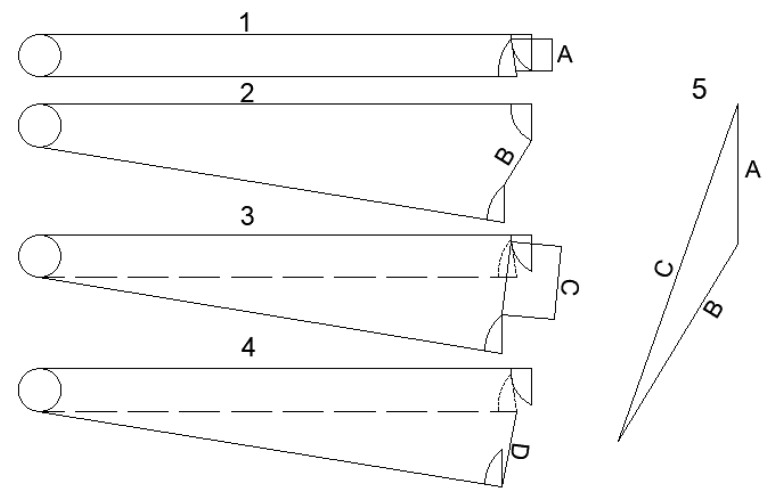
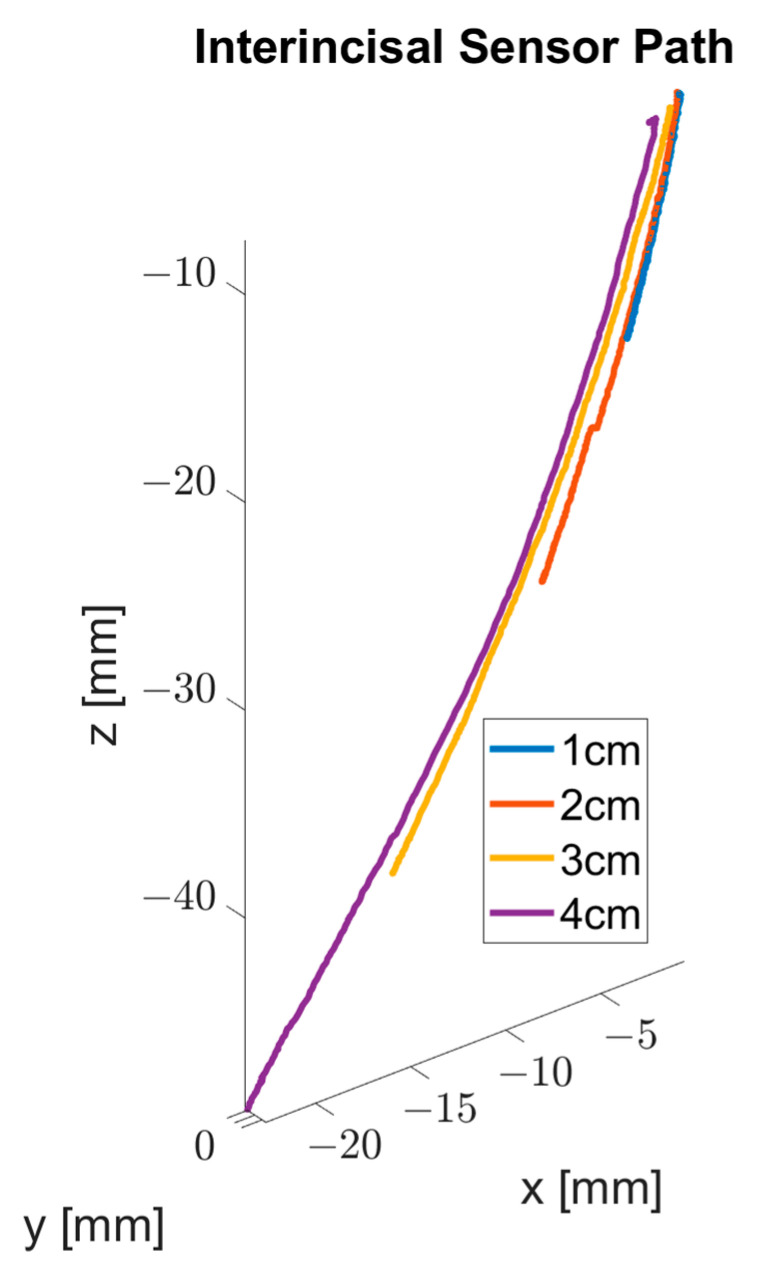
The mouth opening is an important indication of the functionality of the temporomandibular joint (TMJ). Mouth opening is usually evaluated by asking the patient to open their mouth as wide as possible and measuring the distance between the edges of the frontal incisors with a ruler or caliper. With the advancement of technology, new techniques have been proposed to record mandibular movement. The aim of this work is to present a novel technique based on 3D electromagnetic articulography and data postprocessing to analyze the mouth opening considering distances, trajectories, and angles. A maxilla-mandible phantom was used to simulate the mouth opening movement and fixed position mouth opening. This was recorded using the AG501 3D EMA (Carstens Medizinelektronik GmbH, Bovenden, Germany). The collected data was processed using Matlab (Mathworks, Natick, MA, USA). Fix and mobile mouth opening of 1, 2, 3 and 4 cm were simulated. It was possible to evaluate the mandibular opening through the vertical distance, the Euclidean distance, the trajectory, and the opening angle. All these values were calculated and the results were consistent with expectations. The trajectory was the highest value obtained while the vertical distance was the lowest. The angle increased as the mouth opening increased. This new technique opens up new possibilities in future research since oral opening can be analyzed using multiple variables without the need to use different devices or depending on the researcher's experience. This will make it possible to establish which parameter presents significant differences between groups of patients or between patients who have undergone some treatment.
张口度是颞下颌关节(TMJ)功能的一项重要指标。通常通过要求患者尽可能张大嘴巴,并用直尺或卡尺测量上前牙边缘之间的距离来评估张口度。随着技术的进步,已提出了记录下颌运动的新技术。这项工作的目的是提出一种基于三维电磁关节造影和数据后处理的新技术,以从距离、轨迹和角度方面分析张口度。使用上颌-下颌模型来模拟张口运动和固定位置的张口。使用AG501三维电磁分析系统(德国博文登的卡斯滕斯医学电子有限公司)进行记录。使用Matlab(美国马萨诸塞州纳蒂克的Mathworks公司)对收集的数据进行处理。模拟了1厘米、2厘米、3厘米和4厘米的固定和动态张口情况。通过垂直距离、欧几里得距离、轨迹和张口角度来评估下颌开口是可行的。所有这些值均已计算得出,结果与预期一致。轨迹的值最高,而垂直距离的值最低。角度随着张口度的增加而增大。这项新技术为未来的研究开辟了新的可能性,因为可以使用多个变量来分析张口情况,而无需使用不同的设备或依赖研究人员的经验。这将使得确定哪些参数在患者组之间或接受某种治疗的患者之间存在显著差异成为可能。