Brzost Jacek, Czerwaty Katarzyna, Dżaman Karolina, Ludwig Nils, Piszczatowska Katarzyna, Szczepański Mirosław J
The Children's Memorial Health Institute, 04-730 Warsaw, Poland.
Department of Otolaryngology, The Medical Centre of Postgraduate Education, 01-813 Warsaw, Poland.
Diagnostics (Basel). 2022 Sep 23;12(10):2301. doi: 10.3390/diagnostics12102301.
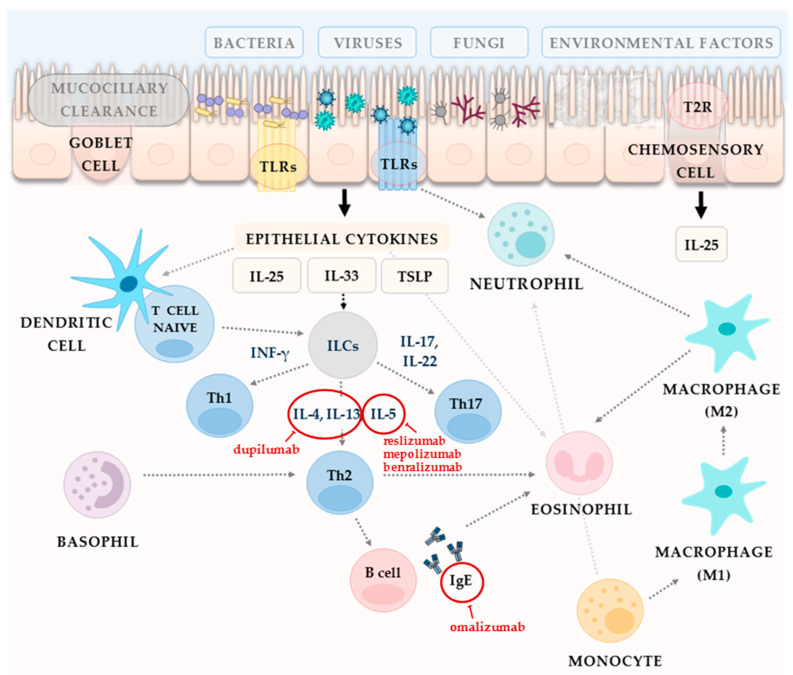
The recent classification of chronic rhinosinusitis (CRS) focusses on investigating underlying immunopathophysiological mechanisms. Primary CRS is subdivided based on endotype dominance into type 2 (that relates mostly to the Th2 immune response with high levels of IL-5, IL-13, and IgE), or non-type 2 (that corresponds to the mix of type 1 and type 3). The treatment selection of CRS is dependent on endotype dominance. Currently, the majority of patients receive standardized care-traditional pharmacological methods including local or systemic corticosteroids, nasal irrigations or antibiotics (for a selected group of patients). If well-conducted drug therapy fails, endoscopic sinus surgery is conducted. Aspirin treatment after aspirin desensitization (ATAD) with oral aspirin is an option for the treatment in nonsteroidal anti-inflammatory drug (NSAID)-exacerbated respiratory disease (N-ERD) patients. However, in this review the focus is on the role of biological treatment-monoclonal antibodies directed through the specific type 2 immune response targets. In addition, potential targets to immunotherapy in CRS are presented. Hopefully, effective diagnostic and therapeutic solutions, tailored to the individual patient, will be widely available very soon.
慢性鼻-鼻窦炎(CRS)的最新分类侧重于研究潜在的免疫病理生理机制。原发性CRS根据内型优势分为2型(主要与Th2免疫反应相关,IL-5、IL-13和IgE水平较高)或非2型(对应于1型和3型的混合)。CRS的治疗选择取决于内型优势。目前,大多数患者接受标准化治疗——传统药理学方法,包括局部或全身使用皮质类固醇、鼻腔冲洗或抗生素(针对特定患者群体)。如果规范的药物治疗失败,则进行鼻内镜鼻窦手术。对于非甾体抗炎药(NSAID)加重的呼吸道疾病(N-ERD)患者,口服阿司匹林进行阿司匹林脱敏治疗(ATAD)后使用阿司匹林是一种治疗选择。然而,本综述的重点是生物治疗的作用——针对特定2型免疫反应靶点的单克隆抗体。此外,还介绍了CRS免疫治疗的潜在靶点。希望能很快广泛提供针对个体患者的有效诊断和治疗方案。